
The question of how to watermark AI-generated text has taken an unexpected turn, with SpaceXSI backing away from its initial plan to enable the feature automatically across Grok. According to the company's revised API documentation, watermarking is now disabled by default, allowing developers to activate it manually through their team administration settings.
The watermarking capability first surfaced in late October without formal announcement. Internet Archive records show that earlier documentation versions, preserved on November 1 and November 6, stated the feature would activate by default beginning November 7. Several prominent X users flagged the pending change on October 31.
SpaceXSI is introducing text watermarking across its Grok API models, starting November 7, 2026. All text outputs from supported Grok models will include a watermark by default. Models included: Grok 4.7, Grok 4.6, Grok 4.5, Grok 4.3, Grok 4.20 Reasoning, Grok 4.20
X Freeze, October 31, 2026
SpaceXSI has since reversed that position, converting watermarking into an opt-in capability for API users. Documentation archiving service Spybara indicates the shift occurred between Monday evening November 9 and Tuesday morning November 10—nearly three days after the scheduled November 7 rollout date. The company has offered no public rationale for the reversal, and it remains unclear whether the original default-enabled policy ever took effect.
Watermarking and regulatory compliance
Text watermarking embeds an imperceptible, machine-readable marker into AI-generated content. The technique subtly shapes which words or tokens a model selects during generation, and across sufficient text length, these selections form a detectable statistical signature that indicates AI origin. Specialized detection tools are typically required, with major labs restricting access to their watermark detectors to authorized parties.
The technology has gained prominence in Europe following the EU AI Act, which mandates transparency requirements for providers of systems generating synthetic material. Article 50(2) requires that AI-generated text, images, audio and video carry machine-readable markings, with enforcement beginning August 2, 2026. A subsequent amendment granted a limited grace period until December 2 for systems already deployed before August 2, putting pressure on AI firms to implement compliance measures.
Different AI companies have adopted varying strategies. Anthropic announced text watermarking in August, applying it globally across supported Claude models and its API without providing an opt-out mechanism—a decision that drew criticism from developers concerned about code generation impacts. OpenAI introduced its textGrain watermarking system in October, offering it as optional for API developers while mandating it for ChatGPT and Codex output in the EU. Google has deployed SynthID watermarking across multiple products including Gemini API, supporting text alongside images, audio and video, and confirmed in July its participation in the EU's Code of Practice on Transparency of AI-Generated Content.
SpaceXSI's updated documentation confirms the company uses SynthID Text for its watermarking implementation.
The policy reversal
SpaceXSI stood apart as the sole major AI lab that had not signed the EU's Code of Practice on Transparency of AI-Generated Content, with some reporting suggesting it would avoid watermarking Grok output entirely. The late October documentation emergence marked the first concrete signal that the company intended to participate. The original text explicitly stated the reasoning: "SpaceXSI watermarks text model output to comply with the EU AI Act."
Watermarking can help enable compliance with the EU AI Act.
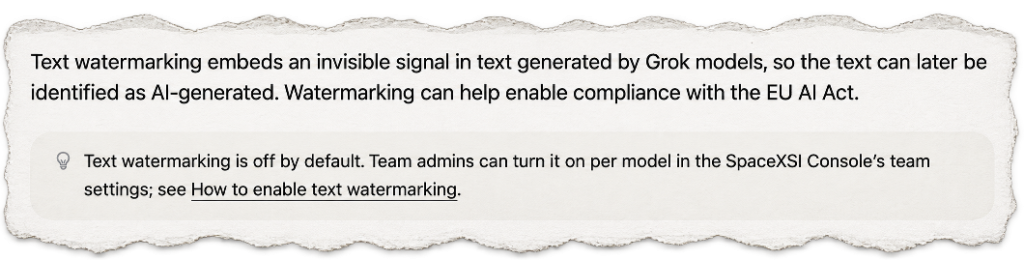
The updated documentation replaces that definitive language with more cautious phrasing. This shift carries significance: the original wording reflected a policy where SpaceXSI unilaterally watermarked Grok output to satisfy EU requirements. Now the company appears to delegate watermarking decisions to developers while expressing less certainty about whether the technology alone fulfills regulatory obligations.
The implementation carries practical constraints. Watermarking operates at the team level, allowing administrators to enable or disable it per Grok model, with the setting applying to all API keys under that team. No per-request toggle exists, preventing developers serving multiple regions from applying different watermarking policies to the same model within a single team—they would need separate team configurations to achieve this.
The revised documentation indicates watermarking is available across seven Grok models including versions 4.7 and 4.6, but remains disabled by default. The company has not explained why it abandoned its earlier automatic watermarking plan. SpaceXSI did not respond to requests for comment.