
Researchers at threat intelligence firm GreyNoise have documented an active campaign in which attackers have successfully compromised Check Point Security management servers across 22 organizations. The operation, tracked as GT13, exploited multiple vulnerabilities to gain access to the systems. While the precise motivations remain unclear, the activity bears hallmarks consistent with cyberespionage efforts.
GreyNoise observed the campaign between October 17 and November 2, though the researchers assess that activity likely continues beyond their visibility window. The 22 victim organizations operate across 17 countries and span diverse sectors including government, financial services, energy, transportation, mining, and manufacturing, with no apparent pattern of selective targeting.

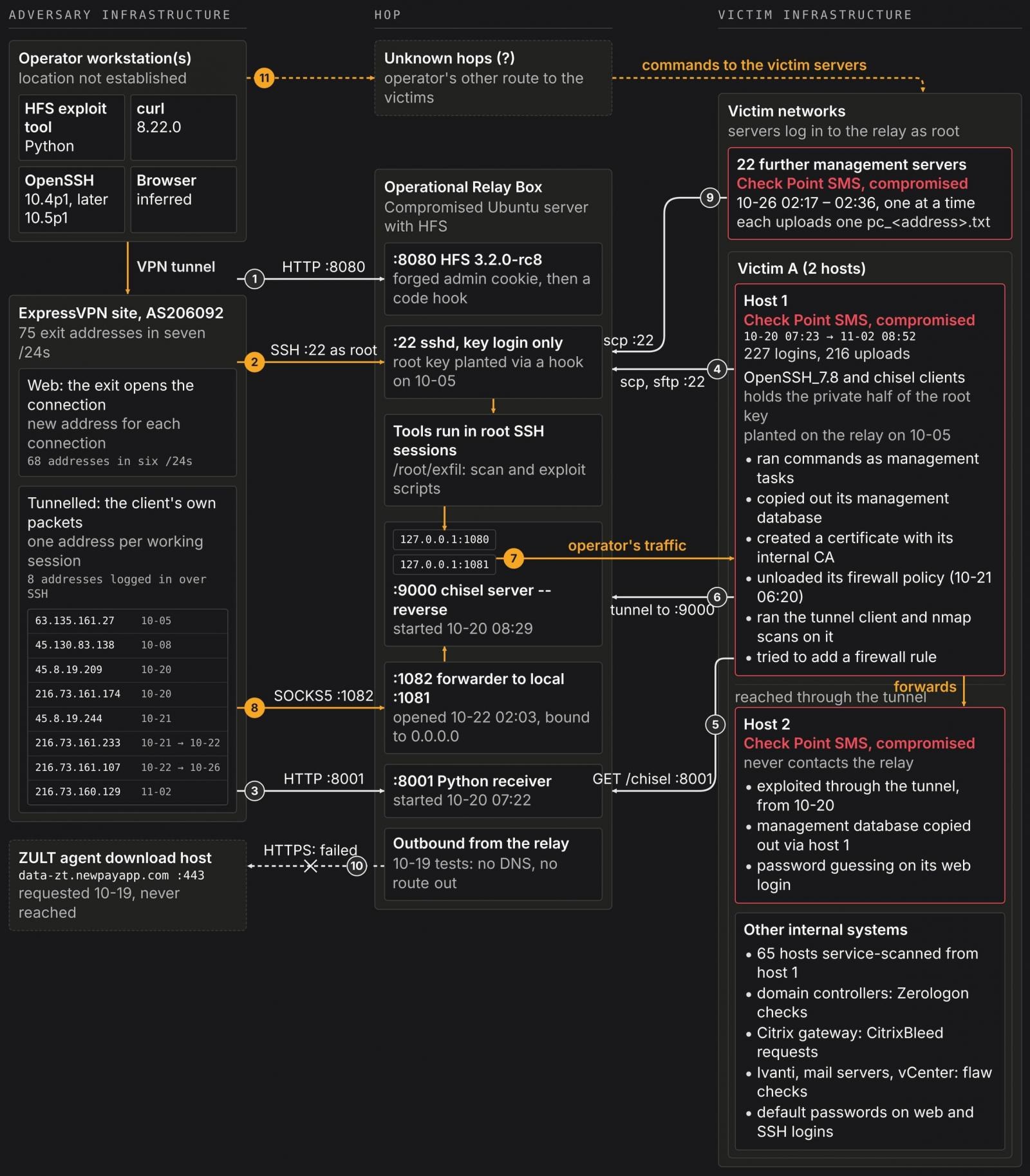
The attacks originated from 99 IP addresses, many of which appeared to be compromised Check Point devices themselves or exit nodes from ExpressVPN. A Rejetto HTTP File Server, compromised through exploitation of CVE-2026-61500, served as an operational relay for managing the intrusions and exfiltrating data from victim environments.
Vulnerabilities exploited
While the initial breach vector remains unknown, GreyNoise documented the exploitation of CVE-2026-16232 during post-compromise activities. This flaw represents an authentication bypass in Check Point SmartConsole that permits attackers to obtain application login tokens and gain administrator-level access. Check Point disclosed the vulnerability in July and classified it as an actively exploited zero-day at that time.
Beyond the Check Point flaw, the campaign also targeted other enterprise infrastructure. Researchers observed exploitation attempts against CVE-2025-5777 in Citrix NetScaler, CVE-2024-21893 in Ivanti systems, CVE-2026-41089 in Windows NetLogon, and CVE-2026-98432 affecting Linux IPv4. Additional targets included Citrix NetScaler (CVE-2023-4966), Ivanti Connect Secure (CVE-2024-21893), VMware vCenter (CVE-2021-21972 and CVE-2023-34048), Microsoft Exchange (CVE-2021-26855 and CVE-2021-34473), and Microsoft Netlogon (CVE-2020-1472).
Observed attacker activities
GreyNoise recorded more than 1,400 network sessions, 800 command-line artifacts, and 1,200 file-related activities across the compromised environments. The attacker's operational pattern included several distinct phases of activity.
- Exfiltration of firewall databases, stored credentials, configuration files, and internal certificate authority certificates
- Creation of new certificates within victim environments
- Removal of security policies to effectively disable firewall protections
- Reconnaissance of internal networks and attempts to move laterally across systems
- Targeting of additional enterprise platforms beyond the initial compromise points
On October 26, the attacker executed a bulk certificate management operation across all 24 compromised Check Point servers. Although the operation ultimately failed, it provided GreyNoise with a mechanism to identify victim organizations.
Assessment and next steps
GreyNoise analysts assess that GT13 may have deployed an AI-powered offensive tool based on observed behavioral patterns, automation capabilities, and custom tooling characteristics, though the actual use of artificial intelligence in the campaign remains unconfirmed.
Although GreyNoise's visibility into the campaign ended on November 2, the researchers believe the operation continues. The firm has notified international government partners and national computer emergency response teams to alert affected organizations. GreyNoise has also released indicators of compromise to help identify additional breaches or prevent future intrusion attempts.
BleepingComputer reached out to Check Point for additional details about the attacks and which vulnerability enabled initial access, but the company has not yet responded.