GL.iNet confirmed on November 20 that attackers leveraged a flaw in its cloud remote management services to deploy malicious software targeting customers' routers and KVM devices. Compromised systems exhibited backdoors and reverse shells, enabling remote adversaries to gain access to infected equipment.

The company manufactures networking hardware spanning home and travel routers alongside KVM devices designed for remote computer access and control. Its GoodCloud platform enables customers to manage supported devices and control systems connected through KVM products.
GL.iNet stated: "The attack path has been blocked. We fixed the cloud vulnerability and blocked the access used in this incident." The company added: "Devices can no longer be newly infected through this attack path. These measures do not remove malware from devices that were already infected."
The vendor has not revealed the exploitation technique, the scope of affected customers, or whether data was exfiltrated from compromised systems. The company is also examining whether computers attached to infected KVM devices suffered compromise.
GL.iNet advised customers to inspect devices for infection indicators and apply the latest security firmware regardless of detection results. Initial detection guidance directed users to identify processes running as crond -i /tmp/.log, which the company designated as a compromise indicator.
Stable firmware updates with additional security improvements for routers and KVM devices are scheduled for November 22, 2026. For KVM equipment, GL.iNet recommends version 1.10.3 or later for the RM10, RM1, RM1V2, RM1PE, and RM4PE models; version 1.10.3 beta or later for the RM10RC; and version 1.8.7 or later for the RMQ1. Router users should deploy the latest security firmware for their specific model upon availability.
Community members flagged that GL.iNet's detection instructions may miss compromised devices, particularly those running alternative backdoors or reverse shells. The company directed users to a community-developed detection and cleanup utility integrated into official support documentation.
The scanner performs checks for known malware artifacts, anomalous processes, altered system binaries, and persistence-enabling configuration modifications. It collects forensic data and can optionally purge identified malware components. Tool developers caution that the scanner cannot identify every infection and that severely compromised devices may require firmware reinstallation without configuration retention, since malicious code in configuration directories could persist through standard upgrades.
GL.iNet instructed potentially affected customers to preserve forensic evidence before device resets, refrain from restoring possibly infected settings, and refresh credentials and access tokens that may have been exposed. The company requested scanner users submit anonymous reports to help quantify and categorize affected devices. KVM users should also examine computers controlled by their devices for potential compromise.
Malware and reverse shells discovered
Following the announcement, GL.iNet customers and researchers disclosed evidence of purpose-built malware targeting GL.iNet devices and root-level reverse shells linking compromised routers to IP address 170.39.226[.]219. The reverse shells leveraged the Linux nc utility to establish outbound connections, permitting attackers to run arbitrary commands on infected systems.
RemoteToHome Consulting researchers identified a potential command injection flaw in GL.iNet's GoodCloud client affecting a handler for AstroWarp/SD-WAN operations. The researchers determined that the handler forwards cloud-supplied parameters into shell commands executed at root level without adequate validation. GL.iNet has not confirmed this vulnerability was exploited in the attacks.
RemoteToHome examined 183 routers under its ownership or management and detected suspicious behavior on 152 systems. The findings included 24 devices with root-level reverse shells, 47 with an older persistent backdoor, and 81 exhibiting traces of attacker-issued command execution. The researchers noted their results may differ from other GL.iNet customers and that older backdoor infections might be unrelated to the November incidents.
A GL-RM1 KVM owner published network logs documenting the device retrieving a malicious ni.sh script and additional executable payloads from 66.245.219[.]252 on November 19. The owner observed the device communicating with roughly 1,800 residential IP addresses daily and repeatedly querying the TRON blockchain API, suggesting peer-to-peer network participation. The intent of these connections remains undetermined, and no evidence confirms the devices served as residential proxies or participated in a botnet.
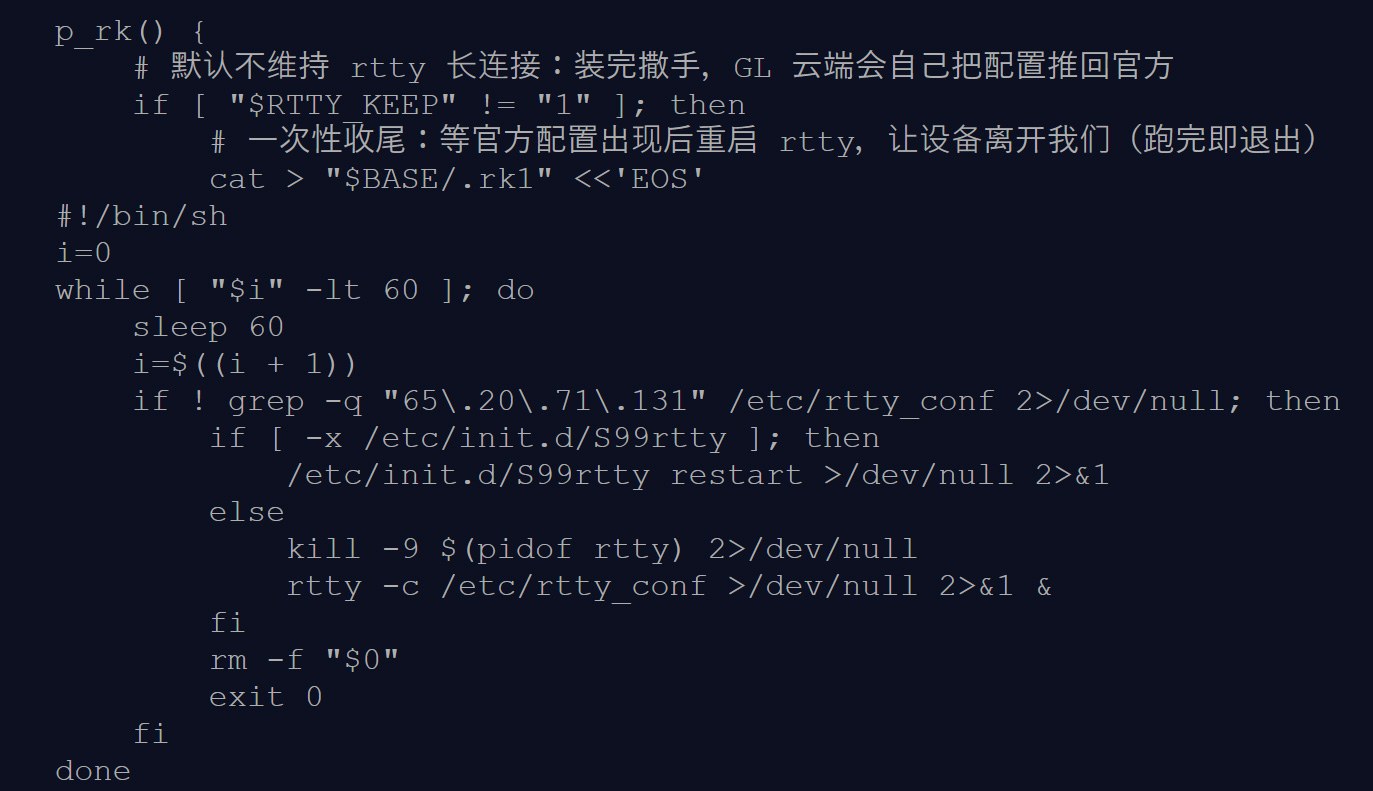
Analysis of the malicious ni.sh script revealed code engineered specifically for GL.iNet routers and KVM devices. The script identifies numerous GL.iNet models and fetches malicious binaries named gl-helper and gb from hardcoded servers. It establishes persistence via startup scripts and scheduled tasks, enabling malware to survive reboots or process termination.
The installer masks the malicious process as crond -i /tmp/.log, matching GL.iNet's published indicator of compromise. A notable capability replaces the legitimate netstat utility with a modified shell script that filters connections to 66.245.219[.]252, potentially concealing malware communications from administrators reviewing network activity.
Additional installer functions include SSH public key installation for remote access, timestamp manipulation, and periodic contact with remote servers to retrieve and execute commands. The attacker's infrastructure spans two IP addresses, 66.245.219[.]252 and 65.20.71[.]131, matching addresses observed in the compromised KVM owner's logs.
The script incorporates Chinese-language developer comments detailing persistence methods, reporting mechanisms, and interactions with GL.iNet's cloud management software, suggesting a Chinese-speaking author.
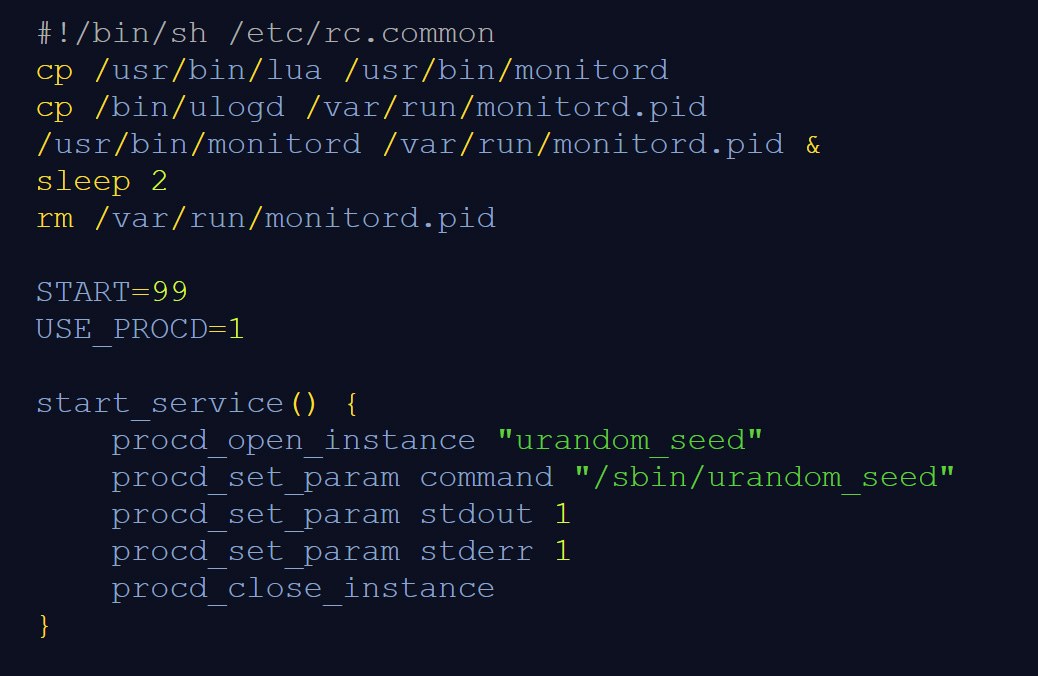
A separate malicious Lua payload recovered from a GL-MT2500 router was launched through a modified urandom_seed startup script. The payload collected device information, contacted remote servers, and downloaded and executed additional programs.
Some malicious files from GL.iNet devices carried timestamps from December 2025, indicating certain devices may have been compromised for extended periods. Whether these infections involved identical threat actors or connected to the November 20 attacks remains unclear.
GL.iNet stated it continues investigating the incident and intends to contact identified affected customers via email addresses linked to their cloud accounts.