
Modern IT operations rely heavily on endpoint management platforms to handle patching, software deployment, script execution, configuration enforcement, and remote administration of thousands of machines from a single control point. These capabilities are essential for maintaining security consistency at scale, yet the same administrative authority that makes them indispensable also creates significant risk.
When attackers compromise an endpoint management platform, they inherit all the trust relationships, communication channels, and elevated permissions the system already possesses. An attacker operating through compromised management infrastructure can deploy malware, run malicious commands, disable security tools, or disrupt operations with the same authority level as a legitimate administrator.
Recent compromises show the scale of the threat
The past few years have produced several high-profile incidents demonstrating how attackers weaponize compromised management systems. In 2026, Huntress documented attackers abusing a compromised BeyondTrust Bomgar remote support infrastructure to deploy ransomware and reach downstream organizations. During 2025, ransomware operators compromised an MSP's SimpleHelp platform and leveraged its management capabilities to access protected systems, exfiltrate data, and deploy ransomware.
In 2024, attackers exploited ConnectWise ScreenConnect vulnerabilities, with researchers documenting Play ransomware deployment through a compromised MSP instance. That same year, attackers abused Microsoft Intune to remotely wipe hundreds of thousands of corporate devices at Stryker. Each incident exploited the administrative reach that organizations had already granted to their management infrastructure.
For cloud-hosted management platforms, compromise of the provider's hosting environment, management services, or software delivery mechanisms can affect multiple customer environments simultaneously, extending the blast radius far beyond a single organization.
Traditional security controls fall short
Multi-factor authentication, role-based access controls, privileged access management, and activity monitoring represent baseline protections. They restrict administrative access, limit permissions, and flag suspicious behavior. However, these controls operate within the management platform's own security boundaries.
An attacker who exploits a vulnerability in the underlying system, compromises a privileged service, or hijacks an authenticated administrative session can issue commands that endpoints will recognize as legitimate. Because the endpoint validates the user identity, not the legitimacy of the instruction itself, an attacker impersonating an administrator can execute sensitive operations without independent verification.
High-risk endpoint operations require authorization that can be verified independently of the management platform delivering them. This security principle demands a separate verification mechanism that the platform itself cannot bypass or forge.
Cryptographic authorization as an independent boundary
Cryptographically verified authorization, controlled separately from the management platform, establishes an independent security boundary. Under this model, sensitive endpoint operations require authorization signed with a private cryptographic key held exclusively by the legitimate administrator. The endpoint independently verifies the signature before executing the protected instruction.
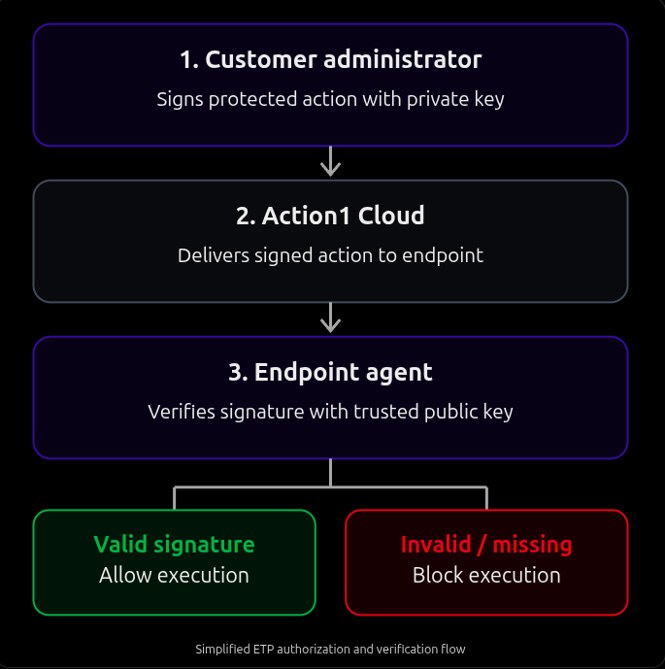
The management platform continues to coordinate and deliver administrative operations, but the authority to approve protected actions remains separately controlled. An attacker who compromises the management infrastructure cannot create valid authorizations without obtaining the owner's signing key or defeating the verification process.
Action1 implements this approach through Endpoint Takeover Prevention (ETP), which uses customer-controlled cryptographic authorization to protect high-risk operations including script execution, software deployment, automations, and remote sessions. Because the private authorization key is maintained independently of Action1's cloud infrastructure, a compromise of the management platform alone does not grant the ability to authorize these protected actions.
Implementing stronger safeguards
Organizations should reassess how endpoint management platforms are secured, how suspicious activity is monitored, and which protections remain effective if management infrastructure is compromised. Testing failure scenarios helps teams understand and contain incidents more effectively.
Customer-controlled cryptographic authorization adds a critical layer by ensuring that sensitive endpoint operations require independently verifiable approval. The goal is to preserve the administrative power that organizations depend on while keeping authority over the most sensitive uses under the owner's control.