
Extended Berkeley Packet Filter technology has earned widespread recognition as a cornerstone innovation within Linux kernel development. The technology enables developers to execute sandboxed code directly in the kernel without requiring custom kernel modules, supporting applications ranging from packet inspection to defensive security measures. Production environments at organizations including Google, Cloudflare, and Meta depend on eBPF functionality on a daily basis.
The very characteristics that make eBPF valuable to defenders have become equally attractive to adversaries. Research by Flare uncovered activity on underground forums where threat actors share eBPF rootkit implementations and instructional materials. One Russian-language post detailed techniques for constructing implants capable of concealing processes and triggering activation through specially crafted network packets, complete with supporting screenshots.
What Makes eBPF Dangerous?
Conventional Linux rootkits have historically depended on loadable kernel modules to intercept system calls and mask malicious operations. Defenders understand these mechanisms well, and endpoint detection and response platforms routinely monitor for anomalous module loading. eBPF operates through fundamentally different mechanisms.
eBPF-based malware can attach to kernel functions, monitor system calls, and examine or alter network traffic through the same bpf() interface that legitimate utilities like Cilium employ. Since these programs operate without loading a kernel module, a standard lsmod check will not detect them. Defenders face the difficult task of identifying who initiated the program and determining its purpose.
From Classic BPF Backdoors to eBPF Rootkits
The initial significant warning emerged in 2022 when PwC and Elastic Security Labs revealed BPFDoor, a passive Linux backdoor attributed to a Chinese threat group known as Red Menshen. The analyzed BPFDoor variant utilized a traditional BPF socket filter to identify specially constructed TCP, UDP, or ICMP packets. Upon activation, the malware could establish a reverse shell or redirect traffic toward the implant. PwC identified the malware during 2021, with public disclosure in 2022 documenting targeting of organizations across the Middle East and Asia.
During the same period, Intezer and BlackBerry jointly revealed Symbiote, a distinct Linux malware variant that leverages BPF for stealth purposes. Rather than functioning as an independent process, Symbiote exploits the dynamic linker to inject a malicious shared library into target processes. The library intercepts setsockopt() calls that attach classic BPF filters via SO_ATTACH_FILTER and inserts its own filter logic to hide specified traffic from packet capture tools.
Academic and security research had previously demonstrated offensive eBPF applications. During 2021, researchers unveiled ebpfkit at Black Hat USA and DEF CON. TripleCross integrates syscall hooks with XDP and traffic control programs to enable library injection, execution redirection, concealment, and command-and-control capabilities. Boopkit employs getdents64 hooks to conceal directory entries. An already-deployed implant can be activated remotely through two documented methods: one using a malformed TCP SYN packet and another leveraging standard TCP connections.
In October 2025, Synacktiv disclosed LinkPro following investigation of a compromise originating from an exposed Jenkins server. LinkPro deployed eBPF programs to mask host activity and trigger the backdoor upon receiving a specially crafted packet.
Underground Adoption: From Research to Weaponization
Both security researchers and state-level threat actors have investigated eBPF's potential for rootkit development. Flare's investigation uncovered underground forum discussions distributing code and instructional guides, indicating these methods have transitioned beyond academic literature and industry conferences into active criminal use.
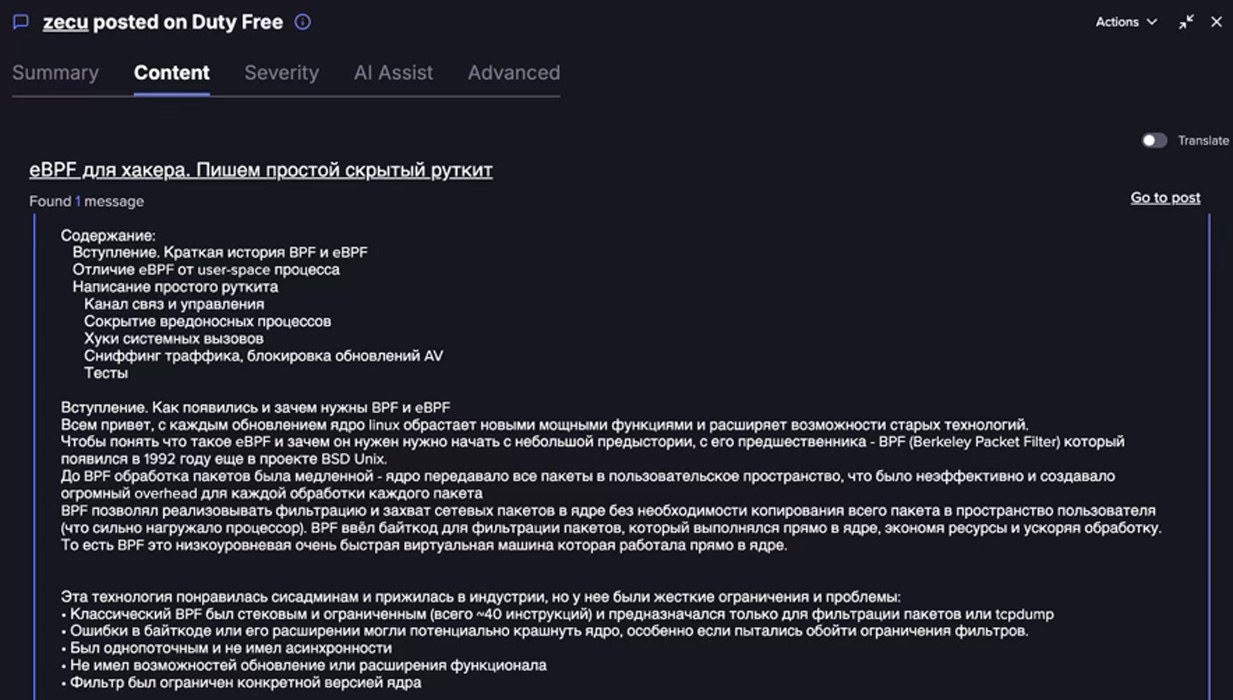
On the Russian-language Duty Free forum, a contributor published instructions for constructing an eBPF rootkit, explicitly referencing BPFDoor and Symbiote as inspirations. The tutorial provides source code and screenshots presented as proof of functionality. It explains triggering the implant using a TCP SYN packet with a particular window size, concealing processes through getdents64 hooking, and securing command-and-control communications with AES-256-GCM encryption. The guide additionally describes deploying XDP to examine incoming unencrypted HTTP traffic and discard packets matching a collection of 43 IP addresses the author identifies as belonging to antivirus companies.
Flare identified an additional 10 Pastebin entries containing XDP packet-processing code and timing parameters specified in microseconds.
eBPF Beyond Rootkits
Flare discovered exploit code distributed across numerous platforms. The most widely shared exploit (appearing on at least six platforms) targeted CVE-2017-16995, a 2017 Linux BPF verifier vulnerability related to improper sign extension handling.
Beyond these older eBPF exploits, researchers uncovered newer variants. One instance involves an unverified Linux local privilege escalation proof-of-concept targeting kTLS and eBPF sockmaps. The proof-of-concept seeks to corrupt the page cache for /etc/passwd and create an account with UID 0. Its assertion of compatibility with all kernels from version 4.18 onward contains inaccuracies. Upstream Linux 4.18 does not include a BPF helper function that the code requires. Successful privilege escalation on Ubuntu 22.04 or 24.04 remains unverified.
In one exploit sample examined, the author credited Claude in a source code comment for generating the BPF instructions.
Why Detection Is So Hard
The core difficulty stems from eBPF threats functioning through a sanctioned kernel interface. In contrast to unauthorized kernel modules, eBPF programs pass through the kernel's integrated verification process, and a malicious program that clears verification appears indistinguishable from any other approved program to the kernel.
Current detection approaches concentrate on observing bpf() syscalls, enumerating loaded programs using bpftool, and identifying suspicious attachment points on critical syscalls such as getdents64 and execve. These represent reactive strategies, and threat actors maintain an inherent advantage by operating through mechanisms the kernel itself authorizes.
What Defenders Should Do
Organizations managing Linux systems should treat eBPF threats as a serious concern:
- Perform routine audits of active eBPF programs using
bpftool prog list. Maintain awareness of what should be present. - Constrain eBPF access through
kernel.unprivileged_bpf_disabled=1and restrictCAP_BPFandCAP_NET_ADMINcapabilities. - Track activation patterns involving magic packets — numerous eBPF backdoors trigger via specific TCP flags or window sizes.
- Apply patches promptly — BPF verifier vulnerabilities constitute a recurring threat category, and weaponized exploits emerge rapidly.
- Monitor for unexpected XDP programs attached to network interfaces.
- Maintain current threat intelligence — staying informed about emerging attack methods, tools and techniques enables organizations to develop targeted detections and controls against eBPF-based malware.
The Bottom Line
eBPF rootkits signify a meaningful shift in Linux threat evolution, as their implants can circumvent detection mechanisms designed for loaded kernel modules. LinkPro demonstrated additional sophistication by attempting to conceal its eBPF programs from bpftool prog list output. Investigators nonetheless identified associated BPF maps and links, underscoring the importance of cross-referencing multiple host telemetry sources.
Flare's research revealed underground discussions distributing source code and guides for process concealment and packet-triggered activation. Synacktiv's LinkPro investigation documented both approaches in practice, offering defenders concrete examples of how these techniques manifest during actual intrusions.