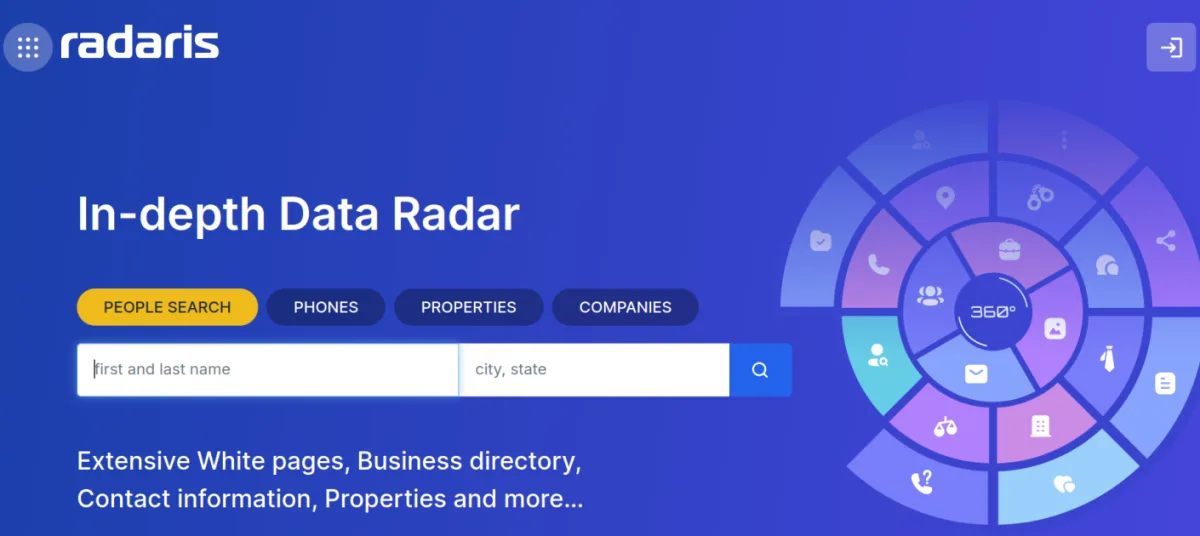
The people-search operator Radaris.com built a reputation for dismissing removal requests from individuals whose data filled its sprawling network of online services. That pattern of resistance finally resulted in consequences when a lawsuit accused the company of violating New Jersey's Daniel's Law, which imposes $1,000-per-violation penalties on data brokers that refuse to scrub information about state law enforcement personnel. After Radaris's legal team engaged in what the court viewed as repeated delays and evasion tactics, a judge ordered the transfer of radaris.com and more than a dozen related domains to the plaintiffs.
In February 2024, Atlas Data Privacy Corp filed suit against Radaris under Daniel's Law, a statute that mandates complete removal of personal data for state law enforcement officials, government employees, judges and their immediate families from commercial data brokers and people-search platforms. The law carries penalties of $1,000 per violation for companies that ignore such removal demands.
Within weeks of Atlas's initial filing, KrebsOnSecurity published an investigation into Radaris's co-founders, Igor and Dmitry Lubarsky, Russian-born brothers based in Massachusetts who oversee a complex web of people-search ventures alongside various Russian-language dating services and affiliate operations. The Lubarsky brothers' legal representatives demanded the story be taken down and retracted, claiming the reporting contained significant inaccuracies and asserting that Ukrainian nationals living in Ukraine were the actual company owners.

KrebsOnSecurity's follow-up reporting demonstrated how the Lubarsky brothers constructed and managed Radaris and related data broker operations using a fictional chief executive identity. The subsequent article revealed that Radaris's attorney Val Gurvits, working with the Boston Law Group, acknowledged his clients had created the fake CEO persona "Gary Norden." Radaris had also distributed numerous press releases over time that featured quotations from this fabricated executive while soliciting investment capital.
Radaris's legal counsel delayed filing a court appearance until the final moment, then argued that Atlas had not properly served the actual owners and operators of Radaris and its subsidiary data broker entities. Atlas subsequently refiled the lawsuit in June 2025, substantially expanding the roster of Radaris-affiliated data brokers named in the Daniel's Law violation claim.
Matt Adkisson, president and CEO of Atlas, characterized Radaris's litigation strategy as textbook obstruction. According to Adkisson, "We refer to this period as their island-hopping phase. Privacy policies changed constantly, and new entities kept appearing from places like the Marshall Islands, the British Virgin Islands, and Seychelles. Behind the scenes, it felt like a shell game. Defense lawyers told the court that certain entities merely operated the domains and were the proper parties to sue. But by the time a judgment neared, those entities would be discarded and new entities would appear. Meanwhile, the lawyers claimed the other entities that actually owned the domains should not be held responsible."
When Radaris updated its terms of service to claim management by a Marshall Islands company, Atlas engaged an investigator in that jurisdiction who discovered the newly claimed managing entity did not yet exist.
Gurvits had previously represented Radaris in a class action case the company initially lost in 2017 after failing to contest the claims. When plaintiffs proved unable to collect on a $7.5 million default judgment, the court directed domain registry Verisign to transfer radaris.com to the plaintiffs. Gurvits appealed, contending the lawsuit had not identified the true domain owner—a Cyprus-registered entity called Bitseller Expert Limited—and that seizing the domain would violate due process. The judge sided with Radaris, halting the transfer and permitting the plaintiffs to refile. Shortly thereafter, Radaris's operator shifted from Bitseller to Andtop Company, formed in the Marshall Islands in October 2020. The plaintiffs never refiled.
Raj Parikh, a partner at PEM Law in New Jersey handling most Daniel's Law litigation for Atlas, explained the pattern: "That seemed to be their modus operandi. In the past, they won by attrition. Plaintiffs' attorneys tired of the procedural games and just gave up. That strategy worked for a decade, and it probably would have worked in this case too, since any financial recovery from foreign actors will be difficult. But we were acutely aware of the threat this website posed to law enforcement officers and other public officials in New Jersey, and decided early on to commit whatever time and resources were necessary to remove that threat."
On August 26, the judge determined the defendants had received multiple opportunities to appear and contest the allegations but failed to do so. Gurvits declined to comment, stating the matter had been reassigned to attorney Victor Worms. Worms responded by asserting the court transferred radaris.com via a default judgment against a non-entity, and announced plans to challenge the judgment's validity and pursue appeals, contending the domain transfer constitutes a forfeiture that violates constitutional protections.
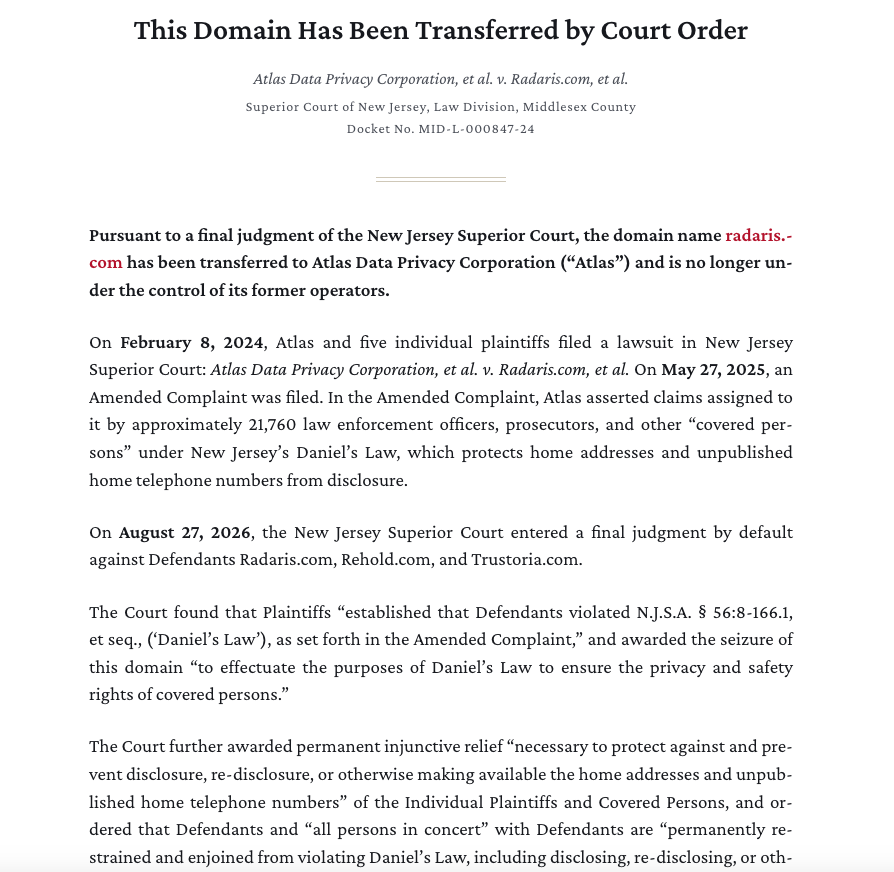
Although radaris.com still ranks high in search results for locating U.S. residents by name, the domain no longer distributes detailed personal profiles on millions of Americans. The homepage now displays an Atlas notice along with links to prior KrebsOnSecurity investigations.
Email Confirmations
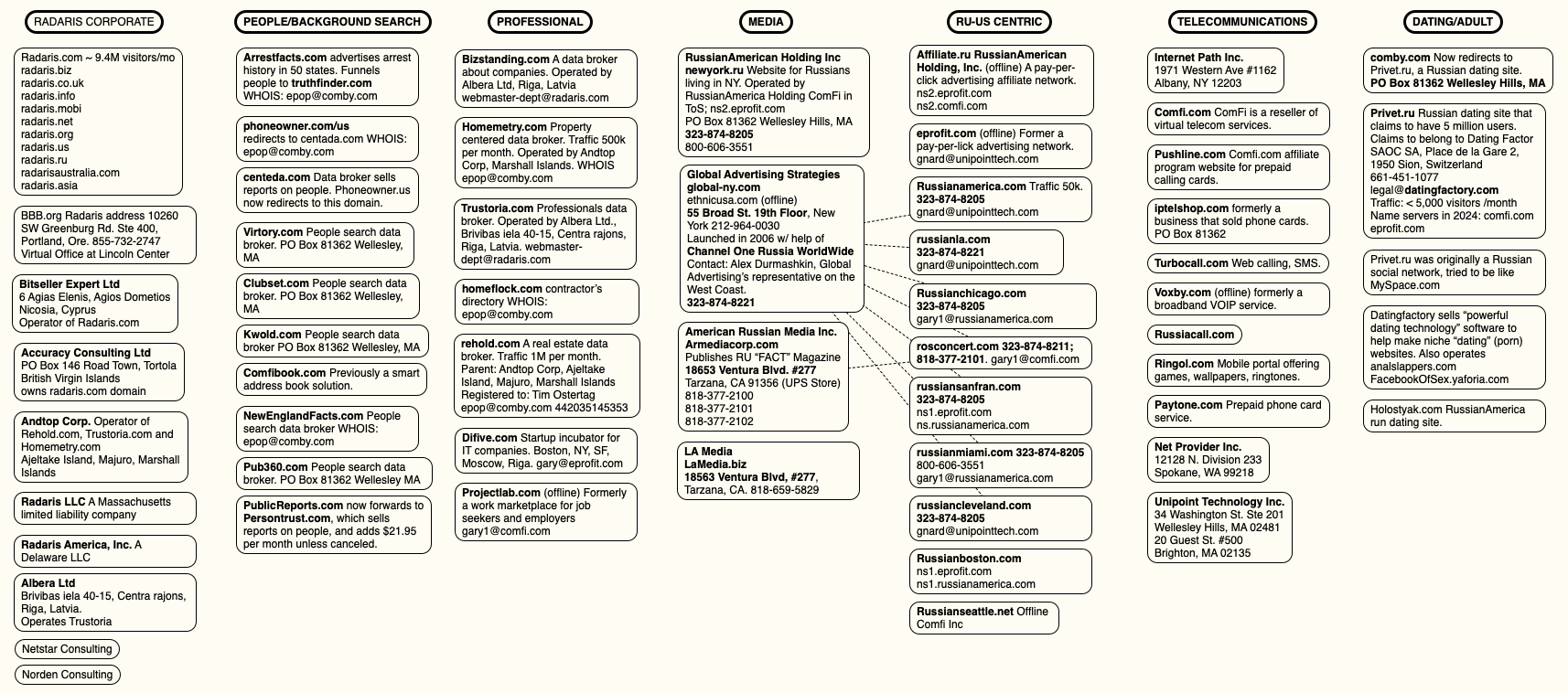
Atlas disclosed it has gathered more than 10,000 emails and documents during litigation that substantiate earlier reporting about Radaris's ownership and management structure. These messages demonstrate that the nominal legal entities—Radaris America, Inc.; Bitseller Expert Limited; Digital Orbit Corp; Core Solutions Group Inc; Lucky Solutions Inc; Virtura Corp; Veripages Inc.; Nuform Solutions Inc.; Growth Data Advisors Inc.; Property Experts, Inc—are all controlled by the same three or four individuals operating from identical email accounts, utilizing the same banking and payment infrastructure, and working from a single virtual office location.
According to Atlas's summary, "The corpus establishes, with documentary evidence generated independently by banks, payment processors, hosting providers, registrars, software-as-a-service vendors and the operators' own systems, that radaris.com and at least twenty-five other people-search websites are one operation run by a small Boston-area group whose administrative, financial and technical functions sit on the difive.com mail domain and its successors (centerex.com, scienteco.com, eprofit.com, realmo.com, pub360.com)."
The emails reveal radaris.com generates roughly $42,000 monthly, while veripages.com produces approximately $45,000 monthly through its arrangement with the Lifetime Value Company, a marketing and advertising organization whose portfolio encompasses PeopleLooker, PeopleSmart, NumberGuru, and Bumper, a vehicle history service.
The correspondence also indicated the Radaris network of websites earns as much as $25,000 monthly from a partnership with Onerep, a firm claiming to assist individuals in removing their information from people-search platforms. In March 2024, KrebsOnSecurity exposed how Onerep's Belarusian founder had established and maintained dozens of people-search operations over time and continued running one of them (Nuwber), essentially perpetuating the problem while simultaneously offering the solution.
The New Jersey court has transferred 14 domain names from the Radaris family to Atlas thus far. Radaris.com now directs visitors to a notice documenting the court-ordered domain transfer.
The Road Ahead
The Radaris network remains exposed to potential fines of $1,000 per alleged Daniel's Law violation. Currently, Daniel's Law itself faces constitutional challenges from nearly all 150 other consumer data brokers being sued by Atlas.
The data broker sector responded by relocating at least 70 Atlas lawsuits to federal court, where they challenge the New Jersey statute as unconstitutionally broad and violative of First Amendment protections. The U.S. Court of Appeals for the Third Circuit has not yet ruled on the constitutional question, though observers anticipate the case will ultimately reach the U.S. Supreme Court regardless of the appellate outcome.
At least 14 additional states have enacted legislation modeled on New Jersey's statute, with others contemplating comparable laws. However, West Virginia's Daniel's Law was declared facially unconstitutional under the First Amendment by a federal district court in August 2025.
Justin Sherman, a privacy researcher and author of the forthcoming book "The Middlemen," which explores the data broker industry's role in contemporary surveillance, noted that federal lawmakers have endured sustained pressure from the technology sector against stricter national privacy rules, yet numerous powerful industries now oppose comprehensive federal data privacy legislation.
"These days at the federal level, add in the intense amount of lobbying against these laws from social media companies, big tech, cryptocurrency firms, and now AI proponents in the mix who claim that limiting their data scraping is somehow going to collapse the whole U.S. economy under Chinese rule," Sherman said.
Sherman contended that people-search operations will persist absent Congressional action establishing robust consumer privacy and data protection standards suited to contemporary conditions. Most state privacy statutes exempt records classified as "public" or "government" documents, encompassing voter registries, property records, marriage licenses, motor vehicle registrations, criminal histories, court filings, death certificates, occupational licenses, bankruptcy records, and comparable materials.
At least 25 states have enacted or implemented age verification requirements for residents accessing adult content, yet no federal law governs how companies scanning driver's licenses may utilize, distribute or retain such information. Had such protections existed in statute, the recent IDScan.net breach—which compromised driver's license data for over 153 million Americans when records were briefly converted into a self-service identity theft tool on the dark web—might have been prevented.
"The average person can look at Daniel's Law and have a perfectly normal reaction, which is that everyone should be covered, not just police and judges," Sherman said. "But we don't need more wake-up calls. We've had eight million wake-up calls already on the need for better privacy laws. The lack of comprehensive federal privacy law is not for a lack of knowledge, and anyone claiming otherwise is either not reading the news or kidding themselves."