
Attackers targeting web applications have grown increasingly organized and capable. Whether operating as individuals, coordinated groups sharing evasion methods, or commercial services available for hire, these adversaries treat bot detection bypass as a specialized discipline. When defenses block them, they pivot to new approaches. The rise of AI-powered tools has further lowered barriers to entry, enabling attackers to quickly construct sophisticated assault configurations with minimal overhead.
This dynamic creates an asymmetry favoring attackers. Defenders must carefully validate changes to avoid harming legitimate users, while attackers face only constraints from available time and proxy infrastructure. Cloudflare processes over a trillion requests daily and observes how rapidly attackers shift tactics. The gap between attacker speed and defense responsiveness continues to widen.
Traditional bot detection rests on a flawed premise: building defenses tall enough to exclude all attackers. In practice, determined adversaries eventually penetrate any static barrier. The real question is not whether they will breach defenses, but what happens when they do. Adaptive Intelligence inverts this assumption. Rather than attempting to block every attacker, it makes successful attacks so slow and expensive that continuing becomes economically irrational.
The Challenge: Attacks Hidden in Normal Traffic
Sophisticated attacks deliberately blend into legitimate traffic. An attacker might distribute requests across residential proxy networks, maintain low rates from each address, and move methodically through login or checkout flows. Each request originates from a different address with fresh user agents and new bot fingerprints, appearing as a separate visitor. No single source triggers rate limits.
This distributed approach creates a detection dilemma. Tightening thresholds too aggressively blocks real customers—the outcome defenders most want to prevent. The attack persists in the space between individual requests. Defenses analyzing each request in isolation will never perceive the pattern.
The Flaw in Rule-Based Detection
Rule-based systems present attackers with a stationary target. Defenders iterate in months between updates while attackers adapt in days. By the time a rule catches a new technique, attackers have already moved beyond it. Some advanced operators have even automated this circumvention process.
This "deterministic" approach—where identical inputs always produce identical outputs—teaches attackers exactly how to evade. Automated probes return clear yes-or-no responses that, over repeated attempts, reveal the system's boundaries. The economics favor the attacker.
Reversing the Economics
Adaptive Intelligence aims to flip this calculation back toward defenders. A constantly changing defense creates advantage only if two conditions hold simultaneously. First, the defender's cost to adapt must be lower than the attacker's cost to circumvent. Second, attackers must receive minimal feedback to learn from, preventing them from simply studying their way back in. When both conditions are met, attackers face escalating costs with each attempt, eventually making the attack uneconomical.
The system limits attacker learning by detecting bots without visibly reacting, so attackers continue relying on signals they do not realize are visible. Detection operates as statistical judgment rather than fixed rules, making it non-deterministic. Multiple signals are weighted simultaneously, eliminating single points of logic for attackers to isolate and defeat.
The Detection Engine Architecture
Bot scores already combine multiple detection methods: machine learning, behavioral validation, JavaScript fingerprinting, heuristic libraries, and verification of known bots like search crawlers. Adaptive Intelligence is a new engine operating behind bot score, built on the premise that attackers will eventually penetrate defenses and designed to maximize the cost of each attempt.
The engine features three unique components compared to traditional approaches. Launching today is the first: continuous retraining of the machine learning model at bot score's core. The system aggregates network signals across Cloudflare's infrastructure and calculates automated abuse probability for every request. Rather than remaining static, Adaptive Intelligence continuously evolves. The second and third components will follow.
1. Continuous Self-Improvement
The engine retrains on live traffic as new bypass tools and bot frameworks emerge. Knowledge of these new techniques folds into the model without waiting for scheduled releases. An evasion method appearing this week becomes recognizable this week. The bot score remains aligned with actual attacker behavior rather than drifting between updates.
2. Disposable Rule Generation
Disposable rules are intentionally temporary, expected to be circumvented but designed not to improve attacker capabilities in the process. Adaptive Intelligence creates rules targeting specific attacks, deploys them at random intervals, and retires them before they become fixed targets. This constant flux injects noise into the signals attackers depend on for training. No single rule must be perfect; it only needs to function long enough before replacement. By the time attackers reverse-engineer a pattern, the engine has already moved on, rendering their effort worthless.
3. Learning from Protected Traffic
Adaptive Intelligence learns from patterns across millions of sites. When customers flag incorrectly scored legitimate visitors or internal measurement detects misses, those corrections become training signals. Over time, the engine tunes to actual customer threats, ensuring protection reflects the current threat landscape rather than historical snapshots.
Operational Loop: Observe, Train, Deploy, Validate
Adaptive Intelligence operates in a continuous cycle as signal sources expand. The observe phase aggregates Cloudflare network signals including JA4 TLS fingerprints, request structures, challenge outcomes, session behavior, network reputation, and meta signals, combined with client-side telemetry from Turnstile and Precursor. A client appearing ordinary in isolation but moving like a script across a session is caught through behavioral analysis, even when individual requests seem legitimate.
Training occurs continuously on live traffic, including newly discovered bypass tools and bot frameworks as they appear. The training set refreshes frequently, enabling rapid reaction to emerging techniques. Model weights deploy automatically across the network with no version selection or upgrade scheduling required. Once enabled, nothing requires customer action. Traffic scoring reflects current threats.
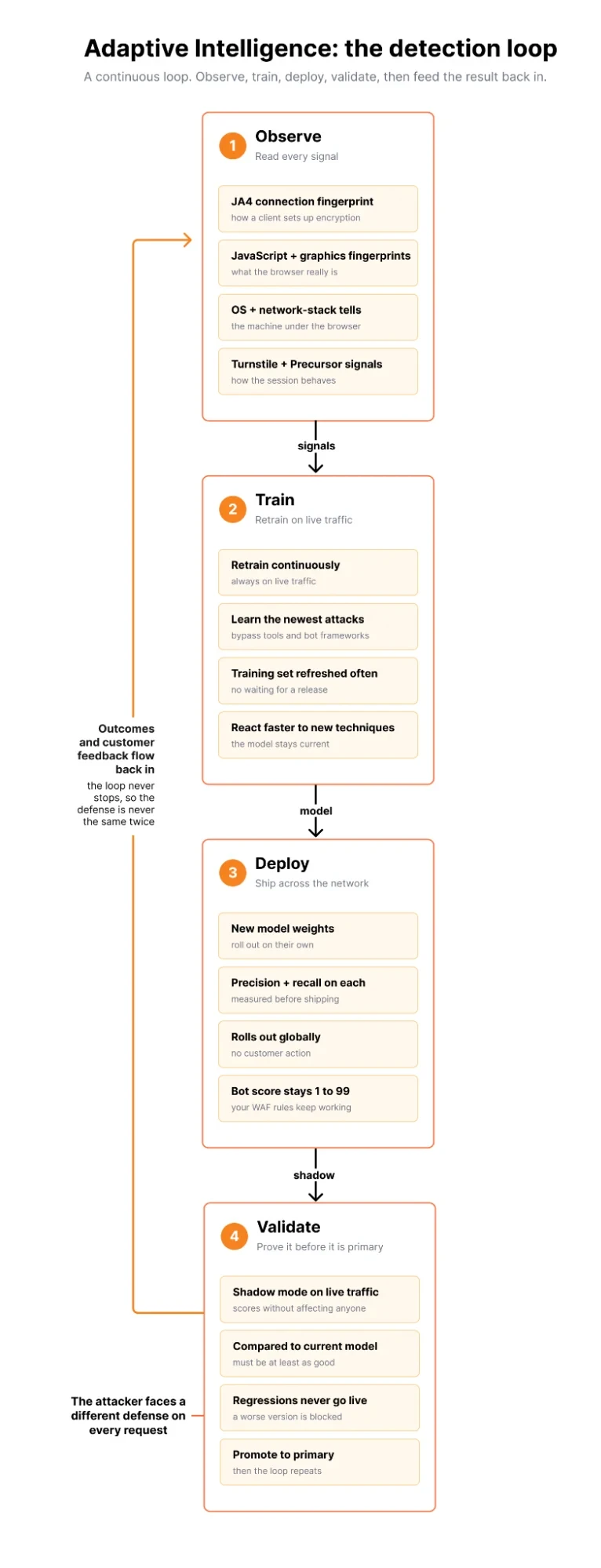
Validation runs new versions in shadow mode alongside current defenses, scoring live traffic without affecting visitors. The two versions are compared using metrics like challenge solve rates. If a new version would score legitimate users worse, it does not go live.
Cloudflare has operated similar automated loops against DDoS attacks for years: sample traffic, fingerprint attack patterns, distribute protections across the network, and continuously measure for adjustment or retirement. Bots present a harder problem because signals are subtler and patterns emerge over time. Individual signals appear perfectly normal; the relationships between them and their associations reveal hidden bots.
Adaptive Intelligence evaluates traffic across multiple time windows simultaneously. Short windows catch sudden bursts as they develop. Longer windows reveal behavior repeating across thousands of addresses, clients, and sessions with no legitimate reason to behave identically, linking scattered requests to single sources. The same engine detecting obvious scraping spikes also surfaces slow, distributed credential-stuffing attacks sending only handful of requests per address.
Automatic Detection Generation
As additional Adaptive Intelligence components launch, mining systems will search recent labeled traffic for signal combinations distinguishing emerging attacks from real users. Often useful detections emerge from relationships between known signals rather than entirely new signals. A client claiming one browser while producing network or JavaScript signals of another, or a request forming odd sequences within a session, can reveal attacks.
Automated mining tests numerous combinations and converts the strongest into candidate detections. These candidates are deliberately narrow, requiring no need to catch every bot globally or every request in current attacks. This narrowness enables quick construction and easy replacement when attacks shift tactics.
Maintaining Historical Context
Attackers do not strike once; they pause, retool, and return. Retiring a detection does not mean discarding the pattern behind it. The engine maintains memory of past attacks even after detections stop firing, preventing attackers from escaping by alternating between profiles and assuming the second looks new.
This memory provides a head start when familiar attacks resurface or related ones emerge. Detections can expire when no longer earning their place while underlying evidence remains available for building subsequent ones. Stale rules never accumulate in production, and the system never relearns old attacks from scratch.
Safe Deployment
Constant change only benefits when every change is safe, and standards are rigorous. Customers tolerate occasional bots slipping through, but legitimate visitors wrongly blocked represent the failure with actual cost. This concern makes teams cautious about automatic updates, so new detections must prove themselves before affecting anyone.
Each candidate is tested against recent real traffic, measuring how much known automation it catches and how often it would incorrectly flag genuine visitors. It rolls out gradually as a bot score input while the system monitors score distributions, challenge outcomes, and customer feedback. Rollback is possible before reaching the entire network. Every update must demonstrate it is at least as effective as its predecessor on precision and recall metrics.
Integration with Precursor
Adaptive Intelligence does not operate in isolation. Last month Cloudflare introduced Precursor, a continuous behavioral validation engine for bot management emphasizing privacy, measuring automated abuse through visitor behavior once reaching the browser: timing, movement, and small human signals that automation struggles to replicate. Precursor and Adaptive Intelligence were designed as two components of a single approach to detecting malicious automation. Precursor measures continuous session behavior; Adaptive Intelligence learns from bot detection signals across the entire network. Signals from each make the other harder to circumvent.
This reflects the underlying philosophy: the bot detection engine should reduce what penetrates defenses and adapt faster than attacking adversaries.
Roadmap
Continuous retraining forms the foundation, with additional engine components coming online. Cloudflare is expanding automatic detection generation for bots, connecting more network observations, challenge data, and browser signals into unified session views, and providing additional response options based on engine findings.
Accepting that no defense stops every determined attacker enables aiming for something more practical: making each attempt short-lived while costing attackers more than they will recover. Adaptive Intelligence reacts faster to new techniques and provides attackers less to learn from with each change. The attacker who never quits now encounters a defense that differs each time they return, rendering persistence unprofitable.
Enabling the Feature
Enterprise customers should enable "Auto Update Machine Learning" in the Bot Management dashboard. With this setting active, Adaptive Intelligence activates automatically with no version migration and no configuration required. The bot score already in use continues functioning unchanged. Customers uncertain about current status should verify the setting is enabled to receive protection from day one.