Check Point Software has issued urgent hotfixes for a high-severity vulnerability that threat actors have been actively exploiting to obtain root-level access and maintain persistence on affected installations beginning in late October.
The flaw, designated CVE-2026-123039, is a local privilege escalation issue residing in the DynamicCLI IPC (Inter-Process Communication) interface, which processes privileged command requests directed to the root-level Gaia OS DynamicCLI (dynamic_server) daemon.
According to Check Point's Thursday security advisory, "Check Point observed an active exploit of this vulnerability against a couple of dozen customers."
The vulnerability stems from a critical design flaw: "The Gaia OS DynamicCLI daemon runs as root and listens on a world-writable local socket (/tmp/dynamic_socket) without authenticating connecting processes. An authenticated local user can send a command to the socket and have it executed as root."

Multiple Check Point products are affected by exploitation of this flaw, including:
- Firewall
- Multi-Domain Security Management Server
- Scalable Platforms
- Security Gateway
- Security Management Server
Attack Chain Details
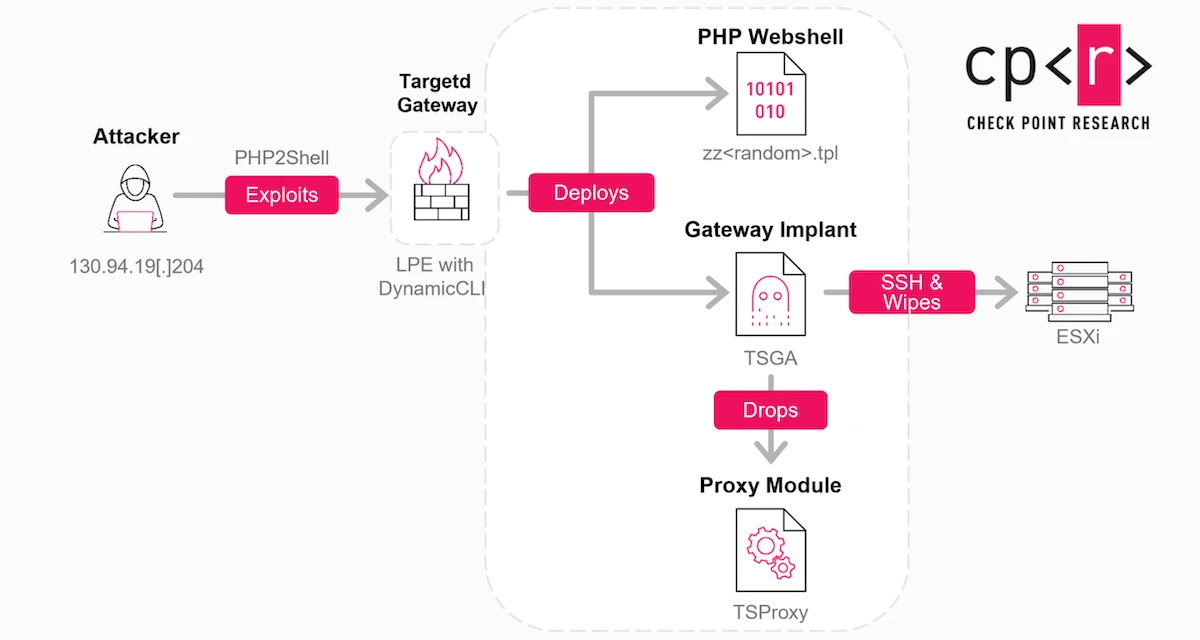
Check Point disclosed that in observed incidents, attackers initially breached the Mobile Access portal by exploiting the PHP2Shell vulnerability. Following this initial compromise, they leveraged the CVE-2026-123039 zero-day to escalate to root privileges.
Once elevated access was obtained, the threat actors deployed webshells and installed both the TSGA backdoor and TSProxy malware—tools previously documented in attacks against Ivanti systems. From the compromised gateway, attackers then moved laterally to a VMware ESXi host and deployed destructive wiper malware.
Mitigation and Detection Guidance
For organizations unable to immediately apply the CVE-2026-123039 hotfixes, Check Point recommends stopping the dynamic_server process and disabling its automatic restart as a temporary protective measure.
The company has released indicators of compromise (IOCs) and provided detection methods. Security teams should search for evidence of exploitation by monitoring for commands typically used in attack attempts, detection of the system() sink (which is uncommon or absent in normal operations), and commands that bypass the default Clish wrapper—a sign the command executed as root through the socket and warrants investigation.
Context: Prior Check Point Vulnerabilities
This disclosure follows a September warning from Check Point regarding two additional critical remote code execution vulnerabilities being exploited in zero-day attacks. CVE-2026-93616 affects the Security Management Server, and CVE-2026-85102 affects the Security Gateway. Neither required attacker privileges on target systems.
Over the past two years, the US Cybersecurity and Infrastructure Security Agency (CISA) has cataloged five Check Point vulnerabilities as actively exploited in the wild. Two of these flaws have also been weaponized by ransomware operators.