Binance has refuted allegations of a security breach after an actor operating under the 'ShinyHunters' moniker surfaced on a recently discovered dark web forum claiming to possess records belonging to 335 million users of the world's largest cryptocurrency exchange.
The individual, suspected of impersonating members of the ShinyHunters extortion gang, announced the availability of purported customer data and set an asking price of $900,000, threatening to release the information if payment was not made.

According to the threat actor's posting, the compromised dataset encompasses Know Your Customer (KYC) documentation, internal infrastructure details, user account passwords, cryptocurrency wallet private keys, transaction records, email addresses, and phone numbers.
A representative from Binance told BleepingComputer that the company's investigation uncovered no signs of unauthorized access. "We have found no evidence that Binance systems, customer KYC data, account credentials, wallet private keys, or internal infrastructure information were compromised in connection with this listing," the spokesperson stated.
The exchange suggested the claim resembles previous fraudulent listings. "Similar past listings have often involved infostealer malware data collected from users' own devices rather than a breach of Binance systems," the company noted.
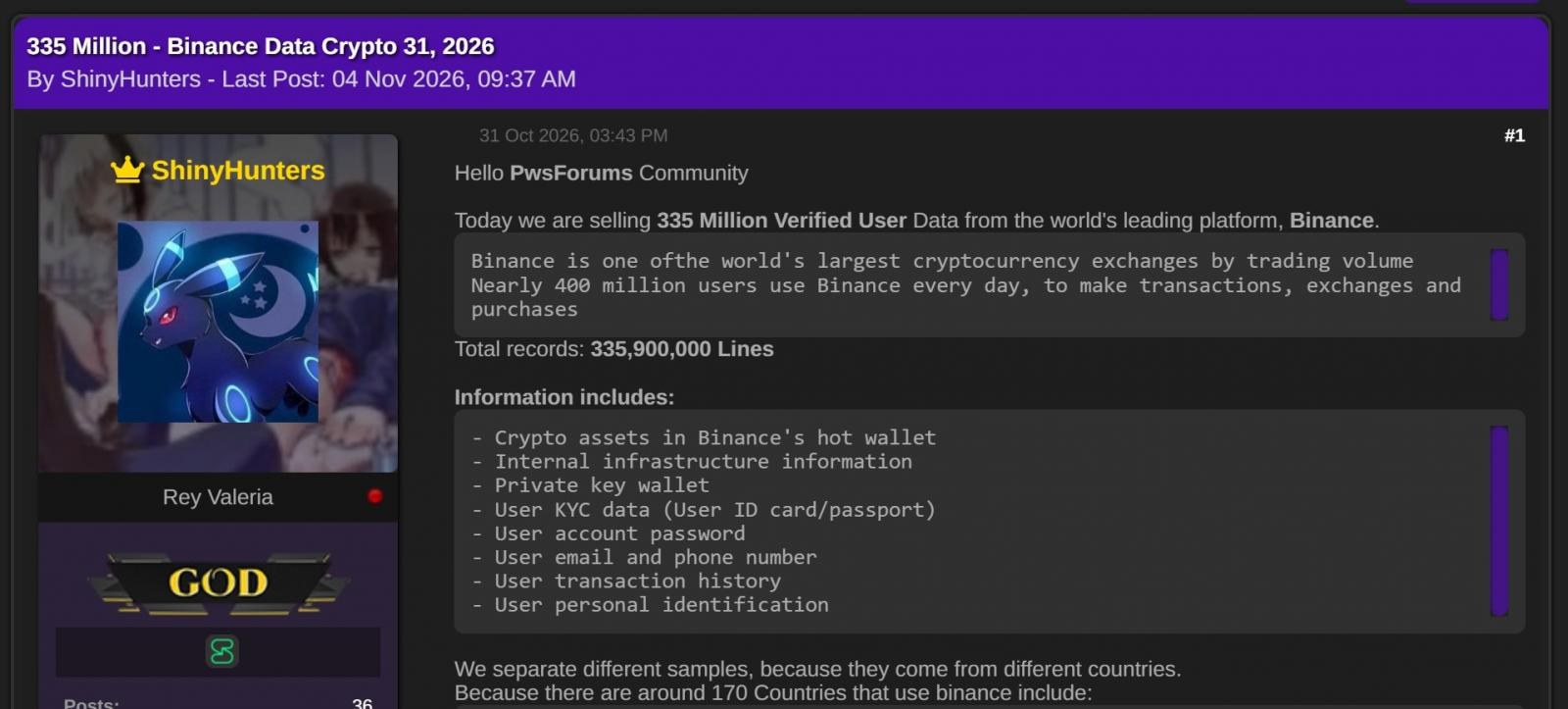
Binance highlighted several inconsistencies between the threat actor's claims and the company's actual data storage practices. The exchange does not maintain private keys for users' external cryptocurrency wallets, does not retain user passwords in unencrypted form, and has ceased operations in certain regions that the threat actor referenced in their forum post.
Skepticism emerged from other participants on the cybercrime forum itself, with some questioning the authenticity of the data being offered. One commenter challenged the seller: "If you hold the private keys to all the wallets, what would be the justification for selling this?"
While dismissing the breach allegations, Binance advised users to refrain from disclosing passwords, two-factor authentication codes, seed phrases, or private keys, and to remain alert to phishing schemes.
The denial comes shortly after Binance disclosed a separate incident in which North Korean state-sponsored attackers compromised the company's wallet infrastructure. The attackers had manipulated an employee into installing malicious software during what appeared to be a legitimate job interview process, resulting in the theft of approximately $6.34 billion in cryptocurrency.
The FBI has attributed this breach to TraderTraitor, a North Korean state-backed hacking operation also known as Lazarus Group, Jade Sleet, and APT38. TraderTraitor has been connected to additional significant cryptocurrency thefts, including a $1.5 billion heist targeting Bybit in February 2025.