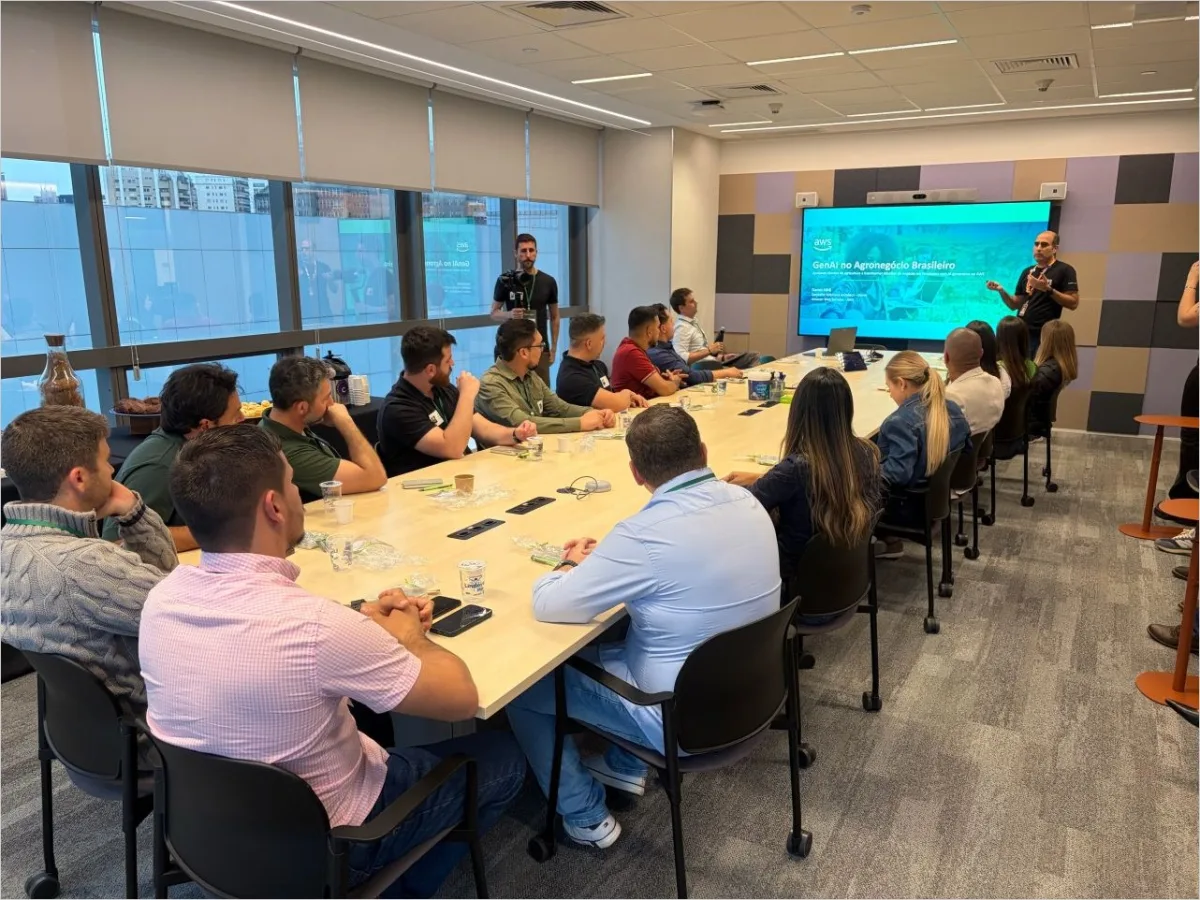
During a recent presentation to agribusiness leaders at the AWS office in São Paulo, the conversation centered on how generative AI integrates into agricultural operations at every stage. The recurring theme was not whether AI belongs in farming, but rather the mechanics of delivery: which users receive the output, what language they need, which devices they use, and often whether they have both hands occupied driving between fields. This context explains why Amazon Polly's latest upgrade takes prominence this week. The Generative engine now includes 14 new voices across 9 locales, with two additions in Brazilian Portuguese—Leo and Carolina. For a user steering a vehicle, voice becomes the only viable interface.
The week's other announcements carried greater urgency. AWS released a security service built on the recognition that the window between vulnerability disclosure and active exploitation has essentially vanished. The company backed this premise with honeypot data collected during the same week. AWS published evidence showing exploitation attempts predating public disclosure by days, and proof-of-concept code circulating hours before the embargo lifted.
AWS Continuum for Code Vulnerabilities Now Generally Available
AWS Continuum reframes vulnerability management as a continuous process rather than a scanning tool that produces a list. The service constructs a context graph from repositories and AWS environments, assigns evidence levels to each finding, and reproduces exploitable issues in an isolated sandbox with proof-of-concept code. This approach shows the actual vulnerability rather than a severity rating. The system ranks issues by proximity to business-critical systems, then opens fixes as pull requests. Human approval gates every remediation today, though autonomous fix classes behind confidence thresholds are planned for the future.
The timing reflects AWS's own honeypot findings. Amazon Threat Intelligence detected a PHP2Shell exploitation attempt in MadPot telemetry on October 17, four days before CVE-2026-109618 and CVE-2026-109619 reached public disclosure. On the disclosure day itself, proof-of-concept exploits were already circulating at 02:00 UTC, roughly twelve hours before the embargo lifted at 14:00 UTC. The implication is straightforward: patch windows measured in days assume delays that no longer exist, and investigations should begin from the earliest known exploitation, not from the disclosure date. AWS also released AWS WAF mitigations for these same CVEs. Continuum is available in US East (N. Virginia) and US West (Oregon).
Amazon ECS Gateway Separates Network and Application Ownership
Amazon ECS Gateway divides the responsibility for exposing services between network teams and application teams. Platform teams configure a single gateway with organizational subnets, security groups, TLS certificates, listener settings, and AWS WAF web ACLs. Application teams integrate by adding a gateway connector to their service definition, and ECS automatically provisions an ACM certificate, unique DNS hostname, listener rules, target group, and security group that only accepts traffic from the Application Load Balancer.
The economics are compelling: a single ALB can serve up to 25 services, ECS creates the first ALB on initial connection and removes it when no longer needed, and a gateway can associate with up to 10,000 clusters with five gateways per cluster. Adoption is incremental—you can run UpdateService while keeping your existing load balancer operational. Amazon ECS Gateway is available in all commercial Regions where Amazon ECS operates, at no additional charge.
Additional AWS Launches
Amazon Polly's Generative engine received a major upgrade. The engine now supports 57 generative voices across 11 languages and 25 locales. The 14 new voices span 9 locales, with Hindi and Finnish becoming generally available for the first time. The two Brazilian Portuguese voices are Leo and Carolina. The upgrade is a drop-in replacement—voice names, the SynthesizeSpeech call, and pricing remain unchanged while output quality improves.
AWS announced TorchNeuron, an open source PyTorch backend now in public beta that enables model execution on Trainium by changing to .to('neuron'), a configuration adjustment rather than a code rewrite. Eager execution and torch.compile remain intact. The tool integrates with the Neuron Kernel Interface for custom operators and runs on Trainium2 and Trainium3 instances. The release accompanies AWS Neuron 2.33.
Amazon SageMaker AI training sessions are now generally available, offering control over the post-training loop including custom loss functions and reward signals while SageMaker AI manages GPU allocation, distributed execution, fault recovery, and checkpoint storage. Billing is based on processed tokens, with the meter pausing while the reward function scores a batch. Support now includes Muse Glimmer, Qwen 3.8, and Ministral 3.
Structured outputs for Claude models are now available on Amazon Bedrock. Any Anthropic Claude model on Bedrock can return schema-compliant JSON across both bedrock-runtime and bedrock-mantle endpoints without custom parsing, retry logic, or post-processing. This simplifies automation of tasks like extracting required fields from financial reports, parsing clinical notes, or routing support tickets by intent.
Amazon ElastiCache Serverless for Valkey now supports zero-downtime online migration. Self-managed Valkey or Redis OSS running on Amazon EC2 can migrate into ElastiCache Serverless with zero errors returned to clients during the move, measured according to ElastiCache SLA standards. Migration preparation, data sync, and manual or automatic cutover require no third-party replication tools. The feature is available in all commercial Regions, China Regions, and AWS GovCloud (US) Regions.
Additional Resources and Upcoming Events
AWS Agent Registry is a managed catalog for MCP servers, agents, and agent skills that allows orchestrators to search approved capabilities at runtime instead of compiling every tool at build time. A working sample demonstrates the discover, instantiate, and execute loop with search results returning connection metadata but never invocation credentials.
A new post addresses tokenomics for coding agents, providing open source tooling to measure model, harness, and hosting choices on your own repositories. Sample results show routing achieved 44.7 percent cost reduction for 4.8 percent lower mean quality.
U.S. Bank migrated 119 TB from four Oracle Exadata databases to Amazon RDS for Oracle using a config-driven pipeline built on Oracle XTTS, AWS DataSync, and Amazon EFS. The initial baseline copy completed in about 7 days with zero data loss, and cutovers averaged roughly four hours per database over a bandwidth-capped Direct Connect link.
AWS re:Invent runs November 30 to December 4 in Las Vegas, featuring more than 2,200 sessions. The session catalog is live and reserved seating is open. AWS Community Day Brasil Norte takes place in Belém on October 31, concluding the 2026 Brazilian community season.