
Intruders obtained compromised identity and access management credentials belonging to Qubole, an enterprise cloud data processing and analytics platform, then leveraged those credentials to infiltrate and steal data from multiple customer AWS environments. The intrusion window spanned October 14 through 26 and impacted numerous organizations whose AWS setups contained IAM roles configured with trust policies pointing to Qubole's AWS account.
Qubole enables enterprises to process large datasets and execute machine learning operations, with built-in AWS integration for managing compute resources. Third-party vendors like Qubole gain access to customer AWS resources through cross-account IAM roles, where trust policies specify which external AWS accounts may assume those roles and permissions define what actions and resources are permitted.

External providers typically use AWS's STS AssumeRole API to obtain temporary credentials for accessing customer resources, according to researchers at cloud security firm Wiz. Wiz launched its investigation after Sentra, a data security and governance company, reported anomalous behavior in several of its customer environments. The probe also involved cybersecurity firm Mandiant.
The investigation revealed that attackers had compromised two Qubole IAM users and assumed previously dormant roles across multiple customer AWS accounts that maintained trust relationships with Qubole's account. This granted the intruders permissions within the scope of those roles.
After gaining initial access, the attackers performed reconnaissance on cloud infrastructure, pulled secrets from AWS Secrets Manager and SSM Parameter Store, and extracted Lambda environment variables. They then deployed the TruffleHog tool to verify discovered AWS keys, Microsoft Entra ID client secrets, and Okta client credentials.
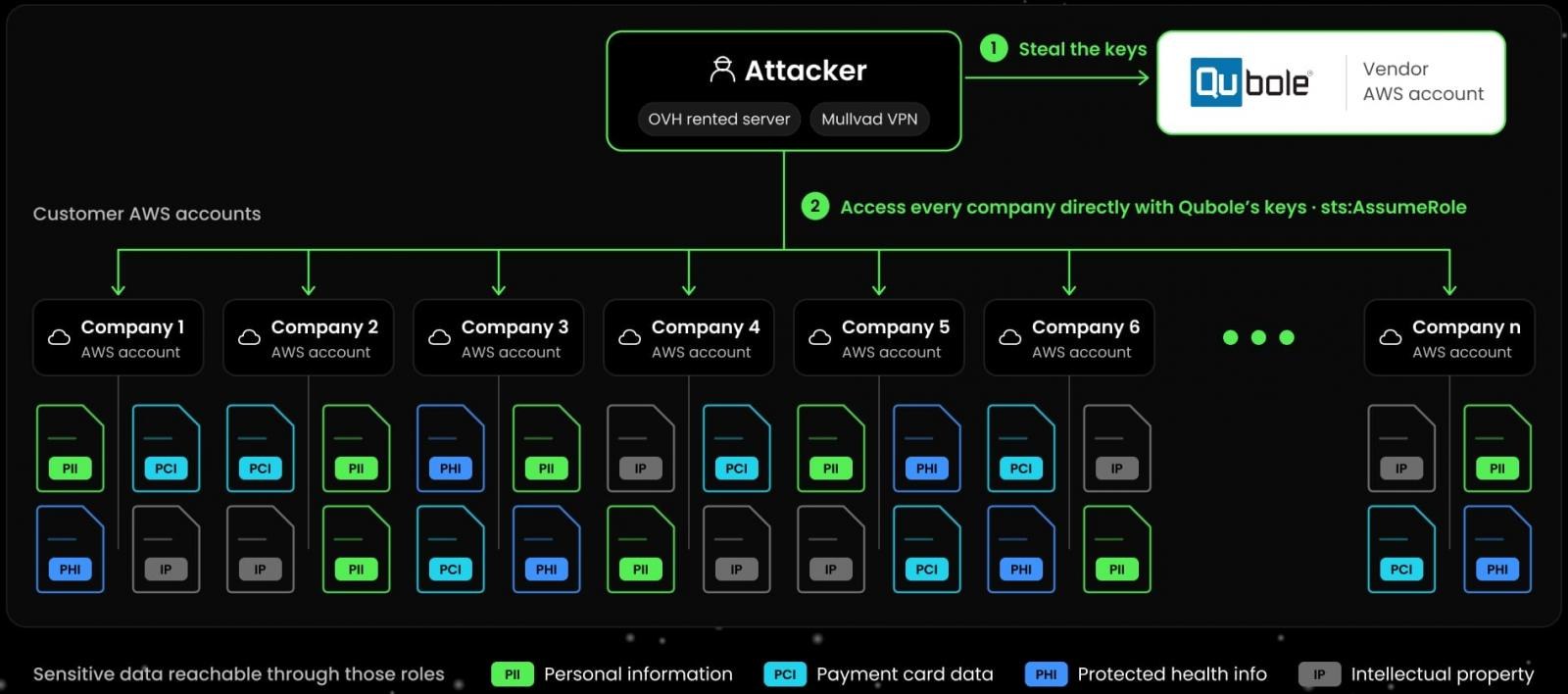
With expanded access established, the intruders downloaded data from all reachable S3 buckets within the AWS environment, employing a broad opportunistic strategy rather than targeting specific datasets. According to Wiz, "The sequence was consistent across environments: assume a role, call ListBuckets to see what the role could reach, call ListObjects and HeadObject to enumerate and inspect the contents, then call GetObject to download them."
The report does not disclose the specific technique used to compromise the Qubole accounts or provide an exact count of affected downstream customers. Sentra confirmed that dozens of organizations fell victim and that millions of files were stolen from a single customer. Sentra also noted that the attacker operated with speed, harvesting secrets at a pace of 100 passwords and keys within seven minutes.
No public statement from Qubole regarding the breach has been located. Kernelwire contacted the company requesting details about the incident but has not yet received a response.
Recommended Actions
Administrators of potentially compromised environments should take the following steps:
- Examine CloudTrail logs from October 1 onward to identify unauthorized access originating from Qubole's AWS account
- Investigate subsequent access patterns involving secrets and S3 operations
- Rotate all exposed credentials immediately
- Revoke any active role sessions that may have been established by the attacker
- Deactivate unused integrations with third-party providers
- Tighten permissions on remaining cross-account roles, limit trusted identities, and restrict allowed source networks