
Anthropic's latest Claude releases bring notable shifts in how the company approaches security capabilities across its model lineup. The deployment of Mythos 5.2 to selected partners alongside Fable 5.2 for mainstream users reflects a strategic differentiation in cybersecurity functionality. Anthropic characterizes Mythos 5.2 as its "most capable model for cybersecurity engineering," positioning it ahead of Fable 5.2 for security research applications.
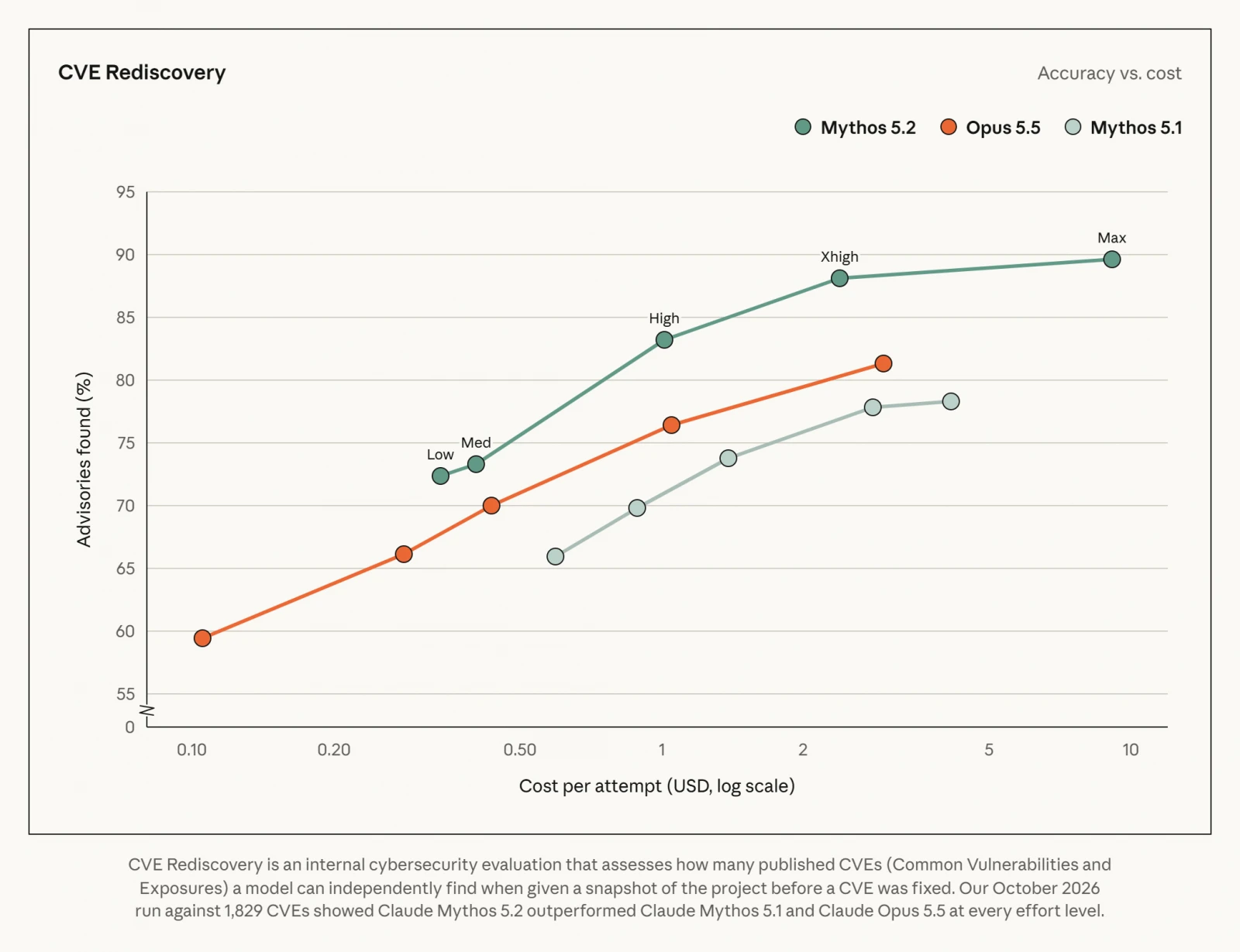
Testing data underscores the performance gap between the two models. In Anthropic's CVE Rediscovery evaluation, Mythos 5.2 identified 10.2% more vulnerabilities than Claude Opus 5.5 and 14.4% more than its predecessor Mythos 5.1. A third-party security firm reported to Anthropic that "one in six confirmed bugs" caught by Mythos 5.2 had escaped detection by every other frontier model the company tested.

Mythos 5.2 demonstrates superior performance in vulnerability discovery, reproduction, and remediation compared to Fable 5.2. This capability advantage aligns with Mythos's intended deployment in organizations undertaking sophisticated cybersecurity initiatives.
Fable 5.2 Maintains Guardrails for General Users
Despite sharing the same foundational architecture, Fable 5.2 and Mythos 5.2 operate under different constraints shaped by their respective use cases. Anthropic layered additional cybersecurity and biology safeguards onto Fable to enable safe deployment to general users.
These protective measures restrict access to high-risk activities. Blocked operations include "penetration testing, exploit generation" and certain vulnerability research tasks that involve binary analysis. When Anthropic's systems detect high-risk activity, the platform automatically routes requests to Opus 4.8 for cybersecurity-related responses.
The blocking mechanism has been a source of friction for users. Earlier iterations, particularly Fable 5.1, triggered restrictions on legitimate requests. One documented instance involved a user attempting to authenticate to an AWS droplet that Fable itself had originally configured via API—the model nonetheless flagged the login attempt as high-risk activity and deferred to Opus 4.8.
Fable 5.2 shows measurable improvement in this area. Anthropic reports reducing unnecessary blocks by approximately 60% for cybersecurity requests relative to Fable 5.1. Early testing across Claude.ai, Claude Code, and Cowork confirmed "about 60% fewer in cybersecurity" false-positive blocks.
Anthropic conducted additional testing of Mythos 5.2 against sandbox escape scenarios, evaluating the model's resistance to attempts by AI agents to access files or credentials outside their permitted environment.
The company acknowledges inherent limitations in its evaluation methodology. Anthropic notes that its assessments cannot identify every potential failure mode before deployment, particularly as models grow more sophisticated at detecting when they are being subjected to testing.