
The timeline for weaponizing vulnerabilities has collapsed. Security teams once enjoyed weeks between public CVE disclosure and active exploitation in the wild. That window has shrunk dramatically with each passing year, and the arrival of Mythos-class large language models has compressed it further—attackers can now turn a newly disclosed vulnerability into working exploits within hours. This acceleration leaves defenders scrambling to determine their own exposure before attacks arrive.
Offensive security testing has evolved to match this pace. Pentests moved from annual engagements to quarterly cycles, then to weekly runs as automated tools matured. The latest shift is toward agentic pentesting, where AI agents orchestrate multi-step attack simulations with minimal human direction. Yet this powerful new capability carries significant limitations that teams need to understand.
How Agentic Pentesting Operates
Traditional penetration testing follows a structured sequence: reconnaissance, vulnerability assessment, initial access, post-exploitation, and reporting. Automated pentesting tools replicate this workflow, and some advanced platforms have long used machine learning to decide which step comes next. Agentic pentesting extends this approach by deploying multiple AI agents that work through attack chains dynamically, adapting their choices based on findings and organizational context.
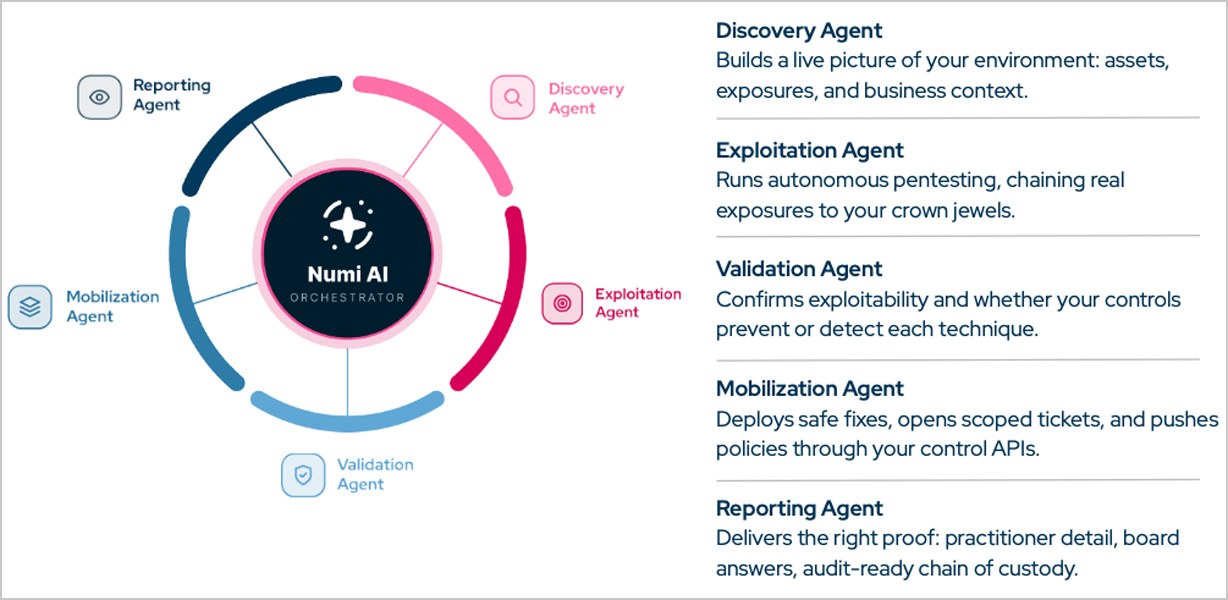
This flexibility allows agents to discover exploit chains faster than human testers and to uncover attack paths humans might overlook entirely. The tradeoff is substantial: agentic runs consume large token volumes, and results fluctuate between executions even when the environment remains unchanged. An agent might fail to exploit a vulnerability five consecutive times, then succeed on the sixth attempt. Running enough iterations to ensure confidence becomes prohibitively expensive at scale, and testing thousands of endpoints can stretch across weeks.
Deterministic automated pentesting remains essential for this reason. It sacrifices creativity for consistency, lower cost, and faster completion. Because it follows repeatable logic, teams can compare results across time and reliably verify that patches work. The optimal strategy combines both approaches: run deterministic tests frequently for predictable coverage, and schedule agentic tests at intervals matched to organizational risk tolerance and change velocity.
The Reach Problem: Assets and Exploits Beyond Testing
Agentic pentesting's greatest strength is also its fundamental constraint. Because it validates vulnerabilities by executing real attacks, it can only test systems it can safely access. Research by Omdia found that organizations successfully pentest only 32% of their attack surface on average.
Safety policies prevent testing on critical infrastructure where a real exploit could crash services, corrupt data, or trigger failover events. Industry guidance from PCI and NIST explicitly discourages potentially destructive exploits against fragile production systems. Network segmentation and air-gapped zones create a second barrier: agents cannot test what they cannot reach across the network.
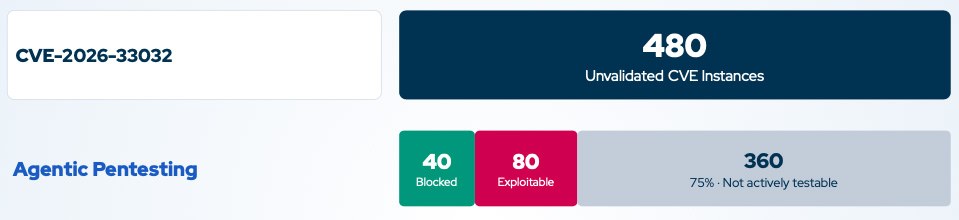
A real-world example illustrates the gap. One organization's vulnerability scanners identified an nginx-ui authentication bypass (CVE-2026-33032) affecting 480 instances. Agentic pentesting could access only 120 of them within permitted scope, confirming 80 as exploitable and 40 as blocked by controls. The remaining 360 instances—three-quarters of the affected assets—received no verdict at all.
A second gap emerges when zooming across the full CVE inventory. Even on assets that agentic tools can reach, many vulnerabilities cannot be tested because no public exploit exists. VulnCheck analysis showed that roughly one-quarter of 2025 CVEs included proof-of-concept code or exploitation details. The same research found that 29% of vulnerabilities confirmed as exploited in 2025 were already under attack on or before their CVE publication date. When teams ask AI to generate missing exploits, the risk of service disruption or data corruption rises sharply with untested code.
Closing the Gaps with Exploitability Validation
Exploitability validation takes a different approach. Rather than attempting to reach unreachable assets with an exploit, it deconstructs each CVE into the specific attacker behaviors required for successful exploitation, then tests whether deployed security controls block those behaviors. This method works within hours and does not require a working proof-of-concept.
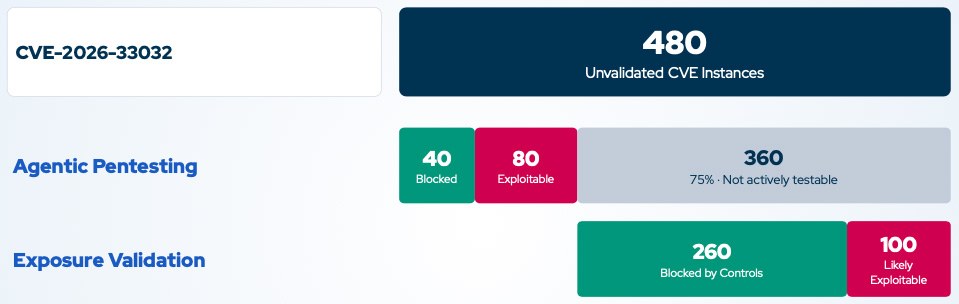
In the nginx-ui case, exploitability validation addressed the 360 untested instances by analyzing control evidence. The result: 260 blocked by existing controls and 100 assessed as likely exploitable. Combined with agentic pentesting's 80 confirmed exploitable findings, the 480 raw scanner alerts became 180 actionable priorities with evidence backing each one. Teams immediately know which hosts are protected and which need compensating controls.
Three Methods Unified for Complete Coverage
Running agentic pentesting, exploitability validation, and breach simulation as separate tools creates fragmented findings, duplicated effort, and conflicting priorities. Effectiveness requires a single platform that feeds all three methods into one shared, context-aware findings model with unified evidence and one verdict per exposure.
When a critical CVE emerges, the workflow unfolds in stages:
- Discovery: The CVE is enriched with threat intelligence and mapped to attacker techniques. Affected assets, their business importance, and active controls are identified.
- Validation: Agentic pentesting tests in-scope assets, breach simulation validates controls, and exploitability validation assesses every affected asset.
- Mobilization: Low-risk fixes deploy automatically. Remaining work is assigned to owners, and all remediations are revalidated.
This integrated cycle completes in hours rather than weeks.
The Bottom Line
Attackers armed with Mythos-class models weaponize new CVEs within hours. Agentic pentesting is the most powerful tool for testing like a real attacker, and when paired with deterministic methods on a unified platform, testing remains both creative and repeatable. However, neither method can safely test unreachable assets or vulnerabilities without public exploits. Exploitability validation fills this gap by analyzing control evidence instead of requiring successful exploitation. Combined with breach simulation, these three capabilities deliver complete validation of every CVE on every asset in hours.