
The SSHole vulnerability in OpenSSH is under active exploitation by threat actors seeking to execute arbitrary commands, harvest credentials, and maintain long-term access to compromised systems. Security vendors tracking the campaign have documented attack activity beginning November 5, coinciding with the public availability of working exploit code, and confirmed successful breaches occurring the following day.
Security researcher Ozgun Kultekin disclosed the flaw last week. SSHole affects OpenSSH deployments on musl-based Linux distributions, particularly Alpine, which is widely deployed in containerized and cloud environments. The vulnerability permits authentication bypass on accounts where the password hash field contains an asterisk (*), a configuration intended to block password-based login attempts.

The underlying mechanism exploits a behavior in musl's password-hashing function. When an attacker submits an oversized password, the function returns an asterisk on error, which OpenSSH incorrectly interprets as matching the account's stored credential value. Kultekin noted that successful exploitation depends on specific authentication configurations and does not compromise accounts with legitimate password hashes. Systems where the affected account possesses passwordless sudo privileges face the risk of root-level compromise.
The OpenSSH project released version 10.6p2 on November 5 to address the flaw. Exploit code emerged approximately four hours after the patch became available.
Observed attack activity
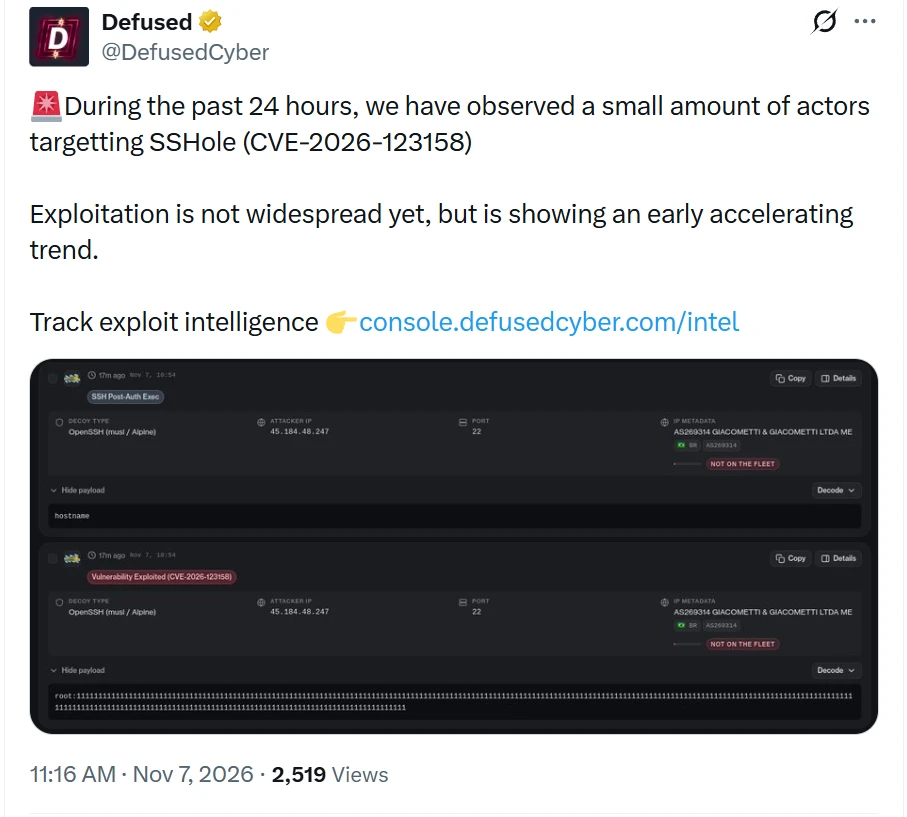
Finnish security firm Defused reported detecting a limited number of threat actors attempting to exploit SSHole over the weekend, though the overall volume remained contained.
Threat intelligence platform GreyNoise documented the first confirmed successful exploitation in the wild on November 7 at 00:46 UTC, roughly 40 hours following the patch release. The company's sensors identified 16 successful exploitation chains originating from six distinct source IP addresses, all targeting networks monitored by GreyNoise. GreyNoise emphasized that these confirmed cases do not necessarily reflect the full scope of SSHole exploitation occurring globally.
In the intrusions GreyNoise tracked, attackers performed reconnaissance of system and container configurations, queried cloud metadata endpoints, attempted to extract password hashes and root-level SSH keys, and modified SSH authorized_keys files to establish persistent access mechanisms.
One attacker successfully escalated to root privileges and deployed TAC Agent, a Python-based command-and-control implant. The implant attempted to reach its C2 infrastructure at tac.vpnla[.]org but failed to establish connectivity and never received operational instructions.
Examination of the TAC Agent payload revealed capabilities including shell command execution, comprehensive system reconnaissance, bidirectional file transfer, and self-update functionality. The implant lacks built-in persistence mechanisms, requiring attackers to manually configure startup services to maintain access. Notably, the implant's source code contained comments, logging statements, and error messages in Chinese, potentially indicating the attacker's geographic origin or operational context.
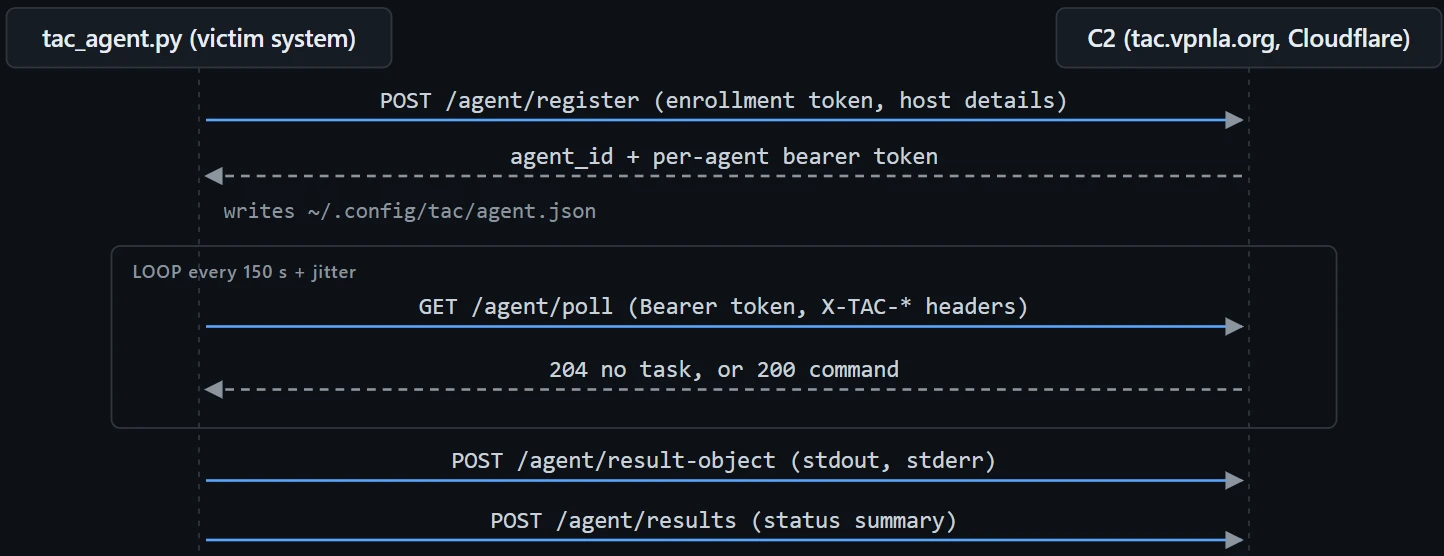
A design feature suggesting possible automated attack orchestration is the implant's tool verification routine, which returns status information that could enable an automated attack planner to adapt subsequent commands based on system conditions.
GreyNoise's broader telemetry captured 27.5 million scans targeting port 22 and 20.1 million attempted SSH sessions, though these figures do not represent confirmed SSHole exploitation attempts.
Network security vendor Previdian's sensors independently confirmed successful SSHole exploitation, detecting 20 attack attempts from 13 attacker IP addresses distributed across nine countries.
Offensive security company watchTower reported on November 6 that SSHole exploitation appears in campaigns linked to botnet operations and cryptocurrency mining activities.
Mitigation and detection guidance
System administrators should prioritize updating OpenSSH immediately or, as an interim measure, disable SSH password authentication on systems vulnerable to SSHole.
Organizations should audit systems for indicators of compromise, including unexpected successful password authentications to accounts with an asterisk in the /etc/shadow password field, unauthorized SSH public keys in user accounts, and the presence of TAC Agent files or associated startup service configurations.