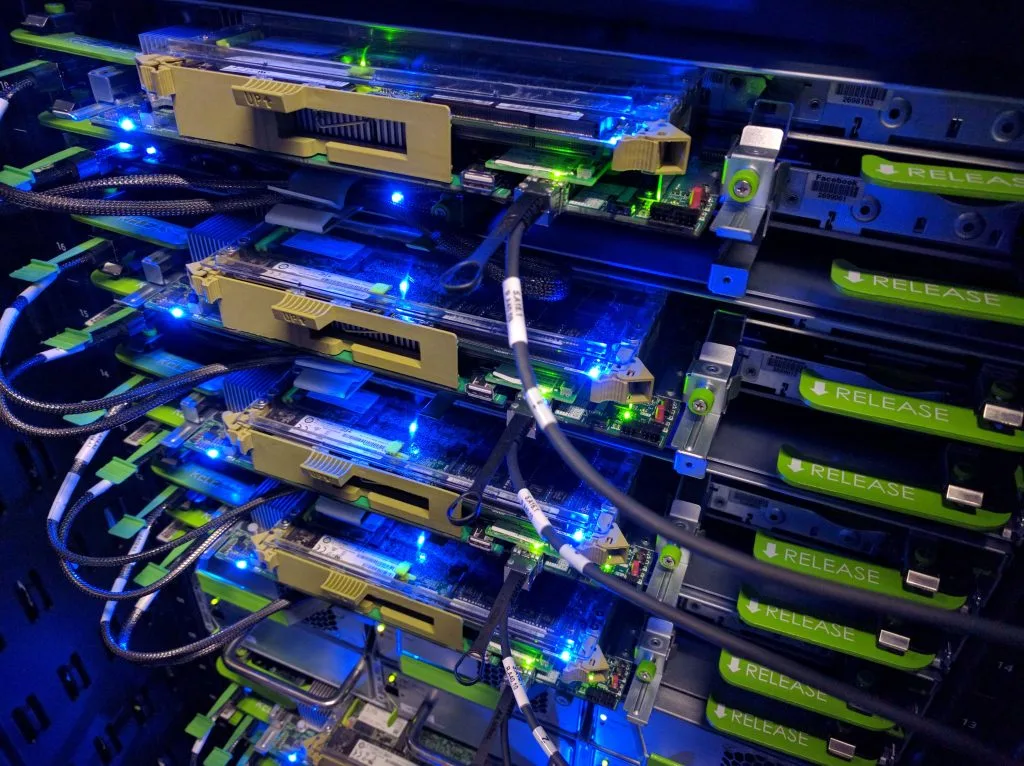
Nvidia unveiled DSX POD at its GTC Berlin conference, a containerized reference architecture designed to accelerate AI infrastructure deployment. The system arrives at customer sites fully assembled with Vera Rubin racks, networking, and liquid cooling already integrated, bypassing the lengthy on-site installation and configuration that typically delays data center operations.
Conventional data center rack deployment can stretch across months, according to Nvidia. By contrast, a DSX POD unit can become operational within 14 days of arrival, provided the facility already has adequate power delivery, cooling infrastructure, and network connectivity in place. Jensen Huang, Nvidia's founder and CEO, framed the value proposition this way: "An AI factory creates value when it starts producing tokens — not when construction is complete."
Container specifications
Each DSX POD container accommodates seven Vera Rubin NVL72 racks, totaling 504 Rubin GPUs. According to Ian Buck, Nvidia's vice president of hyperscale and high-performance computing, a single unit incorporates approximately 10 million components and weighs around 28 metric tons. The containers ship with roughly 20 kilometers of copper cabling and 17 kilometers of scale-out networking already installed and validated. Upon arrival at a data center, installation crews position the container, establish connections between units, and execute final burn-in testing.
Water efficiency through dry cooling
Nvidia engineered the DSX POD to eliminate water consumption for thermal management. Vera Rubin processors can operate with coolant temperatures reaching 45 degrees Celsius, enabling dry coolers—which function similarly to automotive radiators—to replace the evaporative cooling towers still prevalent in many data center facilities. Nvidia estimates that for a 2-gigawatt deployment, dry cooling technology can conserve approximately 54 million liters of water daily compared with traditional cooling tower systems. Buck acknowledged that operators in certain climates may require chiller units during peak temperature conditions.
Containerized data centers: context and precedent
Shipping container-based infrastructure has appeared in the technology industry before. Sun Microsystems introduced Project Blackbox in 2006, a 20-foot containerized data center concept. AWS showcased Snowmobile at re:Invent 2016—a 45-foot container capable of transporting 100 petabytes of data—which then-CEO Andy Jassy drove onto the keynote stage. Microsoft and AWS have subsequently deployed containerized data centers for disaster recovery and military applications.
The DSX POD differs fundamentally from these earlier initiatives. Rather than functioning as standalone, self-contained data centers, DSX POD units serve as modular building blocks that integrate into existing data center infrastructure. Buck characterized them as foundational components for constructing new AI factories.
Manufacturing and rollout
Seventeen partners are manufacturing DSX POD systems, including Armada, Bull, Dell, HPE, Schneider Electric, and Vertiv. Armada already operates in the containerized edge data center market. Nvidia projects that partner deliveries of DSX POD systems will commence globally in early 2027.