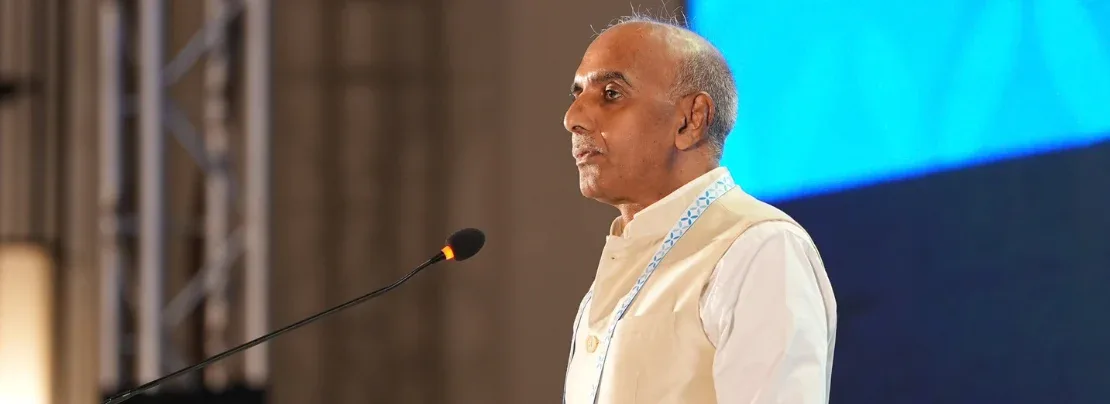
The INNOG 9 gathering at APNIC 62 convened operators, infrastructure providers, security specialists, and policymakers to tackle a pressing question: preparing networks for a landscape reshaped by artificial intelligence, cloud infrastructure expansion, mounting security requirements, and deepening reliance on digital connectivity.
Held alongside APNIC 62, INNOG 9 centered on operational realities, drawing on experiences from India and Bangladesh. Presentations spanned IPv6 rollout, submarine cable systems, enterprise security defenses, and recovery strategies following Internet outages.
IPv6 as foundational infrastructure, not an afterthought
Dr Devesh Tyagi, Chief Executive Officer at NIXI, contended that as AI, Internet of Things, edge computing, and machine-to-machine communications expand, network operators must rethink IPv6's role. Rather than treating it merely as a remedy for IPv4 depletion, operators should embed IPv6 into infrastructure planning from inception.
With AI workloads becoming increasingly distributed and edge computing proliferating, networks, data centres, applications, and security layers require IPv6-native design. Dr Tyagi also outlined NIXI's efforts in expanding Internet exchange capacity, accelerating IPv6 uptake, and deploying routing security mechanisms including Resource Public Key Infrastructure (RPKI), Route Origin Authorizations (ROAs), and Autonomous System Path Authorizations (ASPAs).
Hidden dependencies emerge when submarine cables fail
Sumon Ahmed Sabir, Chief Information Officer at Fibre@Home and APNIC Executive Council member, examined Bangladesh's experience during significant Internet shutdowns in 2024. When international connectivity severed while domestic networks remained intact, critical services collapsed—not from network unavailability, but from reliance on external systems operators had overlooked.
Sabir identified vulnerable dependencies: Domain Name System (DNS) resolvers positioned outside the economy, cloud-hosted application modules, remote Application Programming Interfaces (APIs), time synchronization infrastructure, and mobile payment systems. He advocated for operators to map these dependencies and establish local redundancy where feasible.
Practical steps included deploying local DNS resolvers, caching critical services locally, reinforcing domestic DNS capacity, and preparing contingency plans for extended submarine cable disruptions.
Security posture demands people, process and technology alignment
Abhijit Chakravarty, Executive Vice President – Networks and Cybersecurity at Kotak Mahindra Bank, examined how organizations construct unified security across sprawling infrastructures. Resilience stems equally from people and processes as from technology itself.
Chakravarty urged moving beyond passive security data collection toward generating intelligence that drives action. He stressed Zero Trust frameworks, particularly the mindset of assuming compromise rather than assuming defense remains intact.
His remarks highlighted expanding roles for behavioral analytics, identity safeguards, AI-powered threat identification, and comprehensive visibility spanning enterprise systems.
Network reputation damage extends far beyond email spam
Samarjit Biswas, Vice President Global Emerging CyberSecurity Technologies — Telecom at XELE Labs, examined how spam, abuse, and compromised customer devices degrade network standing and service reliability. IP deny lists and reputation systems can cascade consequences across operators, public agencies, and corporate networks.
Compromised endpoints, credential-stuffing campaigns, malware activity, and misconfigured mail systems trigger IP blacklisting. Once listed, customers face service blocks, connectivity degradation, and mounting support demands.
Biswas emphasized abuse tracking, reverse DNS hygiene, traffic filtering, and user awareness as essential countermeasures.
Submarine cable concentration poses India resilience questions
Ashutosh Zutshi, Senior Vice President at NEC India, noted that submarine cables transport the vast majority of cross-border Internet traffic, making them critical infrastructure. India's expanding data centre sector will reshape submarine cable deployment patterns and landing site selection.
Currently, much of India's international connectivity funnels through a limited set of landing points in Mumbai and Chennai, reflecting present data centre concentration. Growth ahead is projected to diversify landing locations and strengthen overall system resilience.
Zutshi also stressed submarine cable protection and repair capability improvements as cable capacities continue climbing.
AI workloads reshape network optimization priorities
Harsha Ram, Business Head – Network Services at Sify Technologies Limited, closed the session by examining how AI is remaking infrastructure demand. Operators are transitioning from optimizing for content delivery toward optimizing for intelligence processing.
AI workloads impose novel requirements: latency guarantees, bandwidth provisioning, data centre architecture, fibre deployment, and submarine connectivity patterns. Data centres must accommodate increasingly dense Graphics Processing Unit (GPU) clusters. Networks, conversely, must push inference computation toward end users and handle vastly larger traffic volumes between AI hubs.
Ram also addressed sovereign AI infrastructure, as economies seek to retain control over data, models, and AI systems within national boundaries.
Regional collaboration strengthens operational knowledge
Pairing INNOG 9 with APNIC 62 assembled viewpoints from across the region, enabling operators to exchange operational insights, compare strategies, and address shared challenges in infrastructure evolution.
The session underscored the range of pressures confronting network operators as Internet systems advance. Conversations spanned hands-on deployment experience and security operations through economy-scale infrastructure strategy and AI-driven network expansion.