
Two major players in the AI infrastructure space announced a partnership on Monday designed to enhance inference performance and dependability for developers building with language models. Under the arrangement, Hugging Face will leverage OpenRouter's infrastructure to distribute requests across third-party model providers, selecting endpoints based on cost, latency and uptime metrics.
Hugging Face previously operated its own routing mechanism, which debuted as part of the Inference Providers service in January 2025 alongside four initial partners: Fal, Replicate, SambaNova and Together AI. That system would direct each request to a single provider, but if that provider experienced issues, the request would fail entirely. By incorporating OpenRouter, failed requests can now be automatically rerouted to alternative providers, reducing the likelihood that developers encounter errors.
Clément Delangue, Hugging Face's co-founder and chief executive, framed the collaboration as evidence that open-source advancement thrives through partnership rather than competitive isolation. "Too many people treat AI as a zero-sum race," Delangue wrote on LinkedIn. "Open-source is winning by doing the opposite: collaboration over competition!" He added, "Hugging Face for storage and collaboration. OpenRouter for inference."
Stripe, Nvidia and the bigger picture
The partnership announcement arrives just days after Stripe finalized its acquisition of OpenRouter, a transaction initially disclosed in August with a reported valuation exceeding $7 billion. Simultaneously, Hugging Face itself is undergoing acquisition by Nvidia, the AI chip manufacturer, in a deal valued at approximately $13 billion. Nvidia's leadership has faced recent turmoil, with former CEO Jensen Huang stepping down last week following a controversy.
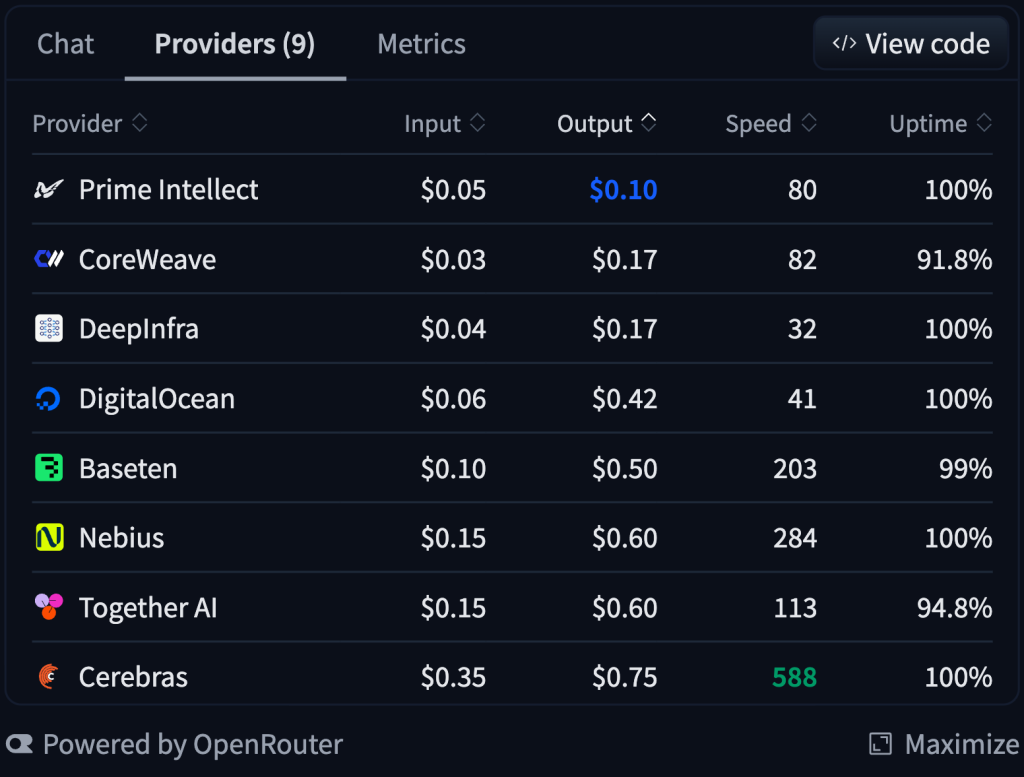
The OpenRouter integration launched immediately, initially supporting 160 models from 38 AI research organizations. For Hugging Face, this arrangement eliminates the burden of maintaining proprietary routing infrastructure while expanding developer access to reliable model endpoints. Users can continue interacting with models directly on Hugging Face's model pages, with new interface options enabling them to evaluate providers by pricing, response speed and availability, plus review performance data to inform their selection.
The connection operates bidirectionally as well. OpenRouter users now have the ability to export their inference request logs to Hugging Face Storage Buckets, where they can analyze prompts and outputs, construct evaluation datasets and prepare models for fine-tuning work.
From a strategic angle, OpenRouter gains direct access to Hugging Face's vast developer base, potentially channeling additional inference workloads—and corresponding revenue—to its parent company Stripe. Hugging Face has indicated plans to enable developers to connect their OpenRouter credentials directly within Hugging Face, and to broaden the integration to encompass additional AI tasks, though no timeline has been specified.
Sasha Blumenfeld, OpenRouter's director of product marketing, described the partnership as an extension of the company's founding objective to streamline model access. "We built OpenRouter so developers can reach many models and providers through one API, use the best model for each task, and count on it to respond," Blumenfeld stated. "Starting today, that extends to everyone building on Hugging Face."
How OpenRouter chooses providers
The integration builds upon a significant routing system redesign that OpenRouter unveiled in October, which shifted the decision-making process for directing requests to providers. Rather than prioritizing advertised rates, the updated system continuously evaluates actual provider performance, factoring in response latency, pricing and accessibility before routing each request. Should a provider face capacity constraints or become unresponsive, OpenRouter automatically redirects traffic and retries failed requests through alternative providers.
OpenRouter reported that its October routing improvements achieved a 46% reduction in capacity-related failures, cut latency for the initial generated token by 16.9%, and boosted token generation throughput by 16.3% in testing. The tradeoff involved a 6% increase in average per-request costs, though these metrics specifically reflect OpenRouter's October routing overhaul.
Developers on Hugging Face now have the option to optimize for lower expenses or faster performance, or to allow OpenRouter to make the determination automatically. The interface displays available providers for each model alongside their respective pricing, speed and recent uptime records, enabling developers to compare alternatives before submitting a request.
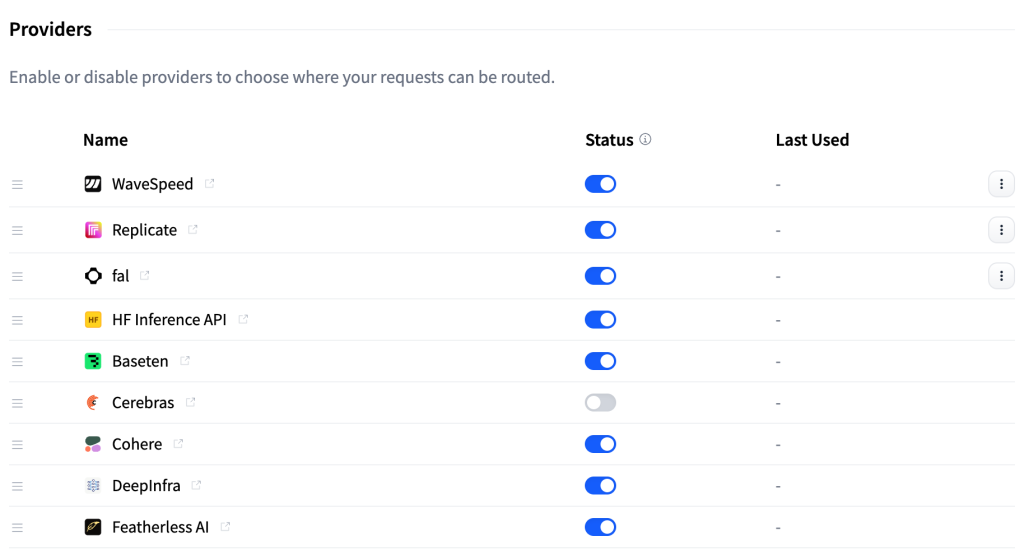
Developers retain the ability to exclude specific providers through their account settings, preventing requests from reaching those organizations. Team administrators can enforce identical restrictions across all requests charged to their organization.
A significant limitation exists: developers can no longer supply their own API credentials from third-party providers for language model requests routed through Hugging Face. All such requests must be billed through Hugging Face directly, though developers retain the freedom to specify which providers they prefer. Hugging Face maintains that it will pass through provider costs without applying any additional markup.
The integration currently applies exclusively to language models. Image, video and audio generation continue to operate through Hugging Face's existing infrastructure.
The rise of open-weights
This partnership emerges against the backdrop of accelerating adoption of open-weight models as economically viable alternatives to proprietary systems from major frontier AI laboratories. The New Stack reported in September that open-weight models represented 60% of OpenRouter's US token consumption in August, with models developed in China driving the majority of that volume.
That same month, open-weight models achieved another milestone by processing a majority of tokens on Vercel's AI Gateway for the first time, capturing 56% in August compared to just 7% in December 2025. Despite this token dominance, they accounted for only 14% of estimated spending, while Anthropic alone represented 64%.
The momentum has intensified further. OpenRouter's September analysis showed that open-weight models processed 71.7% of tokens among its 50 most-used models by month's end, rising from 26.8% one year prior. Weekly token consumption for open-weight models expanded more than sixtyfold during that period.
Vercel's October AI Gateway report documented a parallel trend, with open-weight models accounting for 71.5% of tokens in September. Their share of estimated spending also increased to 23%, though proprietary models continued to capture the majority of financial activity on the platform.
In its Monday announcement, Hugging Face contended that developers frequently do not require the most advanced AI models, particularly when less expensive alternatives adequately address their specific requirements. The company noted that open-weight models typically cost approximately four times less than proprietary equivalents. "The best open-weight models still trail the best proprietary ones on the hardest benchmarks," Hugging Face wrote. "For a lot of workloads, that trade-off is worth it."
For both Hugging Face and OpenRouter, the expanding demand for open-weight models presents a commercial opportunity to capture a growing segment of the market, with developers able to select among competing providers based on expense and performance characteristics.