Two decades have passed since Jeff Barr's blog post introduced Amazon EC2 as a beta service. The original offering was deliberately constrained: hourly billing, a single instance type called m1.small, and availability only in the US East region running resizable Linux virtual servers. Despite its minimalism, the service fundamentally reshaped how organizations approach computing infrastructure.
AWS marked EC2's 15th anniversary in 2021 with a retrospective covering key milestones. Over the subsequent five years, the company has pursued an aggressive expansion into custom silicon for general-purpose workloads and artificial intelligence, alongside new form factors and deployment architectures that would have seemed implausible to 2006-era customers.
Two decades of foundational services
The 15th anniversary post identified critical EC2 milestones that remain central to customer deployments today. Amazon Elastic Block Store arrived in 2008 to provide persistent block storage. The following year brought three complementary services: Elastic Load Balancing and Auto Scaling for application resilience and elasticity, plus Amazon CloudWatch for observability. Amazon Virtual Private Cloud (2009) introduced network isolation. The AWS Nitro System (2017) accelerated innovation cycles and strengthened security posture. AWS Graviton processors (2018) targeted cost-optimized, horizontally scaled workloads.
Instance diversity has expanded dramatically across two decades. EC2 now offers more than 1,200 instance types spanning general-purpose, compute-optimized, memory-optimized, storage-optimized, accelerated computing, and high-performance computing families. Geographic reach has grown from one region to 39 globally. AWS extended EC2 beyond traditional regions through AWS Outposts (2018) for on-premises instances, AWS Local Zones (2019) for edge placement, and AWS Wavelength (2019) for integration into 5G carrier networks.
Notable launches from the past five years
AWS Inferentia for machine learning inference
AWS introduced purpose-built ML inference instances (inf1) with AWS Inferentia chips in 2019. Amazon EC2 Inf2 instances reached general availability in April 2023 for large-scale generative AI inference. The Inferentia family now pairs with AWS Trainium instances to deliver AWS-designed silicon covering the complete AI lifecycle from inference through training.
EC2 Mac instances for Apple development
Mac instances debuted in 2020 with mac1, built on Apple Mac mini hardware featuring Intel Core i7 (Coffee Lake) processors running on the AWS Nitro System. Mac M1 (mac2) instances launched in July 2022 as the first Arm-based macOS instances on EC2. Subsequent releases expanded the lineup: M2 Pro Mac instances in 2023, M4 and M4 Pro Mac instances in 2025, and M3 Ultra Mac instances plus M4 Max Mac instances in 2026. This progression provides Apple developers with cloud-based build and test environments for macOS, iOS, iPadOS, tvOS, watchOS, and visionOS applications.
AWS Trainium for AI training at scale
AWS previewed Trn1 instances with AWS Trainium accelerators in November 2021, optimized for high-performance deep learning training. Trn2 instances powered by AWS Trainium2 launched in December 2024, with Trn2 UltraServers linking 64 Trainium2 accelerators via NeuronLink for trillion-parameter foundation model training. At AWS re:Invent 2025, Trn3 UltraServers powered by AWS Trainium3 emerged for next-generation agentic, reasoning, and video generation applications. A single Trn3 UltraServer interconnects up to 144 Trainium3 chips to train and serve the largest frontier models. AWS Trainium3 now delivers leading price-performance for high-performance AI training and inference at scale.
EC2 Capacity Blocks for ML
Introduced in 2023, EC2 Capacity Blocks for ML democratizes access to GPU instances for ML and generative AI model training and deployment. Users reserve GPU capacity for a future date for only the duration required. In November 2024, the service added support for provisioning in minutes with extensions up to six months. EC2 Capacity Blocks for ML now supports P6-B300, P6-B200, P5e, P5en, P4d, P4de, Trn1, Trn2, and Trn3 instances alongside the original P5.
AWS Graviton5 processors
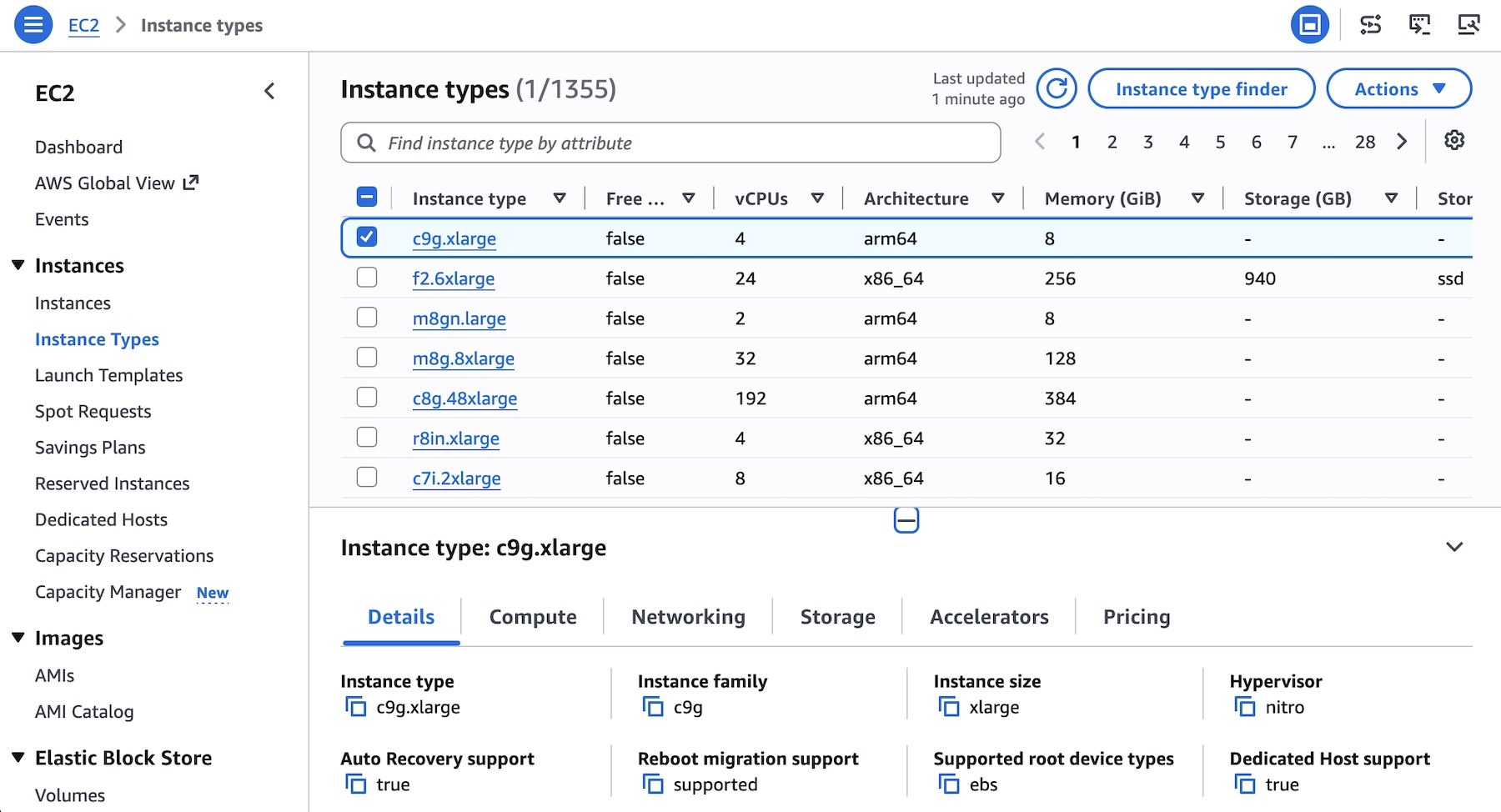
Building on eight years of Graviton development since 2018, AWS previewed Graviton5 chips at AWS re:Invent 2025 and launched M9g and M9gd instances powered by Graviton5 on the sixth-generation AWS Nitro System. C9g and C9gd instances followed in June 2026. Graviton5 features 192 cores, a 5x larger cache, and up to 33% lower inter-core latency, positioning it for agentic AI workloads including real-time reasoning, code generation, and multi-step task orchestration requiring sustained high-throughput CPU compute at scale.
AWS Nitro Isolation Engine
Launched in 2026, the AWS Nitro Isolation Engine represents a purpose-built component within the Nitro Hypervisor employing formal verification to provide mathematical assurance of workload isolation between customers and from AWS operators. This advancement establishes a new standard for mathematically proven cloud security. The feature builds on the sixth-generation AWS Nitro System, which has continued evolving since its 2017 introduction.
The enduring value proposition
Despite twenty years of evolution, EC2's fundamental value proposition has remained constant. Customers provision secure, resizable compute capacity within minutes, pay exclusively for consumed resources, and scale on demand without long-term contractual obligations. This flexibility now extends to AI workloads at scales unimaginable in 2006.
EC2 functions as the foundational compute layer for AWS. Services including Amazon ECS, Amazon EKS, AWS Lambda, AWS Fargate, AWS Batch, Amazon EMR, Amazon SageMaker AI, and Amazon Bedrock ultimately execute on EC2 capacity. Every architectural pattern developed over twenty years—from basic web servers to trillion-parameter foundation model training clusters—begins with an instance launch decision.
AWS made deliberate foundational choices in 2006 and designed the service with room for expansion. Two decades later, the strategy of building minimal-yet-useful services, launching rapidly, and iterating based on customer feedback continues to guide development. The coming twenty years will demand capabilities not yet conceived, and EC2 will remain the foundation supporting customer workloads.