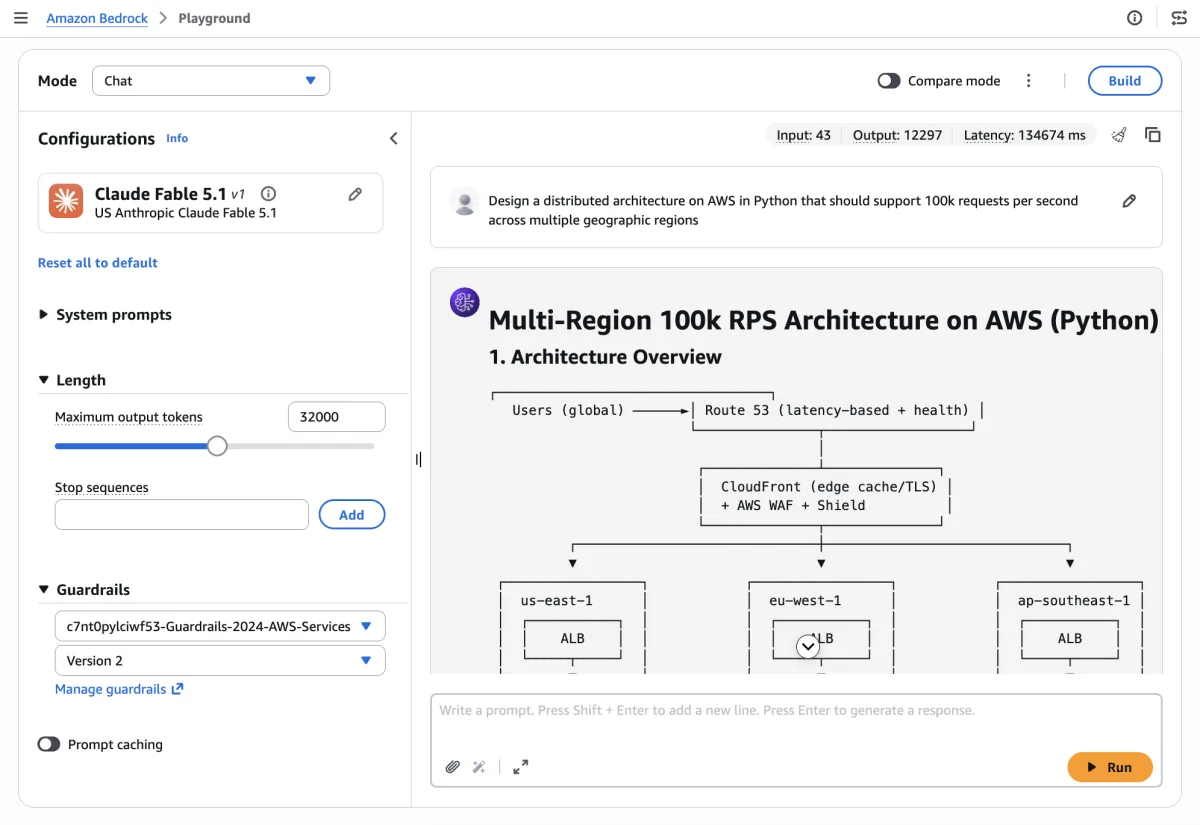
Claude Fable 5.1 launched on AWS last week, marking the availability of Anthropic's latest large language model on the platform. The model is engineered to handle demanding workloads spanning software development, scientific inquiry, and business applications. Its architecture supports extended sessions that can persist for hours across multiple systems, enabling it to manage larger portions of codebases independently while performing code reviews and optimization tasks.
Anthropic has classified Fable 5.1 as a Covered Model, a designation that imposes stricter governance around data handling and safety protocols. Under this classification, AWS retains user prompts and model outputs for up to 30 days to enable human safety review by Amazon staff through the new aws_review data retention mode. The legacy provider_data_share mode remains available, though Amazon Bedrock does not transmit customer data to external model providers under this setting. Enterprise Frontier Safeguards (EFS), developed jointly by AWS and Anthropic, enables qualifying organizations to deploy Covered Models while maintaining data residency within their own cloud infrastructure.
Users can access Claude Fable 5.1 through two channels: Amazon Bedrock and Claude Platform on AWS. Additional technical details are available in the Claude Fable 5.1 model card documentation.
Recent AWS Service Launches
- Amazon Linux 2027 (AL2027) entered public preview as the successor to the Amazon Linux distribution. Built on AL2023 foundations and running kernel 7.1+, the operating system targets cloud-native deployments requiring robust performance, scalability, and security. AL2027 addresses use cases including web application hosting, database systems, containerized microservices, artificial intelligence and machine learning workloads, and large-scale distributed infrastructure.
- Amazon EC2 R9g and R9gd memory-optimized instances leverage AWS Graviton5 processors to optimize price-to-performance ratios for memory-bound applications. Compared to their Graviton4-powered R8g and R8gd predecessors, the new instances deliver 25% higher compute throughput, 30% faster database performance, 35% faster web application execution, and 35% faster machine learning operations.
- AWS Lambda SnapStart now supports container image functions, expanding beyond its previous limitation to managed runtimes including Python, .NET, and Java. The capability reduces application startup latency from several seconds to potentially sub-second performance, benefiting use cases such as machine learning inference and real-time API endpoints.
- AWS Agent Registry achieved general availability, offering organizations a private, controlled repository for discovering and managing agents, tools, skills, MCP servers, and proprietary resources. Beyond the preview features of manual and URL-based registration, approval workflows, semantic and keyword search capabilities, and CloudTrail audit logging, the general availability release introduces additional enterprise-grade functionality.
- Amazon Redshift extended compatibility to Apache Iceberg v3 tables, enabling read and write operations against data lake tables. The integration introduces support for default column values, row-level lineage tracking, and deletion vectors. Both Graviton-based provisioned and serverless Redshift clusters support the v3 format.
Additional AWS Developments
- AWS secured its 16th consecutive Leader designation in the 2026 Gartner Magic Quadrant for Strategic Cloud Platform Services, maintaining the highest ranking on the Ability to Execute dimension. AWS attributes this recognition to its comprehensive portfolio spanning infrastructure, artificial intelligence, security, and operational tooling.
- The AWS Certified AI Business Strategist credential targets organizational roles responsible for evaluating, promoting, and scaling AI adoption, including business unit executives, sales teams, management consultants, and program management professionals. Beta exam registration commenced September 1, 2026, with formal exam administration beginning September 29.
- AWS collaborated with the SANS Institute to contribute a chapter to the 2026 Cloud Security Exchange eBook focused on agentic security detection and response. The contribution provides architectural guidance, deployment patterns, and maturity frameworks for securing autonomous AI systems across evaluation, pilot, and production phases.