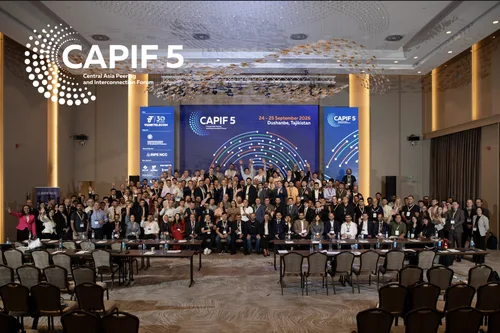
Central Asia's network operators gathered in Dushanbe, Tajikistan on 24–25 September 2026 for the fifth Central Asia Peering and Interconnection Forum (CAPIF 5), the first edition held in the country. The event, organised with support from the Communications Service of the Republic of Tajikistan and national operator Tojiktelecom, drew 229 attendees representing 23 nations. Discussions centred on reducing reliance on external routing, building redundancy and establishing more direct interconnections within the region.
Keeping traffic within the region
A recurring theme across CAPIF meetings has been the push to route regional traffic locally rather than sending it outside Central Asia. Operators have worked to establish additional peering relationships, optimise traffic paths and introduce failover capacity to maintain connectivity during link outages. Ahead of CAPIF 5, a regional report documented measurable progress: more direct routes between neighbouring countries and fewer circuitous paths through distant networks. However, improved routing diversity has not always translated into more efficient traffic flows.
Speakers at CAPIF 5 examined this progress from multiple angles, including presentations from Bakhtovar Abdusattorzoda of Tojiktelecom on keeping Central Asian traffic local, Oleksiy Semenyaka of the RIPE NCC on interconnectivity trends across 2022, 2024 and 2026, and Paulius Vaina on regional connectivity initiatives.
Internet exchange points expand rapidly
Early CAPIF discussions focused on foundational questions about Internet exchange points—their purpose and implementation. By CAPIF 5, the conversation had matured to address growth metrics, CDN server localisation and distributed peering models. The number of IXPs across the region jumped from a handful in 2022 to 22 across four countries by 2026. Many of these exchanges were established through government-led programmes, including KazIX, UZ-IX and TJ-IX.
While government investment in IXP infrastructure has accelerated ecosystem development, observers cautioned that an overemphasis on national exchange points could constrain market dynamics. IXP markets function most effectively as open, competitive environments. Sessions on peering and exchange points featured Oleg Yemelyanov discussing recent legislative changes in Kazakhstan, Robbie Mitchell of ISOC examining IXP peering costs, Anton Tarassov on IXP and IPv6 deployment, Sergey Mazurov of KG-IX on Kyrgyzstan's exchange, and Bernd Spiess and Bülent ŞEN of DE-CIX sharing lessons from 15 years operating UAE-IX.
IPv6 deployment accelerating
Central Asian countries lag behind global IPv6 adoption rates, but operators are modernising infrastructure to support the protocol as digital transformation accelerates. The region's population reached approximately 86 million in 2025 according to the World Bank, creating substantial demand for additional address space. IPv4 scarcity increasingly constrains connectivity expansion, making IPv6 transition inevitable. Dual-stack operation carries significant cost, and evidence shows IPv6-mostly and IPv6-only deployments are viable alternatives.
Presentations included Dmitriy Melnik of the RIPE NCC on IPv6-mostly deployment models, Buzurgmehr Davlatzoda on IPv6 operations, and Anastasiya Pak of the RIPE NCC updating progress on RPKI deployment and IPv6 adoption since CAPIF 4.
Routing security gains momentum
Central Asia has demonstrated substantial progress in routing security and RPKI (Resource Public Key Infrastructure) adoption. At the RIPE NCC, staff noted that spikes in RPKI uptake align closely with operator engagement timelines. Following CAPIF 4 in Almaty in 2025, Kazakhtelecom signed Route Origin Authorisations (ROAs). Tojiktelecom followed suit after Internet Measurement Day Tajikistan. Training sessions hosted by the RIPE NCC immediately before CAPIF 5 prompted additional major operators to sign ROAs, raising IPv4 ROA coverage from 40 percent to 62 percent at the event and subsequently to 74 percent.
The RIPE NCC identified further implementation of route origin validation and signing of ASPA (Autonomous System Provider Authorization) objects as next priorities. Talks on routing security included Anurag Bhatia of Hurricane Electric on ASPA for path validation, Ehsan Ghazizadeh of Sotoon Cloud on ASPA and BGP security, Milad Afshari of MTN Irancell on route persistence, and Anastasiya Pak of the RIPE NCC on RPKI and IPv6 progress.
Documenting Internet history
A panel session examined Central Asia's Internet evolution since the Soviet Union's dissolution in 1991. When five Central Asian republics became independent nations, each began constructing separate Internet infrastructure after decades of shared systems. The newly independent countries faced common obstacles: accessing global submarine cable networks from landlocked territory and, in mountainous regions, connecting dispersed communities across difficult terrain. Different nations pursued different strategies, yet encountered similar constraints.
Routing decisions and shifts in transit provider relationships over the past 20 years reflect these historical choices. Advances in agentic AI now enable new approaches to documenting and analysing this history. However, data alone cannot convey the full narrative. Network builders and operators possess knowledge of the circumstances, constraints and objectives that shaped infrastructure decisions. Recording their accounts will provide future Internet researchers with richer context for understanding how today's networks developed.
Related presentations included Jim Cowie of the Internet History Initiative on AI tools for studying Internet history, Ties de Kock of the RIPE NCC on routing history as documented in RIPE RIS data, and Dmitry Kovalenko of msk-ix on DNS resource record evolution in Eastern Europe and Central Asia.
Looking forward
CAPIF 5 featured numerous additional presentations and discussions beyond those highlighted in this report. The forum's value extends beyond formal sessions to encompass informal conversations, personal relationships and the hospitality of hosts—connections that sustain community growth. Event recordings will be made available in English, Russian and Farsi. The call for hosts for CAPIF 6 remains open, with further developments to be shared ahead of the next gathering.