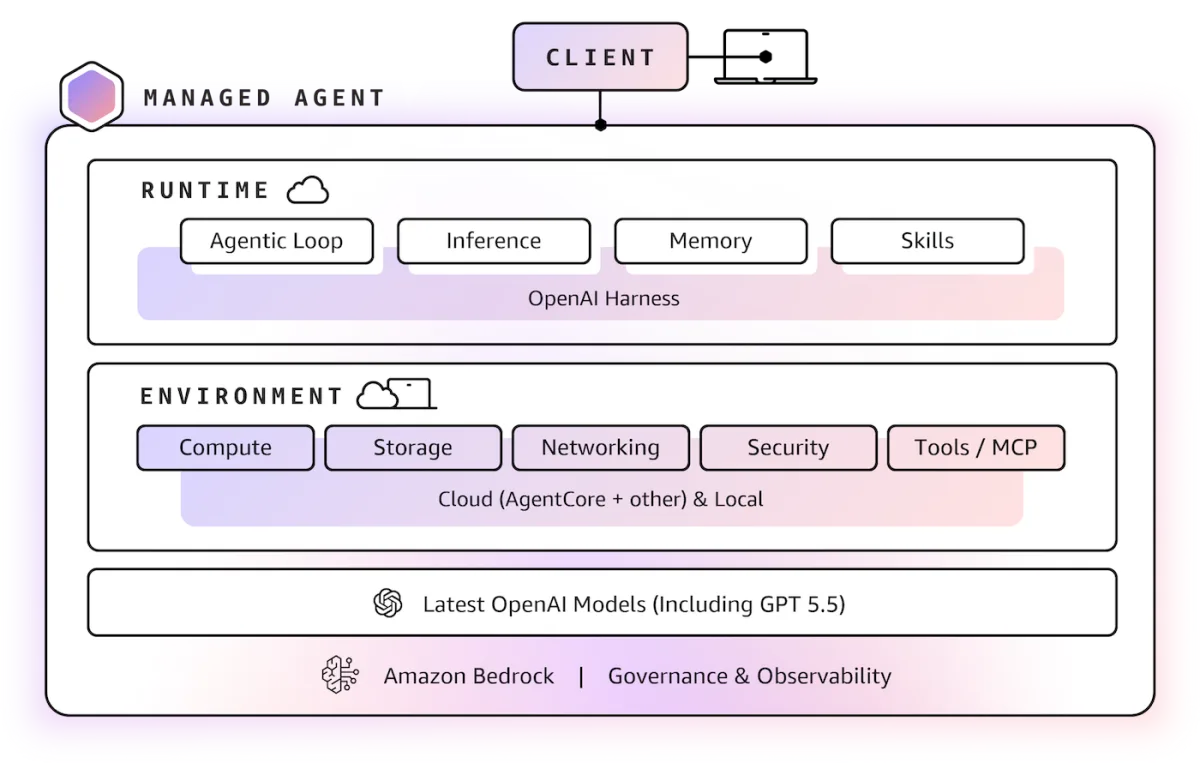
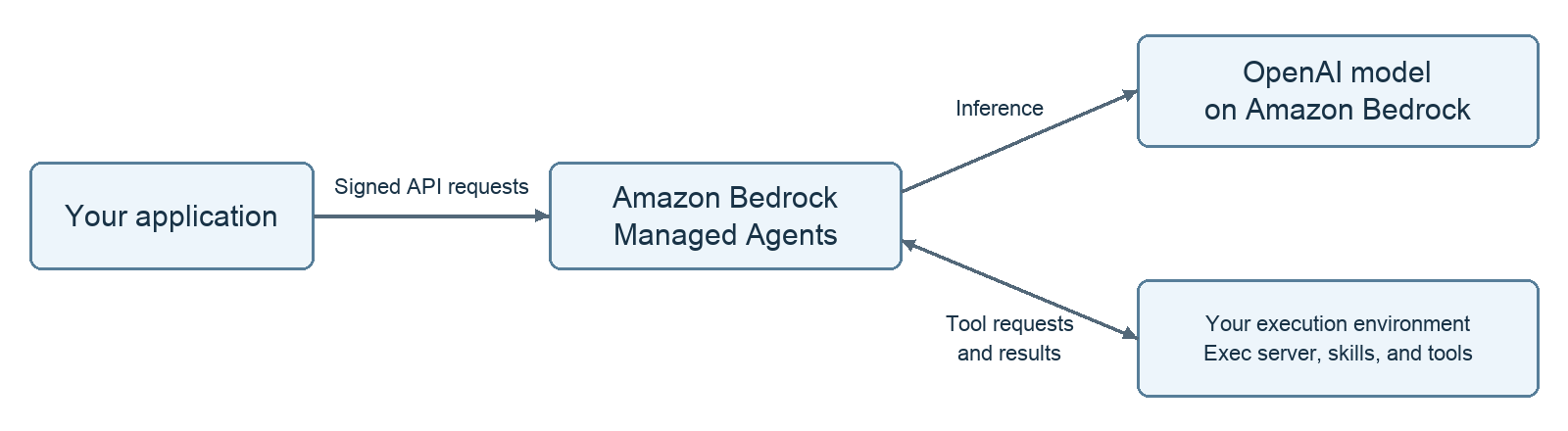
A public preview of Amazon Bedrock Managed Agents powered by OpenAI became available, built on a customized implementation of OpenAI's Agents API designed for AWS integration. These agents operate entirely within AWS infrastructure while leveraging existing identity, permission, and governance frameworks. Developers can select between self-hosted compute environments—using existing development machines, containers, or compute resources—or Amazon Bedrock AgentCore Runtime, which provides managed runtime sessions and configurable storage within AWS accounts.
New frontier models on Amazon Bedrock
AWS expanded its model catalog with four new offerings across multiple providers:
- OpenAI GPT-6.1 Sol represents an enhancement over GPT-6 Sol, delivering strong results on agentic coding, computer use, and professional tasks. According to OpenAI, it approaches GPT-6 Astra performance across demanding benchmarks at approximately one-fifth of the cost, enabling developers to deploy capable agents at greater scale.
- OpenAI GPT-6 Astra UltraFast mode is a premium speed tier designed for latency-sensitive applications. OpenAI reports up to 6x faster inference speeds through the API, reaching up to 300 tokens per second, with Amazon Bedrock's inference engine providing the performance, security, and reliability needed for production systems.
- Anthropic Claude Sonnet 5.5 offers improvements over Sonnet 5, positioning itself as a natural upgrade for teams already using Sonnet. The model demonstrates stronger capabilities for coding tasks, including feature development and fixing within single sessions, as well as output verification against specifications.
- SpaceXAI Grok 4.7 builds on Grok 4.6 with enhancements to mixed-document processing, more reliable repository-scale coding with planning and error recovery, and improved browser-use agents for form completion and portal navigation.
Recent AWS service launches
Several new capabilities rolled out across AWS services:
- AWS Well-Architected Agent (preview) provides an AI-powered service that examines AWS environments and delivers targeted recommendations for improving cost, security, performance, and resilience. The agent analyzes infrastructure and business objectives to generate contextual guidance.
- Amazon Aurora PostgreSQL now supports direct querying of Apache Iceberg and Parquet data, allowing operational data and data lake contents to be queried together using existing PostgreSQL applications and tools without requiring ETL pipelines or data duplication.
- Amazon S3 Tables added support for all Apache Iceberg V3 data types, including geometry, geography, unknown, and nanosecond timestamp types, plus column default values. Geospatial coordinates and nanosecond-precision event times can now be stored natively rather than encoded as strings or integers.
Service lifecycle changes
AWS updated its product lifecycle on September 29, 2026, with several services transitioning to maintenance status or end of support. The following services are moving to Maintenance and will no longer be accessible to new customers beginning October 29, 2026:
- Amazon Managed Blockchain (end of support September 29, 2027)
- Amazon DevOps Guru (end of support September 30, 2027)
- AWS Backint Agent for SAP ASE (end of support September 29, 2027)
- AWS Infrastructure Composer standalone console (end of support December 7, 2026)
Amazon Mechanical Turk reached end of support as of September 29, 2026. AWS recommends consulting relevant service documentation or contacting AWS Support for migration guidance and alternatives.
Additional AWS announcements
Kiro workflows enable execution of complex tasks involving multiple agents with reduced manual oversight. AWS has been using Kiro internally for cloud configuration, cloud sessions, and workflow experience development.
Strands Decider represents a new class of decision or system one models, a category that has gained prominence following TypeSafe AI's recent launch of Jev. Strands Decider 2B is a compact, open-source decision model optimized for rapid experimentation, local development, and innovation.
AWS Partners now have access to three new Forward Deployed Engineering (FDE) pathways and credentials. This follows AWS's June 30 announcement of the Forward Deployed Engineering organization, backed by a $1 billion investment, and the subsequent extension of its hands-on delivery model to partners through the Partner-Led FDE motion. The new credentials recognize the applied proficiency required to deliver production agentic AI systems.