The Internet community confronts a dual imperative as cloud and artificial intelligence reshape digital systems. Infrastructure must evolve to become faster, more intelligent, and increasingly self-managing to handle demanding workloads. Simultaneously, the organizations securing those systems must strengthen their ability to work together across jurisdictions and sectors.
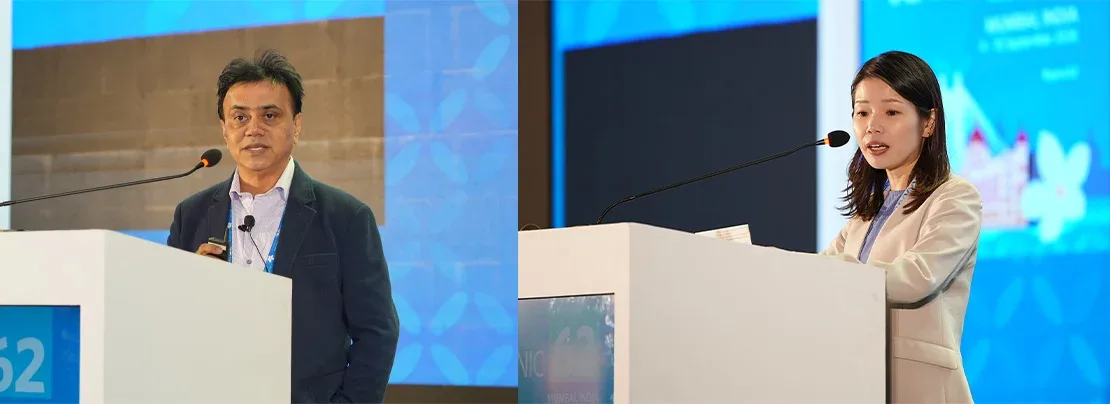
At APNIC 62, two keynote presentations tackled these interconnected challenges from different angles. Amajit Gupta, Group CEO and Managing Director of Lightstorm, examined how autonomous networks will respond to AI's demands. Yukako Uchida, Manager of the Global Coordination Division at JPCERT/CC, explored how trust and human relationships underpin effective cybersecurity collaboration. Together, their talks illustrated that Internet development's next chapter will require both technological breakthroughs and community strengthening.
Networks in the age of AI
Gupta opened the keynote session by suggesting that September 2026 could eventually be remembered as a turning point for network infrastructure evolution. He drew parallels to earlier transformative moments: the Internet's emergence in the 1990s and cloud computing's rise in the mid-2000s. Today's AI wave, he argued, represents an equally profound shift.
The sector's central constraint has shifted, according to Gupta. Compute power and bandwidth are no longer the limiting factors.
The scarce resource is not bandwidth or compute. It is latency.
Amajit Gupta
As AI workloads distribute across cloud platforms, data centers, and edge infrastructure, networks must reroute traffic, handle failures, and sustain performance within milliseconds. Conventional operational approaches, centered on manual processes and human judgment, cannot keep pace with these demands.
Gupta emphasized that while investment can expand compute resources, latency lost cannot be recovered. For AI services, financial systems, industrial operations, and other delay-sensitive applications, each millisecond carries economic weight. Using India's digital payments sector as an illustration, he showed how network delays translate directly into financial impact—a problem AI will intensify across industries.
AI is exposing network limitations
Rather than simply driving demand for greater bandwidth, Gupta contended that AI is revealing deep structural flaws in how networks are designed and operated. Research he cited shows enterprises already facing networking obstacles as they scale AI deployments. Survey participants identified workload placement as the primary challenge, followed by WAN-edge latency, traffic prioritization, and congestion control.
These results point to a fundamental shift: application performance now hinges on networks making split-second decisions independently.
The issue really is not that AI needs faster networks. AI is likely to expose the structural limitations of networks, which largely today are still operated by hand.
Amajit Gupta
For Gupta, AI is accelerating the necessity for a new operating paradigm—one capable of reacting dynamically to shifting demand and infrastructure conditions.
From networks to utility grids
To overcome these constraints, Gupta proposed that networks should function like electrical grids. Power systems continuously equilibrate supply and demand, track infrastructure condition, and automatically redirect resources to maintain stability. Internet systems should follow this trajectory, he argued.
Rather than merely delivering connectivity, networks of the future should operate as intelligent utility platforms responding dynamically to shifting conditions and application needs. Gupta termed this vision the 'autonomous grid'—fundamentally a highly automated, software-controlled setting that identifies situations, decides, and acts in real time with limited human involvement.
He outlined four essential capabilities for autonomous networking:
- Real-time telemetry
- Intent-based orchestration
- Programmable path control
- Resilient, self-correcting architectures
While these capabilities sound straightforward in theory, Gupta acknowledged that deploying them proves far more complex, especially for operators managing legacy systems, established procedures, and entrenched organizational cultures.
Beyond automation
Despite decades of industry conversation about network automation, Gupta conceded that results have been inconsistent. The vision has remained constant, yet putting it into practice remains difficult. Successful automation demands more than technology—it requires shifts in organizational design, operational workflows, and technical expertise.
Many operators still depend on engineers to spot issues, execute fixes, and confirm results. Each step consumes time, money, and effort. The autonomous grid transforms this into a self-contained cycle where networks identify situations, decide, and execute automatically within human-defined limits.
Critically, Gupta rejected the idea that automation reduces human value. Rather, it frees engineers from repetitive tasks, enabling them to concentrate on higher-impact work: system design, resilience strategy, governance, and supervision.
Gupta also outlined the business case for automation: reduced operational expense, quicker response, lower troubleshooting burden, and better customer results. Autonomous networking is thus not merely a technical goal but an operational and financial one.
Building a regional digital utility
Looking ahead, Gupta articulated a vision for Internet infrastructure spanning the Asia Pacific region. The autonomous capabilities he outlined are equally vital for managing infrastructure across regions. Returning to the electricity grid parallel, he suggested that carriers, submarine cable operators, cloud providers, and data center operators should function increasingly as components of a unified ecosystem, bound by shared standards for resilience, security, interoperability, and service assurance.
As AI and cloud services expand across borders, the region must transition from disconnected links toward a more unified and robust digital utility framework, he argued.
The best network is actually the one that you never have to manage.
Amajit Gupta
Trust as infrastructure
While Gupta addressed network infrastructure's technical evolution, Uchida examined a different pillar of Internet resilience: trust.
Drawing on more than a decade of work building international partnerships for Japan's national Computer Emergency Response Team, JPCERT/CC, she underscored the human dimension of robust cybersecurity.
CERTs serve as critical nodes in identifying, examining, and orchestrating responses to security incidents. Their work regularly involves working across organizations, sectors, and countries.
Whether exchanging confidential data, synchronizing responses to breaches, or requesting help from other entities, security professionals must believe their partners will handle information carefully, respond appropriately, and supply trustworthy intelligence.
For Uchida, trust emerges not from contracts or technical infrastructure. It develops through direct contact, ongoing engagement, and interpersonal bonds.
Trust at global scale
Though often treated as theoretical, Uchida demonstrated that trust has become a practical operational necessity for cybersecurity.
In 2025 alone, JPCERT/CC handled roughly 20,000 cybersecurity incidents, many spanning multiple nations. Over two decades, it received reports from organizations across more than 100 countries and distributed alerts to stakeholders in more than 160 countries.
These numbers reveal how interconnected modern incident handling has become. Countering cyber threats increasingly demands organizations to transmit information across national lines, synchronize efforts across industries, and establish confidence that shared intelligence will be safeguarded appropriately.
For Uchida, effective incident response depends not just on technical resources but on the caliber of connections established before an incident strikes.
The value of community
Much of Uchida's presentation centered on how communities foster and reinforce trust.
Groups like APCERT and FIRST create venues where security specialists gather, exchange insights, run drills, and cultivate bonds that later become essential during actual incidents.
These connections frequently start simply:
- A conversation between sessions
- A discussion over coffee
- A question asked during a conference presentation
Over time, these exchanges build a web of trusted contacts supporting data exchange and incident coordination.
Reflecting on her career path, Uchida described years spent traveling, joining gatherings, engaging with communities, and nurturing connections.
Trust is built by your own firsthand experience.
Yukako Uchida
Uchida stressed that trust cannot be outsourced and cannot be manufactured instantly. It accumulates gradually through repeated contact and reciprocal confidence among people and institutions.
The bonds formed between individuals frequently become the bedrock for wider institutional cooperation, particularly in complex incidents requiring fast information flow and synchronized action.
Diversity strengthens collaboration
Uchida also considered the diversity of the worldwide Internet community and the need to appreciate variations in communication approaches, professional customs, and cultural norms.
Through examples from her experience, she illustrated how minor behavioral distinctions can shape cooperation. Styles of raising concerns, joining conversations, handling schedules, and managing transactions differ markedly by culture.
Acknowledging and honoring these variations produces stronger connections and more productive teamwork. For a sector operating across national, linguistic, and cultural lines, this flexibility is vital. Uchida urged participants to capitalize on the possibilities created by gatherings like APNIC 62.
Everything you do, every engagement you make during this week is the first step in building trust relationship in this community.
Yukako Uchida
She reminded the audience that conferences serve purposes beyond talks and technical workshops. They represent occasions to establish connections that may later become vital during incident response or collaborative problem-solving.
Two sides of the same future
Though their subjects diverged, the two APNIC 62 keynotes tackled deeply intertwined problems. Gupta sketched a future where networks grow progressively autonomous, intelligent, and equipped to function at machine pace supporting AI-powered applications and digital economies. Uchida highlighted the partnerships enabling organizations to coordinate during security incidents, move information across boundaries, and tackle collective threats.
Both contended that current models cannot sustain indefinite expansion. Networks must turn more flexible and self-operating, while Internet communities must persist in strengthening the trust and bonds enabling cooperation.
One keynote centered on infrastructure increasingly capable of autonomous decision-making. The other focused on the individuals who must remain coordinated when those systems break down, face assault, or need cross-organizational synchronization.
For APNIC 62 participants, the takeaway proved unmistakable: Internet's trajectory will hinge on both intelligent systems and trustworthy communities. While automation may enable networks to operate at unprecedented scope, Internet durability will persist in depending on the relationships binding the engineers and operators behind the infrastructure.