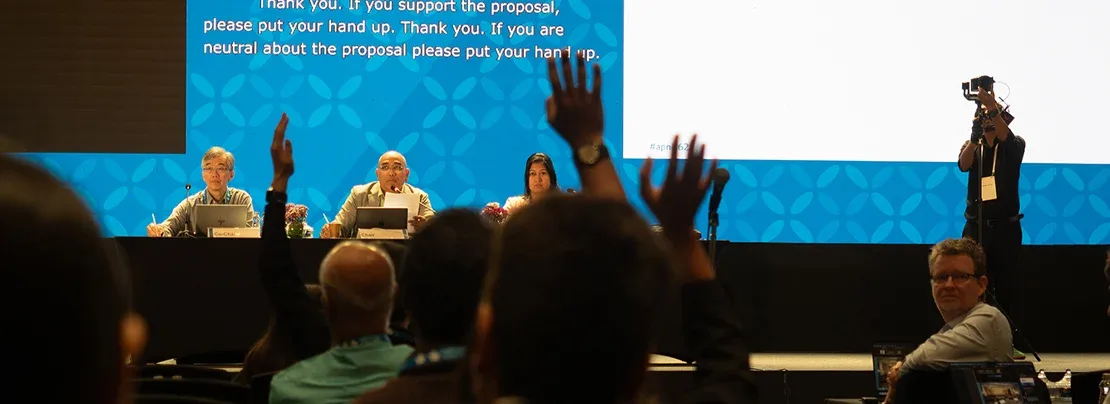
Deliberations at APNIC 62 brought together the Policy SIG to evaluate seven distinct proposals spanning two open policy meetings. Of these, two proposals secured consensus backing and will advance through the APNIC Policy Development Process. Three additional proposals were sent back to the mailing list for continued refinement, while the remaining two remained under active discussion without triggering a formal consensus determination.
Prop-164: IPv6 allocations with nibble boundary alignment
This proposal sought to expand APNIC's flexibility in assigning IPv6 resources by permitting allocations smaller than the standard /32 minimum, extending down to /40, provided they maintain nibble-boundary alignment. Backers contended that such flexibility would align assignments more precisely with actual operational needs, curtail unnecessary over-provisioning, and enable more granular tracking of delegated resources. The discussion centered on whether the need was sufficiently widespread, the implications for APNIC's operational systems, and potential effects on member decision-making processes. Despite considerable backing, unresolved concerns prevented consensus. The proposal returned to the mailing list for additional work.
Outcome: No consensus, returned to the mailing list.
Prop-165: IPv4 space for IPv6-only networks during transition
The proposal permitted organizations running IPv6-only infrastructure to obtain a modest allocation of IPv4 address space—specifically a single /24—to facilitate transitional operations. Eligible uses included DNS resolvers, mail gateways, monitoring systems, logging infrastructure, and bridging to legacy IPv4-dependent services. Advocates argued this would eliminate practical obstacles to IPv6-only deployment while preserving IPv4 conservation principles. Key implementation questions emerged around validation procedures, usage monitoring, and whether delegated space would remain restricted to transitional functions indefinitely. Because a revised version arrived shortly before the meeting and required additional review, the Policy SIG Chairs withheld a consensus determination.
Outcome: No consensus call.
Prop-168: Raising maximum IPv4 delegation limits
This proposal aimed to increase the ceiling on IPv4 allocations from APNIC's dwindling stock, raising the maximum from a /23 to a /22. It also proposed establishing a dedicated reserve pool to support emerging operators deploying transition mechanisms such as NAT64 and DNS64. Proponents noted that smaller and expanding operators maintain genuine needs for additional IPv4 resources and that higher delegation ceilings would reduce pressure on secondary markets for transfers and leasing. Opposition centered on concerns that larger allocations could accelerate depletion of APNIC's remaining IPv4 inventory. After discussion, the Chairs determined no consensus existed and returned the proposal to the mailing list for refinement.
Outcome: No consensus, returned to the mailing list.
Prop-169: Aligning IPv4 assessment language with current practice
The proposal sought to update policy language to eliminate a gap between existing text referencing justification for a /23 and actual operational procedures permitting assessment of smaller blocks. Supporters emphasized that the change would enhance clarity and synchronize policy wording with real-world practices without altering allocation principles or eligibility standards. The proposal garnered substantial support, and the Chairs determined consensus had been achieved.
Outcome: Consensus reached.
Prop-170: Optional nibble-boundary alignment for IPv6
This proposal introduced an optional pathway allowing applicants to request IPv6 allocations aligned to nibble boundaries when they could justify a legitimate operational need. Advocates pointed to tangible benefits including simplified reverse DNS administration, better network planning, enhanced automation, improved route aggregation, streamlined troubleshooting, and flexibility for future growth. The proposal did not alter minimum allocation thresholds or APNIC's needs-based review framework; rather, it offered an additional choice when operationally warranted. Although some questioned whether existing policies already provided adequate flexibility, broader sentiment favored the operational advantages. The Chairs concluded consensus existed.
Outcome: Consensus reached.
Prop-171: Abuse contact accountability in delegated address space
The proposal aimed to strengthen abuse reporting effectiveness by ensuring registered abuse contacts ultimately route reports to the organization with authority to investigate and remediate the issue. The concern addressed a real problem: abuse reports sometimes reach upstream resource holders but fail to reach downstream operators managing the affected networks. Rather than prescribing a specific solution, the proposal focused on establishing a functional reporting pathway. Participants debated responsibilities for maintaining contacts, validation approaches, operational burden, and implementation difficulty. While many endorsed the goal of better abuse handling, disagreement persisted on the policy mechanism. The proposal did not achieve consensus and returned to the mailing list for further work.
Outcome: No consensus, returned to the mailing list.
Prop-172: Defining Internet abuse in the context of IP resources
This proposal opened discussion on whether APNIC should establish a formal definition of Internet abuse as it relates to Internet number resources. The intent was to create shared understanding of abuse involving IP addresses and clarify resource holder responsibilities. The conversation touched on technical evidence standards, jurisdictional variations, the appropriate reach of policy, and the proper role of a Regional Internet Registry in abuse matters. Participants expressed willingness to continue exploring the topic, but diverged on both the definition and APNIC's policy scope. Given the exploratory character, the Chairs did not call for consensus.
Outcome: No consensus call.
What comes next
The APNIC 62 deliberations demonstrated the community's ongoing commitment to reconciling operational demands, resource stewardship, and accountability as Internet infrastructure matures. Prop-169 and prop-170 will proceed through the APNIC PDP following their consensus achievement. Three proposals—prop-168, prop-164, and prop-171—return to the mailing list for continued development. Prop-165 and prop-172 remain in exploratory discussion without a consensus determination and will continue receiving community attention. Further work on these topics is anticipated on the Policy SIG mailing list leading up to APRICOT 2027 and APNIC 63.