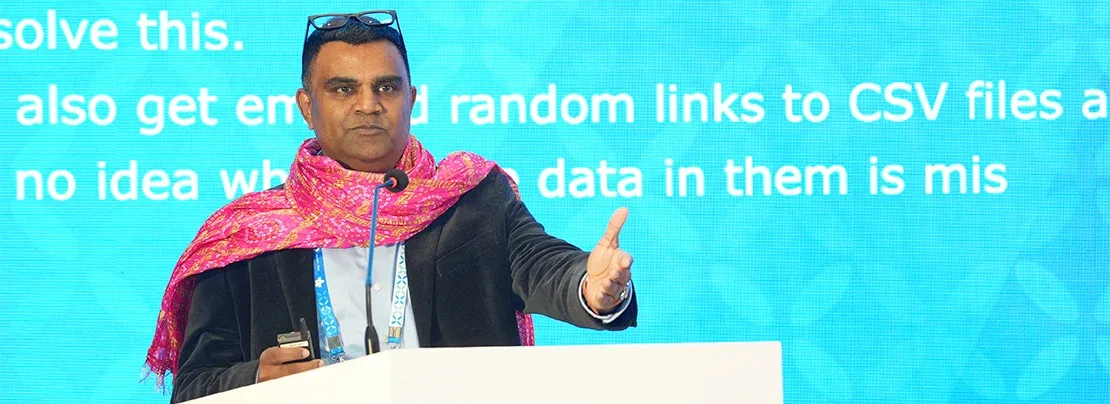
The evolution of networks to handle AI workloads is forcing operators to reconsider both the physical systems they deploy and the methods they use to manage them. During Technical Session 2 at APNIC 62, speakers examined how data centre architecture, machine learning, agentic AI, and operational automation are transforming the way networks are built and operated. The discussion spanned optical fabric design, autonomous management systems, fault prediction, and AI-assisted data quality tools, revealing both the potential and the risks of scaling networks in an AI-driven world.
Data centre topology shifts from fat tree to jellyfish
Lalit Singh Chowdhary, Chief Technology & Innovation Officer at Lightstorm Telecom Connectivity Pvt Ltd, examined the infrastructure foundations of modern data centres. The scale of switching fabrics has grown dramatically: in 2019, approximately 200 million Ethernet ports were deployed inside switching fabrics; today that number approaches one billion, with 40% operating at 400Gbps or faster. The number of active network ports now exceeds the number of babies born annually.
The traditional fat tree architecture, conceived by Charles Leiserson at MIT in 1985, increases available bandwidth as traffic moves up the switching hierarchy to prevent congestion. This design remains the basis for the spine-and-leaf model used in most data centres. Core network layers operate at a 1:1 oversubscription ratio, while edge layers tolerate some oversubscription. Data centre topology ultimately depends on three variables: the number of equal-cost paths, the latency of those paths, and the level of oversubscription compatible with five nines availability.
Lightstorm employs a three-spine, fully meshed interconnect architecture with expansion occurring at the leaf layer. Any data centre can reach another within two hops. Traffic distributes across the three spines to achieve five nines availability, roughly 26 seconds of downtime monthly. If a path fails, traffic redistributes without requiring large-scale workload migration. However, the transition from 10Gbps and 40Gbps line cards to 100Gbps and 400Gbps platforms presents cost challenges for operators accustomed to older pricing models. Simultaneously, application complexity and workload sharding make placement decisions increasingly difficult.
Chowdhary introduced an alternative: the jellyfish architecture, developed by researchers at the University of Illinois Urbana-Champaign and HP Labs. This design replaces structured tiers with a conceptually random topology lacking a visible core. It employs colourless, directionless, contentionless reconfigurable optical add-drop multiplexer (CDC-ROADM) technology and reduces path costs through wavelength switching. The wavelength-switching plane remains fully transparent, allowing any wavelength to travel in any direction without contention. When a required wavelength is already in use, the system dynamically recolours traffic. This shift responds to expectations of tenfold capacity growth. Future expansion will be constrained increasingly by power availability, requiring workloads to relocate where power exists and network capacity to follow. The architecture maintains five nines availability through a fully integrated optical interconnect operating under a single management framework.
Agentic AI and autonomous network operations
Akhilesh Thakur presented a vision for autonomous networks requiring minimal human intervention, reducing the operational burden of reactive troubleshooting. Earlier AI initiatives in network management often lacked sufficient data. Today, network operators access richer datasets spanning network elements, control and data planes, infrastructure platforms, business systems, and external information sources.
- Task automation
- Dynamic network reconfiguration
- Event correlation
- Event management
- Digital twin modelling
Thakur discussed agentic AI, which decomposes complex problems into smaller actions while maintaining context through a retrieval-augmented generation (RAG) knowledge base. The Model Context Protocol (MCP) establishes a standard interface between AI agents and operational tools. Rather than integrating directly with APIs, databases, or NetConf implementations, MCP functions as an intermediary layer. This provides agentic systems with a consistent operational view across platforms and vendors while reducing integration complexity.
Thakur demonstrated a Junos MCP implementation. Following HPE's acquisition of Juniper Networks, Junos routing and switching platforms can integrate into large-scale AI and data centre environments. Large language models such as Claude can interact with those environments through Junos MCP. MCP also supports feature introspection, enabling systems to identify available capabilities dynamically and map high-level requests into executable workflows using natural language.
One demonstration generated a network audit through a Claude conversation over MCP, including recommendations on reporting structure and analysis. Thakur emphasized the importance of strong negative prompts to reduce hallucinations. A second demonstration integrated MCP with external sources such as Cloudflare Radar and RIPEstat to support detection and investigation of BGP route hijacking. Higher-order MCP models combine information from multiple sources into single analytical workflows. For example, latency data from hosts, routers, and switches can be analysed together to identify root causes. The agent constructs a unified model using tabular datasets, joins, and integrated testing, including ping and round-trip time measurements.
Another demonstration showed agentic AI performing network reconfiguration with human oversight. Fully autonomous operation remains a future objective; current deployments maintain a human-in-the-loop approach. For Method of Procedure (MOP) generation, the LLM receives the change objective and refines it using information from the RAG knowledge base. Using a site-wide software upgrade as an example, Thakur noted that combining inference and RAG within a multi-agent framework produces MOPs that align more closely with intended outcomes while reducing unnecessary actions. Digital twin environments further support 'what if' analysis while minimizing risk to production systems.
These approaches introduce new risks, including hallucinations, credential exposure, expanded operational blast radius, and model drift. Effective governance requires current RAG data, strong auditing practices, and careful oversight. Audience discussion focused on industry caution regarding automation, the combined cost of human oversight and AI token consumption, testing methodologies, and the performance of open-source models.
Machine learning for broadband network operations
Dr Girish Saraph from Vegayan Systems Pvt. Ltd. addressed the widening gap between network growth and the resources available to small and medium-sized enterprises and Network Operations Centres (NOCs). Increasing expectations for responsiveness require operators to prioritize issues more effectively and identify potential failures before they occur.
The example network contained 10 million customer endpoints across optical network terminal (ONT) and gigabit passive optical network (GPON) infrastructure. It generated 10 million alarms, approximately 200 active issues each day, and required four to six hours on average from diagnosis to remediation. The scale exceeded the capacity of available NOC staff. Prioritization is critical because missing a major outage can trigger substantial service-level agreement penalties. Predictive and proactive insights can therefore provide significant operational value.
The ML Ops platform acts as a network expert, drawing data from either a data lake or directly from operational systems. Historical outage and fault records spanning several years train multiple specialist models, each focused on a specific problem domain. These models process live network data and generate predictive insights and prioritization recommendations.
Applied to ONT and PON environments, the platform identifies ports with a history of recurring faults. In the example presented, 7.5% of customer access ports fell into this category. The system achieved a reported 74% hit rate when predicting reviewed ports, improving customer-facing reliability. Early identification allows operators to remediate issues before customers are affected, reducing churn. The same technique was applied to GPON aggregation nodes. In the example network, 5.8% of nodes were classified as high risk, with reported predictive accuracy of 65%. Operators gained a three- to four-day prediction window and could better distinguish fibre cuts from hardware-related issues such as overheating or voltage instability. The approach reportedly improved service performance by 20%.
Given the volume of alarms generated in modern networks, the platform consolidates alarms into events, assigns severity levels, and ranks incidents according to customer impact. This allows NOC teams to focus on the highest-priority issues. Saraph emphasized that no single machine learning algorithm should be assumed to be optimal. Operators should test multiple approaches and select the model that performs best for their specific environment.
AI-assisted geofeed authoring and validation
Sid Mathur from Fastah Inc. covered geofeed publication best practices and the use of MCP-enabled AI tools to improve geofeed quality. He began with the example of a customer whose IP address appeared to be located in a different economy because of incorrect geolocation information. In many cases, content providers direct these complaints back to the customer's ISP.
Internet Service Providers publish geolocation information for IP address blocks using the format defined in RFC 8805. The format resembles a CSV file and emerged from industry and regulatory requirements to identify the location of IP address allocations. Operators associate an IP prefix with an ISO 3166 economy code, a region identifier, and a city. All fields are optional, allowing publication at economy, regional, or city level. Operators can also publish 'NONE', indicating that addresses should not be geolocated. This is particularly useful for infrastructure addresses and anycast deployments, where assigning a specific location may be misleading.
RFC 9632 defines discovery mechanisms within Regional Internet Registry frameworks, enabling geofeed consumers to locate and interpret published data. RFC 9877, currently under development, proposes representing the same information using a JSON-based Registration Data Access Protocol (RDAP) model. Mathur noted that geofeed management is an ongoing process rather than a one-time activity. Smaller ISPs may update data infrequently, while larger networks may require continual changes as allocations evolve.
Publishing geofeeds through an RIR-linked URL places responsibility for data accuracy on the address holder. Platforms such as GitHub can host the data, but external parties do not control the content. Because accurate geolocation information has privacy implications, city-level accuracy is typically sufficient and should be viewed as approximate rather than precise.
Mathur explored the use of LLMs within geofeed workflows. When provided with relevant RFC guidance and IP address management (IPAM) information, an LLM can generate compliant geofeeds and perform audits. He developed an AI skill focused on geofeed management. Demonstrations showed the tool identifying common problems in public geofeeds, including missing region information for ambiguously named cities such as Frankfurt. It can also detect excessive use of 'do not geolocate' entries and identify cases where numeric values have been used instead of ISO 3166 codes. These checks function much like a software linter. An MCP server can provide access to specialized geographic information, helping distinguish locations that share the same name. Mapping tools and scale-independent visualizations support this process. Mathur concluded by recommending the GitHub-hosted CSV publication model and demonstrated how his semantic validation tool can be integrated directly into operational workflows.
Convergence around intelligence and automation
A common theme across the presentations was the growing need for intelligence, flexibility, and automation throughout the network stack. Whether through new data centre topologies designed for massive AI-driven workloads, AI agents capable of assisting with network operations, machine learning systems that predict faults before they occur, or tools that improve the quality of operational data, the goal is increasingly the same: enabling operators to manage more complexity with greater confidence.
While challenges around cost, governance, accuracy, and trust remain, the technologies presented at APNIC 62 demonstrated how AI and advanced automation are becoming practical tools for improving network performance, resilience, and operational efficiency.