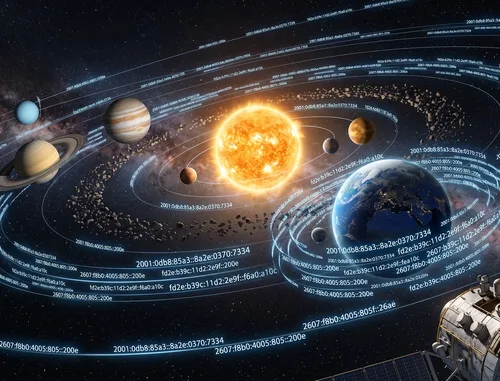
Significant portions of IPv6 address space are destined for orbital and interplanetary use, yet the policy frameworks governing such allocation remain undefined. Currently, the Regional Internet Registries are being asked to defer all such questions to their policy development processes, leaving a critical gap between technical allocation and operational governance.
The Scale of the Challenge
Consider the arithmetic of space networking. A /3 allocation, following established conventions with a /64 at the endpoint level per RFC 4291, 16 bits of subnetting for non-residential sites, and 45 bits spanning from IANA through RIRs to customer assignments, works adequately on Earth. Beyond low Earth orbit, those same 45 bits must also encode orbital position, body of reference, trajectory location and distance from a moving endpoint traveling at tens of kilometers per second—an endpoint with no fixed ground station, no stable jurisdiction and no registry anchor. The mathematics is not the constraint. Rather, nearly every mechanism for spending those bits assumes conditions that cease to hold once you leave the terrestrial sphere.
A Better Acronym
At IETF 126, the TIPTOP working group convened to discuss space addressing. Attendees from the RIR community consistently reported the same observation: the technical discussions treated address allocation as someone else's responsibility, and that someone was not the IETF. A proposal emerged to allocate an IPv6 block for space use and hand it to the RIRs with implementation details marked TBD.
In response, a new working group took shape: EXPANSE (Extending Policy, Addressing and Numbering across Space Ecosystems). The problem statement crystallized during concurrent GROW sessions and captured fourteen distinct gaps in current space networking architecture.
Four Critical Gaps
No registration model. Space segments lack any defined mechanism for delegating, registering or attributing number resources within or parallel to the IANA/RIR hierarchy. Mission-specific and agency-specific address plans are already solidifying into de facto parallel registries with no guarantee of uniqueness against terrestrial networks. History shows such fragmentation, once deployed, becomes effectively irreversible. The tempting shortcut—using reserved or special-use space—has a proven track record of leaking into production, especially at the worst moments.
Earth as the default interconnection point. At interplanetary distances, routing traffic through terrestrial gateways creates inefficiencies measured not in milliseconds but in tens of minutes per detour. Some orbital geometries make such routing a question of availability itself. The natural interconnection hubs of a solar-system topology are gravitationally stable Lagrange points—Sun-Earth and Earth-Moon L4/L5—the equivalent of terrestrial Internet Exchange Points. No work has addressed how these hubs should be numbered, registered, operated or kept jurisdictionally neutral, despite these being the exact questions terrestrial interconnection spent three decades solving. A Mars-to-Ceres path should not require up to 80 minutes and prohibitively expensive bandwidth.
Jurisdiction as an unengineered partition. Gateways, relays and ground segments belong to national agencies and jurisdictionally bound operators. Sanctions regimes, export controls and national security law will partition space networks exactly as they do terrestrial ones. An architecture without neutral interconnection models and jurisdiction-aware routing policy will be divided by treaty and statute rather than by engineering.
Nothing is standing still. Spacecraft on transfer trajectories, extraction platforms with lifecycles tied to mission phases, and peer-to-peer adjacency without fixed backbone infrastructure all fall outside current work. Registration practice assumes decadal stability. Off-planet assignment, mobility and return must become routine operations, not exceptions. Binding addresses to orbital position replicates, at solar-system scale, the locator/identifier conflation the Internet has struggled with for decades.
A final gap, already recognized in the current TIPTOP draft, concerns application awareness. Endpoints and applications must know when a correspondent sits at interplanetary distance. Terrestrial-tuned timers, retransmission logic and congestion behavior all fail silently when round-trip times stretch to minutes instead of milliseconds. A dedicated address block could signal this condition, but 'far away' is not a distance. How the address space should encode this information, and how much capacity to allocate, remains an open question best settled by design rather than accident.
The Planetism Problem
Current space networking work rests on an implicit assumption: address uniqueness, registration and routing policy are terrestrial phenomena to be extended off-planet mission by mission. This worldview—call it planetism—has visible consequences already. Per-mission address plans will not aggregate, traffic routes through Earth gateways, and partition risk concentrates in ground stations located in single jurisdictions each.
Two of these consequences represent deployed infrastructure rather than missing mechanisms. The Internet Numbers Registry System is operationally rooted on Earth, codified in RFC 7020 and ICP-2, neither of which offers guidance on this topic. Additionally, RPKI freshness machinery operates on minute-scale propagation timelines. At eight light-minutes to Mars and forty at worst, certificate revocation becomes a historical document by the time it arrives.
The Proposed Work
The charter for EXPANSE is deliberately constrained:
- Establish a technical framework in the IETF enabling policy work in registry communities, with neither duplicating the other's function
- Document where existing addressing architecture applies off-planet and where it does not
- Define requirements for registration, uniqueness and attribution within the existing hierarchy
- Analyze RPKI and routing security behavior when validation cannot outpace light speed
- Define addressing and routing for continuously moving platforms in ways that provide stability and preserve aggregation
- Specify that space-to-space traffic must not route through terrestrial gateways and describe interconnection architecture for stable hub locations
- Provide sufficient guidance to IANA and RIR communities for policy development without the IETF conducting that policy work itself
The alternative to conducting this work through the IETF and RIR communities is not that the work remains undone. Rather, space addressing and numbering gets defined elsewhere—by treaty bodies, national agencies or individual vendors—outside the open, bottom-up processes that built the Internet.
Timing and Precedent
The reflexive objection claims this work is decades premature, yet history contradicts that reasoning. IPv6 address policy was written when IPv6 deployment remained decades away. That lead time is precisely why IPv6 space today remains more coherent than the accumulated mess IPv4 became. Early action is the lesson, not the mistake.
The urgency is also less theoretical than it appears. An IETF draft currently under discussion proposes that IANA carve an IPv6 block for space use and delegate it to the five RIRs, with every policy question explicitly deferred to RIR policy development processes. That draft made the premise concrete. A substantial portion of IPv6 is heading to space, and the hierarchy within it remains marked TBD.
That TBD is an address policy question that will land in RIR policy development processes, which is why this article exists. RIR institutions are aware of this work; the policy-forming communities largely are not, because it occurs in a different forum. This gap runs the wrong direction for a bottom-up system. What does registration mean for something that never stops moving? What constitutes evidence of occupancy? Should the registry function off-planet resemble the one operated on Earth? These are all address policy questions, all within scope, and all easier to think through while still theoretical.
This community is typically asked whether it could do the work. But when administering addressing in the Solar System, the first question should be whether the RIRs actually want to do this work. Full analysis might conclude the registry function off-planet is much smaller or fundamentally different from the terrestrial one, with physics handling more of the work and adjudication handling less. The opposite conclusion is also possible. Either answer is acceptable. What is not acceptable is discovering the answer by accident, repeating the RPKI experience where original IETF work created undesirable side effects for the RIR system, or finding out after something is already flying with a per-mission address plan that will never aggregate with anyone else's.
Better to resolve these questions now, while they remain largely theoretical.
The problem statement is on the IETF datatracker as draft-vanmook-expanse-problem-statement, with a number of drafts pending alongside it. Objections and better ideas are both welcome, especially the second kind.
Remco van Mook