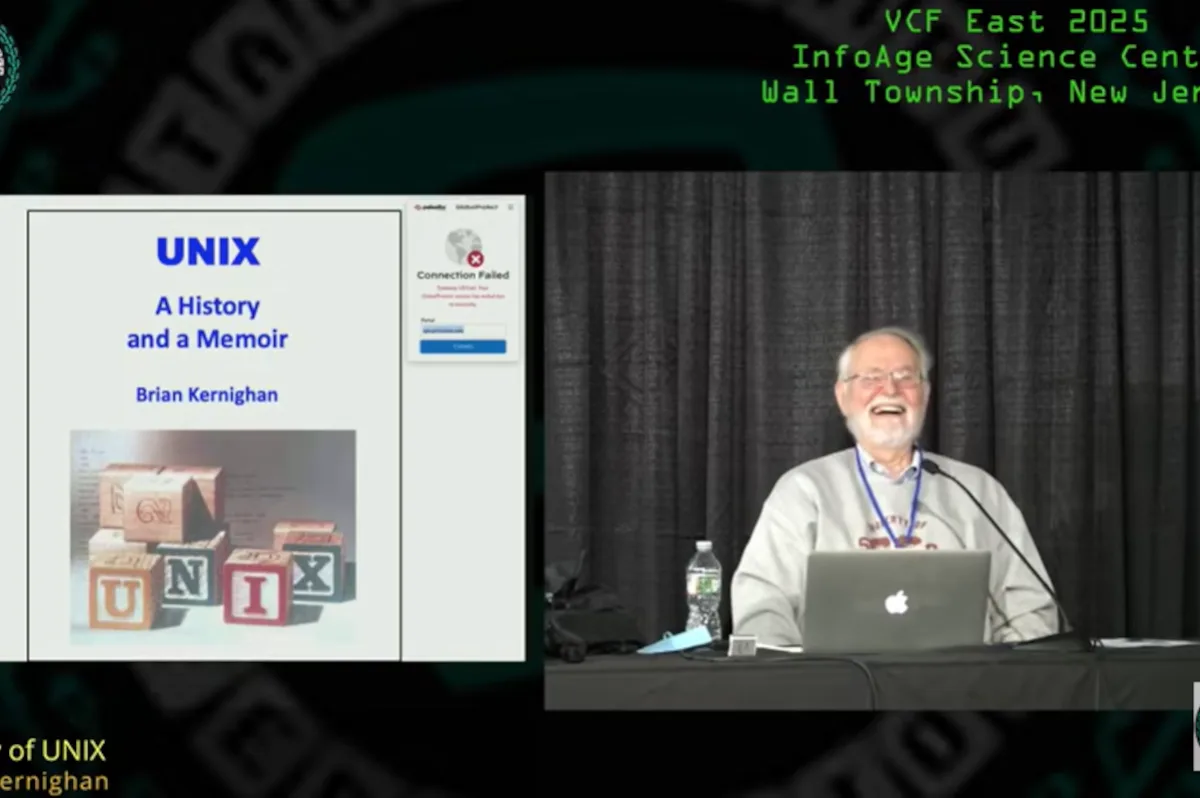
During a recent appearance at the Vintage Computer East festival held at the InfoAge Science and History Museums in Wall, New Jersey, 83-year-old Brian Kernighan addressed an audience on contemporary technology trends. The Unix pioneer and co-author of the 1978 definitive C programming language guide discussed the industry's shift toward memory-safe languages, the multitude of Linux variants, and how Unix descendants now run on virtually every mobile device. "I'm still teaching at Princeton," Kernighan told the crowd, "I have not yet retired!" Video recordings of his presentation, including an extended question-and-answer session, were subsequently posted to YouTube.
Rust Replacing C?
When an audience member asked whether Rust has genuine merit as a C replacement or represents merely hype awaiting collapse, Kernighan offered a measured perspective from someone who championed C for more than fifty years. His assessment was grounded in limited personal experience. "I have written only one Rust program, so you should take all of this with a giant grain of salt," he explained. "And I found it a — pain… I just couldn't grok the mechanisms that were required to do memory safety, in a program where memory wasn't even an issue!"
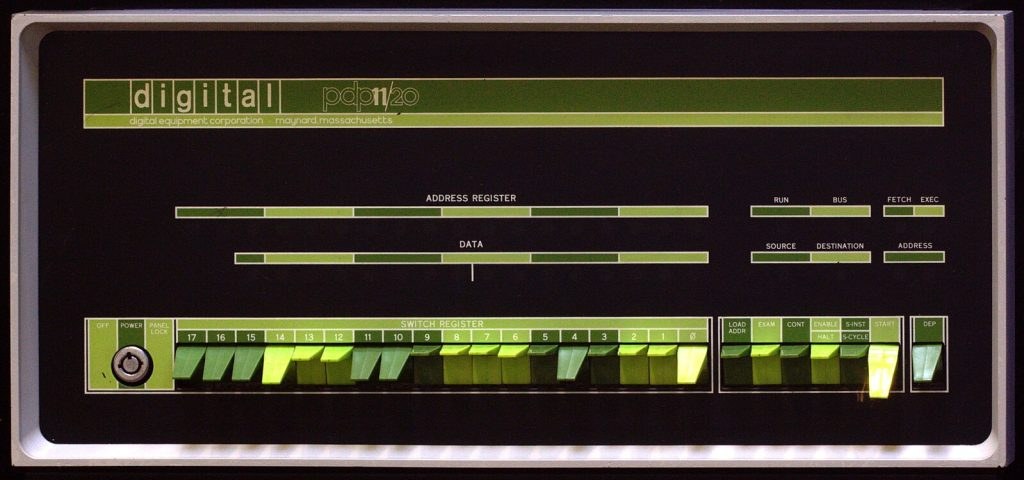
Performance emerged as Kernighan's primary grievance—a particularly pointed criticism from someone whose early work involved 16-bit PDP 11/20 systems. "The support mechanism that went with it — this notion of crates and barrels and things like that — was just incomprehensibly big and slow." He continued, "And the compiler was slow, the code that came out was slow…" The experience proved frustrating enough that development tasks requiring mere minutes in other languages consumed days in Rust, compounded by language changes that rendered existing documentation obsolete.
Acknowledging his limited exposure to the language, Kernighan conceded that "I'm probably unduly cynical." Nevertheless, he offered his forecast: "But I'm — I don't think it's gonna replace C right away, anyway."
What's a Distro?
When asked to name his preferred Linux distribution, Kernighan responded with humor and candor. Though he uses a Mac, his actual computing work occurs through terminal windows connected to "whatever Linux system the computer science department is running at any given moment. And I don't even know what it is." He acknowledged the limitation with characteristic honesty: "So, uh — sorry! I can't be more helpful than that."
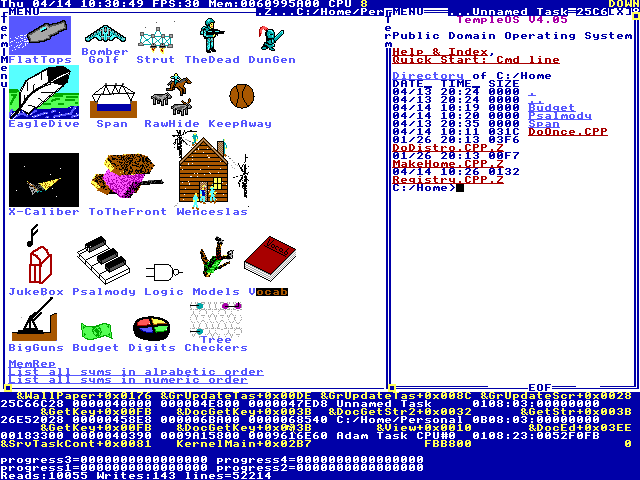
The conversation shifted when someone inquired about Holy C, the esoteric C variant developed by the late Terry A. Davis for his TempleOS operating system. This derivative language blends source code with x86_64 assembly and remains capable of compiling to x86_64 assembly code. Kernighan's reply was straightforward: "the short answer is no." He then posed a playful counter-question, referencing the 99 Bottles of Beer on the Wall website that documents how various programming languages would render the song's lyrics across approximately 1500 different languages—though Holy C does not appear among them.
A subsequent question about the Nix package manager and NixOS distribution drew a similar response. "God, it's another one I've never heard of," Kernighan said with laughter, later clarifying that "I think I've heard it, but I don't know anything about it, so I can't give you an answer."
Yesterday and Today
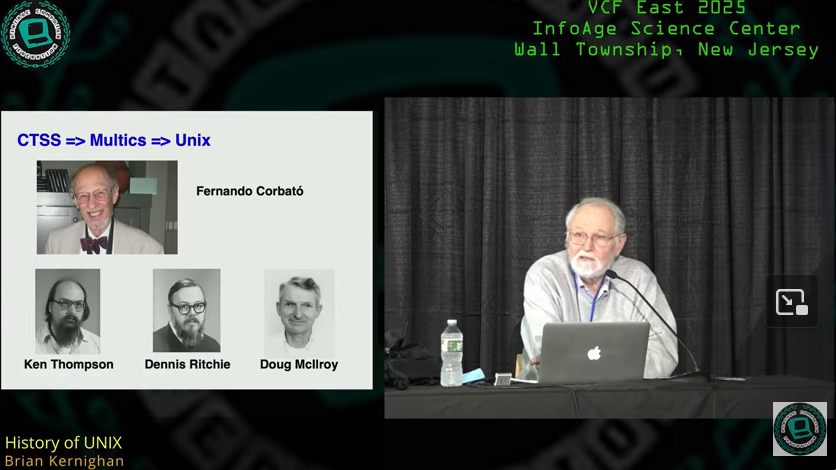
Reflecting on his time at Bell Labs, Kernighan described the environment as cooperative, collegial, and enjoyable. "It was great fun to hang out with these people." However, the arrival of Microsoft Windows fundamentally altered the technology landscape. "a lot of effort, focus, and talented people started to work in the PC world…" according to Kernighan, who observed that "the good ideas and the talented people sort of drifted away, to some extent — or even a lot — from Unix." Microsoft's focus on consumer products for non-technical audiences introduced "much more of a focus on interaction." Yet Kernighan emphasized that Linux subsequently emerged to "keep this legacy of Unix alive."
Regarding the present-day consumerization of Unix—where iPhone and Android users unknowingly rely on its descendants while straying from the original free and open-source ethos—Kernighan acknowledged the observation. "I think you hit the nail on the head," he said, "when you said that most people don't know it…" iPhones run "a fairly long-path-of-evolution version of Unix," while Android phones operate on "a different flavor there of Linux underneath all of that." His perspective blended fascination with frustration: "I think from my side, as just — you know, somebody who was involved loosely in the early days — and has a phone — I find it intriguing. And I also find it kind of irritating that underneath there is a system that I could do things with — but I can't get at it!"
When asked for his assessment of contemporary software's state, Kernighan delivered a blunt verdict. "A lot of it sucks…!" he declared to audience applause. "Unfortunately, it's all too true." He offered to elaborate further but suggested continuing the conversation offline.
Kernighan vs. Vibe Coding
During his presentation, Kernighan highlighted a Unix legacy: "programs that write programs." He illustrated this concept through compilation: "A compiler creates assembly language…? That's a program writing a program… And once you get it right, programs that write programs do a good job. They do it often better than people do." However, he immediately added a qualification regarding large language models. "I will pass over what's happening with large language models…" he said as the audience laughed, continuing that "my few attempts on that have kind of invalidated what I just said!"
When asked for guidance for aspiring programmers, Kernighan began with characteristic humility. "the answer to that — the real answer — is 'I don't know.'" Yet he proceeded with substantive counsel. "I think probably computers in useful forms, where you could be doing things with them, will be with us for a very, very long time." He noted that while most people remain unaware of software's pervasive control over their activities, those pursuing technical careers will possess that knowledge. "I think that will give you something to do that will be interesting — and probably actually employable, for some time in the future."
Kernighan concluded with encouragement rooted in passion. "if this stuff turns you on, do it. Okay…? I think you can do that kind of stuff, and you can have a good time, and you can probably make a living and enjoy what you're doing… I think doing stuff that you find intriguing is the way to go."
https://www.youtube.com/embed/WEb_YL1K1Qg?start=3473&feature=oembed
Source: The New Stack