
Developers increasingly turn to AI agents for tool recommendations, with nearly 70% of respondents in Stack Overflow's 2026 developer survey reporting they use an AI agent to find answers. This shift means that appearing in LLM responses has become as important as traditional search visibility. Webflow began tracking how major AI engines answer questions about CMS platforms to understand what drives recommendations and how to improve visibility.
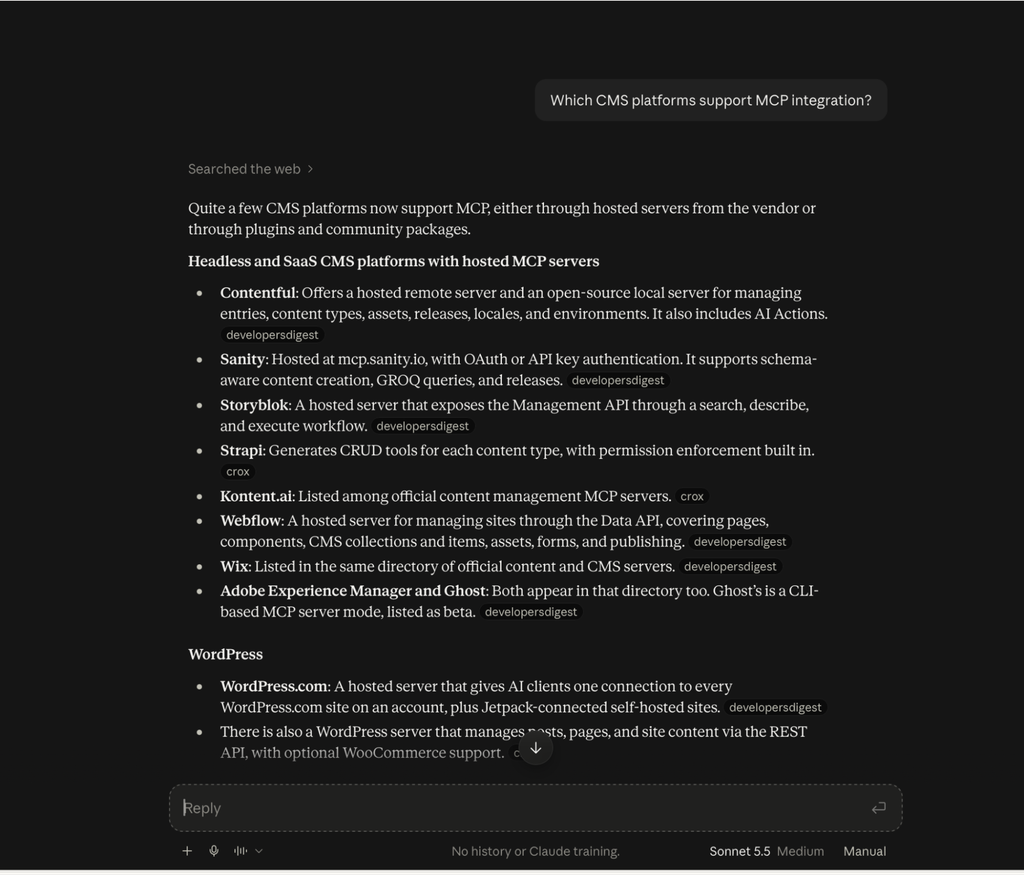
When asked "Which CMS platforms support MCP integration?", Claude placed Webflow sixth in its first group, describing it as "A hosted server for managing sites through the Data API, covering pages, components, CMS collections and items, assets, forms, and publishing." Running the same question four times revealed inconsistent results: Webflow appeared in three of four responses but with varying levels of detail and positioning.
Why position in AI responses matters
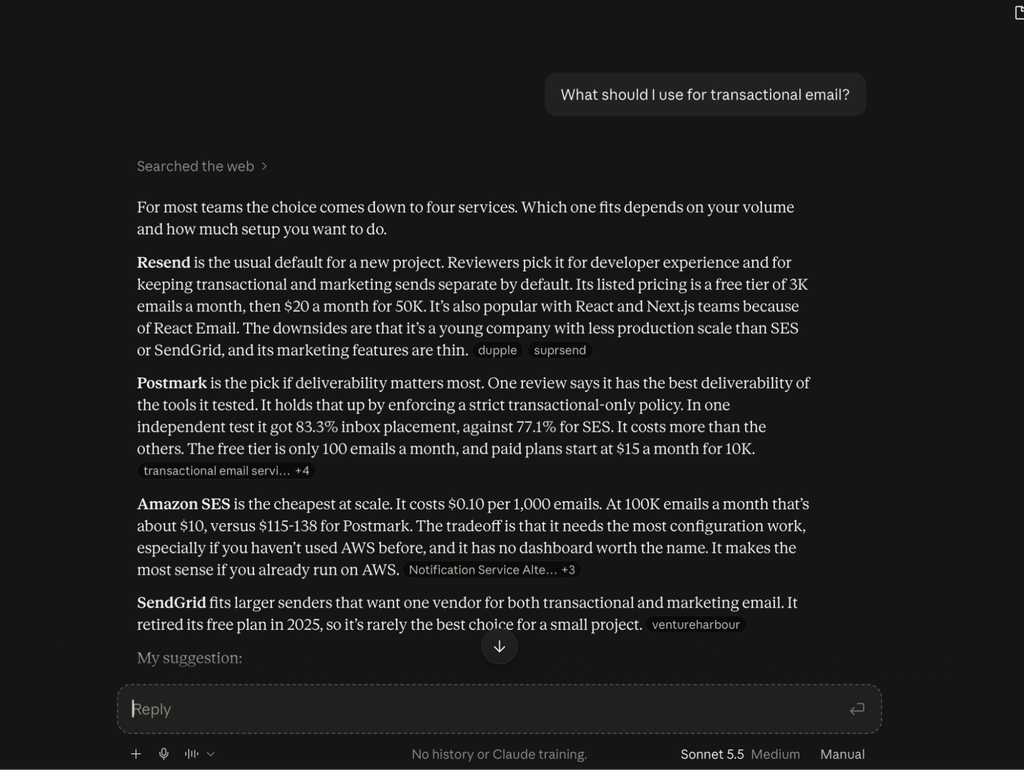
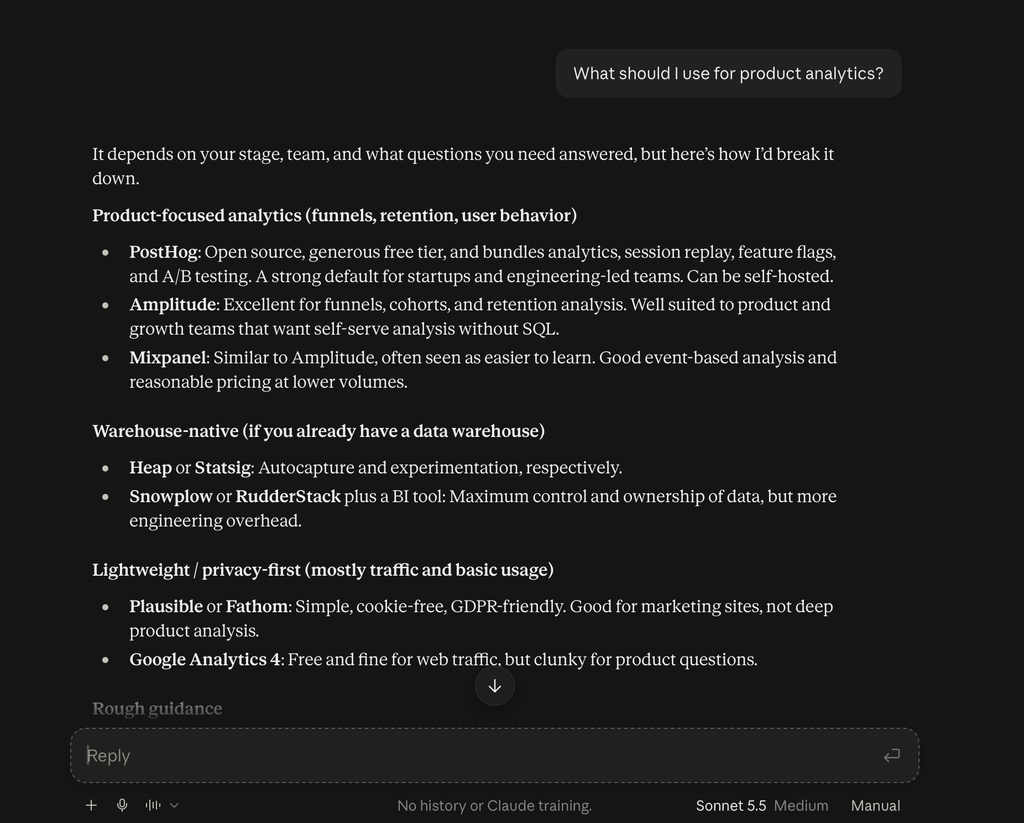
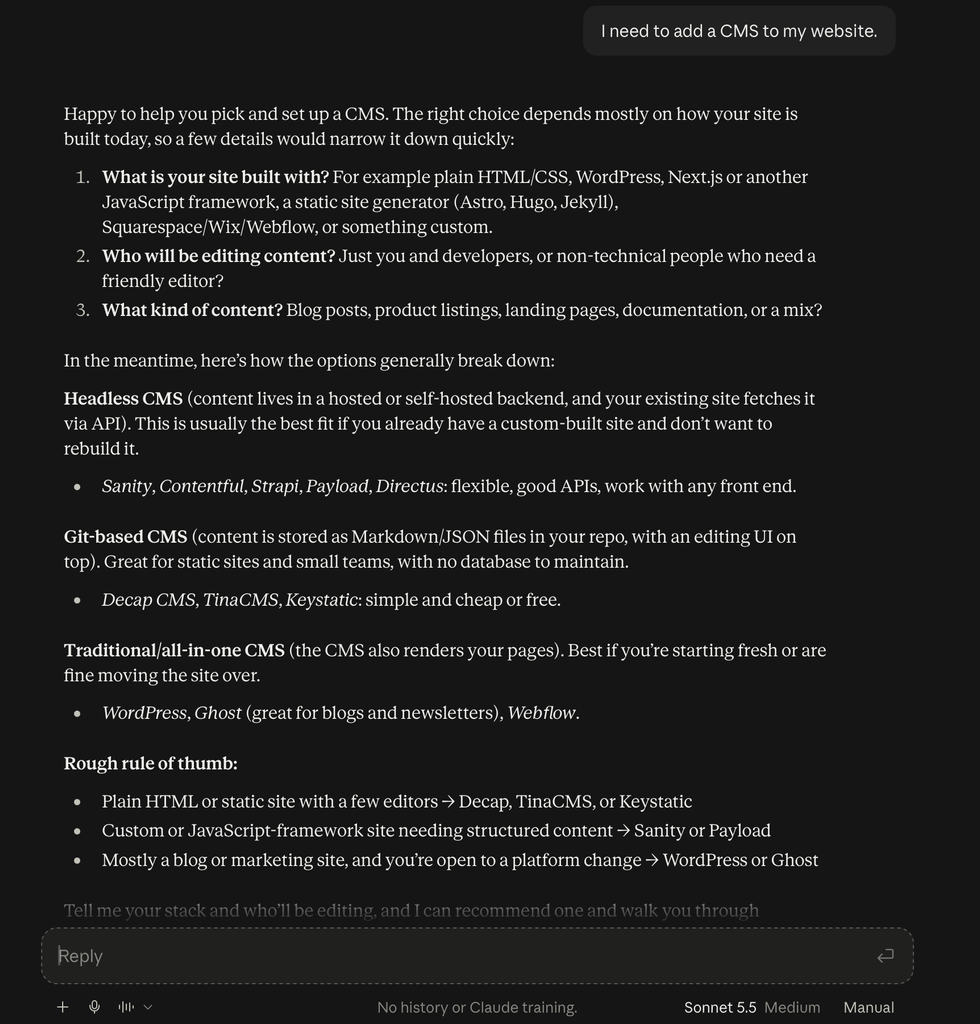
When Claude recommends Resend for transactional email or PostHog for product analytics, these tools appear first in the response. While data on how many developers stop at the first recommendation remains limited, being named first carries obvious advantages. For the CMS category, Webflow tracked the prompt "I need to add a CMS to my website" across three runs. Sanity, Payload, WordPress, and Ghost appeared in all three responses, while Webflow was recommended only once and placed last in its group.
The critical gap is that when an AI engine omits a product entirely, developers never see it, and no analytics record the missed opportunity. Unlike traditional search referrals, these interactions happen before any page visit occurs. Webflow cannot measure whether LLM recommendations drive signups or revenue without referral data, but it can track whether products are named, how they are described, and which sources engines cite.
Measuring visibility across engines
Between September 25 and October 19, Webflow ran the MCP integration prompt 100 times—25 on each of four engines. Webflow appeared in 49 of those 100 responses, but distribution varied dramatically: Perplexity named it in 22 of 25 responses, ChatGPT in 15, Gemini in 8, and Claude in only 4. The company uses Webflow AEO, accessed through Insights > AEO, to track these metrics automatically.
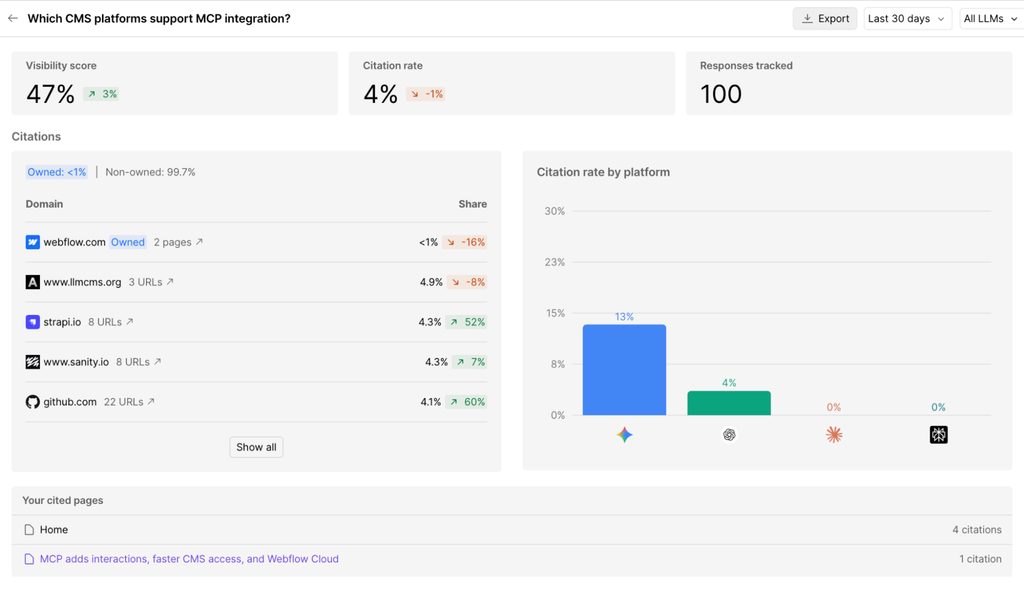
The AEO dashboard displays mention rate, visibility score, citation rate, and week-over-week changes for each tracked prompt. Opening a specific prompt reveals how many responses were tracked, citations split between owned and non-owned domains, citation rates by platform, which company pages were cited, and an exportable response log. The visibility score for the last 30 days reads 47%, though this differs from the raw mention count because scoring accounts for accuracy and context.
Each response is logged as a structured record capturing the date, engine, prompt, whether the product was mentioned, its position in the list, total items listed, section name, tier classification, accuracy assessment, and cited sources. Webflow leaves the accuracy field empty until someone verifies the description against official documentation, preventing confident-sounding but incorrect answers from being counted as accurate.
How four engines described Webflow
Claude placed Webflow under "Website Builders / E-commerce CMS" with the description "Has an official remote MCP server with OAuth support" and mentioned it in the closing summary as a platform "generally cited as having the most mature official implementations." None of Claude's sources were from Webflow's own documentation.
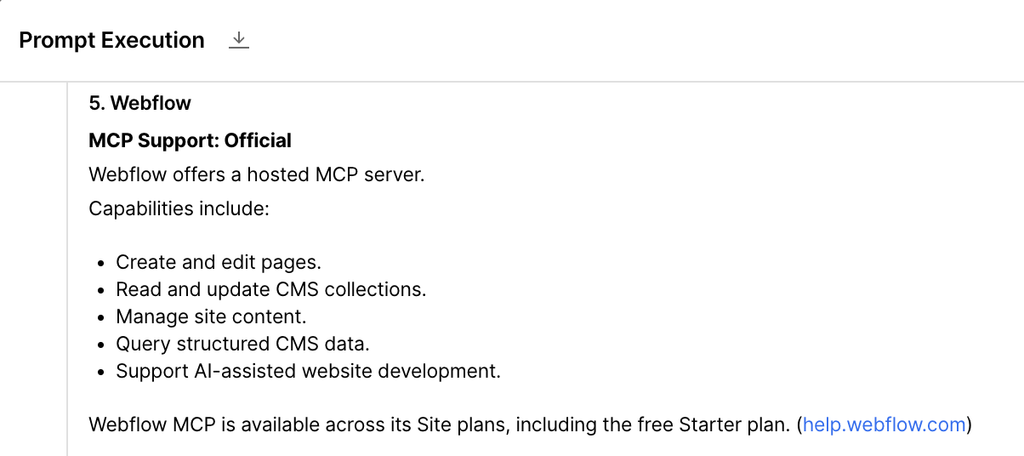
ChatGPT gave Webflow its own section, labeling it "MCP Support: Official" and stating "Webflow offers a hosted MCP server." It listed the server's capabilities and noted that "Webflow MCP is available across its Site plans, including the free Starter plan." ChatGPT cited help.webflow.com as its source.
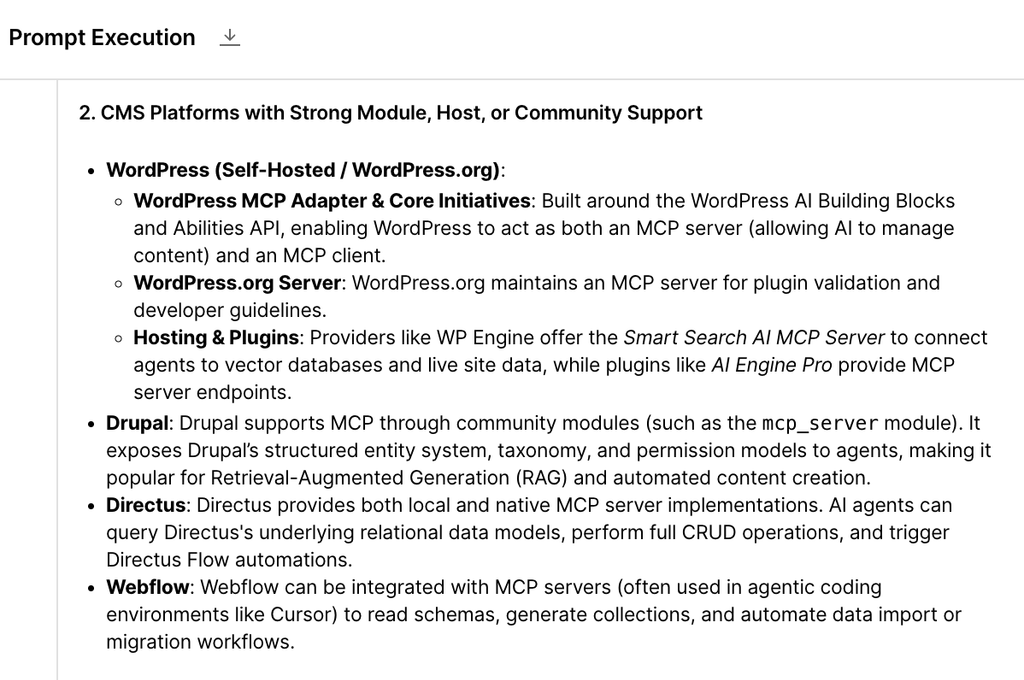
Gemini described Webflow as a platform that "can be integrated with MCP servers (often used in agentic coding environments like Cursor) to read schemas, generate collections, and automate data import or migration workflows." This framing suggested a third-party integration rather than a native server, and Gemini placed it in the second tier, "CMS Platforms with Strong Module, Host, or Community Support." None of its 14 citations came from Webflow.
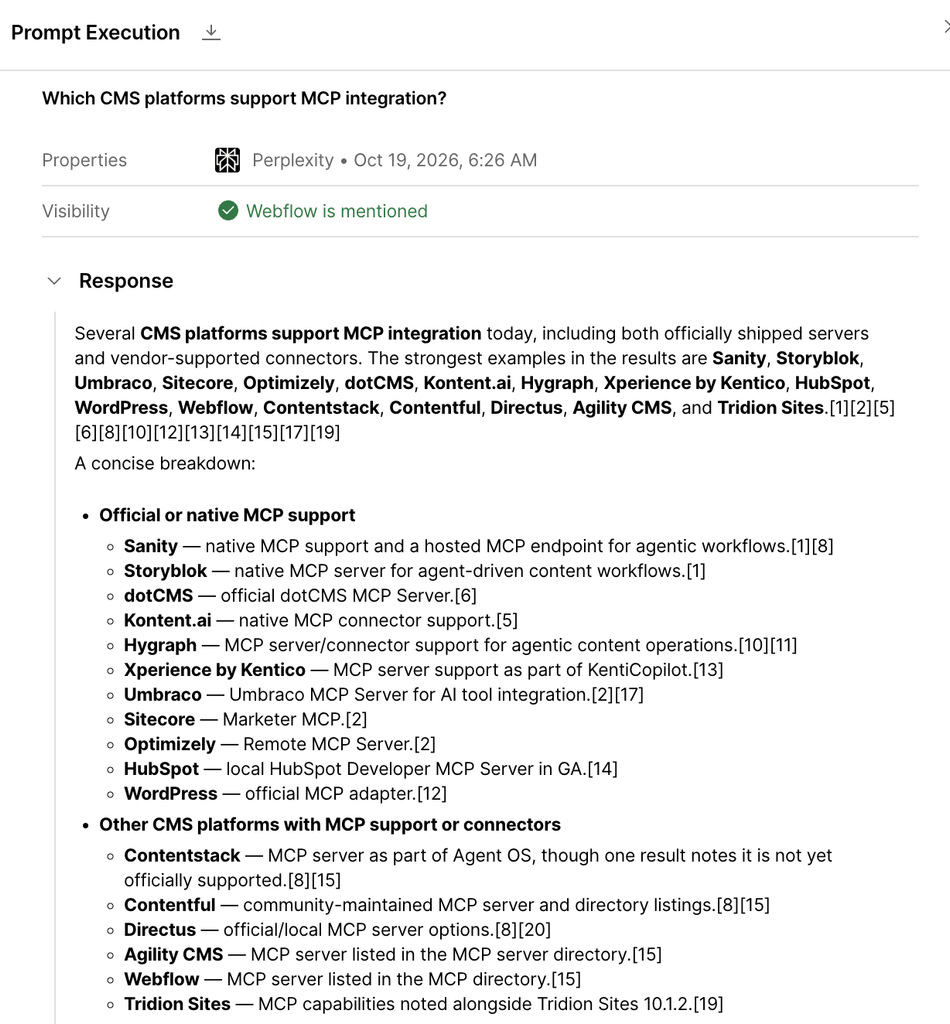
Perplexity named Webflow in its opening list with a single line: "MCP server listed in the MCP directory," pointing to machalliance.org. Since Webflow's MCP server is built and operated by Webflow with remote hosting and OAuth support, Claude and ChatGPT correctly identified the tier, Gemini mischaracterized it, and Perplexity did not specify.
The source citation gap
Between September 25 and October 19, Webflow was cited in only 6 of the 100 responses, all from ChatGPT or Gemini. In contrast, a third-party guide on llmcms.org appeared in citations for 60 of the 100 responses. ChatGPT cited vendor documentation for each platform it listed, while the other three engines mixed vendor blogs with third-party guides and directories.
Being named is the easy part for us. Being described correctly, from our own pages, is the part we can influence.
Webflow
This disparity reveals that while mention rates vary by engine, the sources engines rely on are concentrated among a small set of third-party roundups. Improving visibility requires not only ensuring documentation is accessible to crawlers but also ensuring it appears in the guides that LLMs cite most frequently.
Improving documentation for AI readers
Documentation now serves two audiences: developers and the AI agents working on their behalf. Several concrete steps can improve visibility in LLM responses.
Verify crawler access
Before optimizing content, confirm that AI crawlers can reach documentation. Testing with a GPTBot user agent reveals whether firewalls or CDN rules block access:
curl -sI -A "GPTBot" https://your-docs-site.com | head -n 1
Repeat this for each crawler's user agent and review robots.txt and firewall rules for any blocks.
Use language engines search for
Webflow's MCP documentation states the server runs remotely and uses OAuth, but the pages checked do not use the words "official" or "hosted"—terms that appear in engine responses. A short answer block at the top of the main documentation page should state what the product is, who builds it, how it authenticates, and what it costs. For example: "The Webflow MCP server is an official, hosted server built by Webflow. It uses OAuth and is available on all Site plans, including the free Starter plan."
Target third-party guides
Since engines rely heavily on third-party roundups, identify which guides and directories engines cite for your category. Ensure your product is listed or correct any inaccuracies in those sources.
Optimize for agent readability
Documentation can be appended with .md or /llms.txt for cleaner text extraction. Verify that versioned URLs point to a single canonical page and check for JSON-LD markup:
curl -s https://your-docs-site.com/page | grep -c 'application/ld+json'
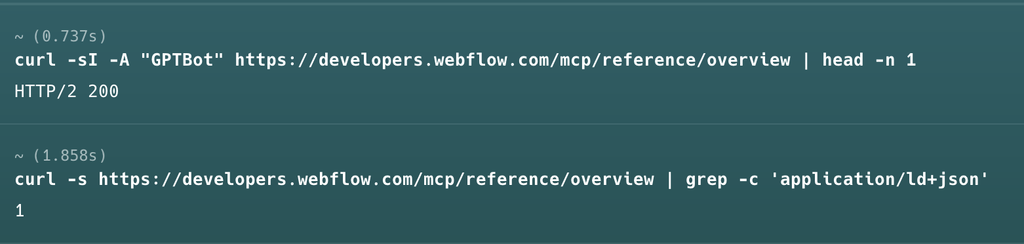
A 200 status indicates the page responds to GPTBot requests. A count of 1 or higher means JSON-LD tags are present in the HTML.
Count all owned domains
If documentation lives on subdomains, verify that tracking systems count them as owned properties. Webflow's dashboard counts only webflow.com as owned, treating help.webflow.com and developers.webflow.com as separate projects.
Designing for agent consumption
Four design choices matter most when documentation must serve AI agents:
- Write tool descriptions as product descriptions. An agent selecting an MCP tool reads only the description, schema, and prior responses. "Gets a user" provides no guidance; instead, state what the tool does, when to use it, what it returns, and what happens on error.
- Publish answers to specific questions. A page listing every platform and its supported features gives engines something concrete to quote. Specify exactly which actions, scopes, and plans your server covers.
- Keep specifications current. A stale OpenAPI spec breaks an agent as thoroughly as outdated documentation breaks a person. Update docs in the same pull request as API changes.
- Grant agents minimal access. Use scoped keys and OAuth so agents can perform only actions the user authorizes. Webflow's MCP server uses OAuth for this reason.
Measuring progress
Webflow's baseline metrics are mention rate by engine, accuracy by engine, and source type. The company plans to re-run the same prompts in four to six weeks and report ranges rather than single numbers. Since results are not yet available, it remains unclear which documentation improvements will move the metrics.
To run this analysis on your own product, select five plain-language prompts and run each on ChatGPT, Claude, Gemini, and Perplexity. Suggested prompts include:
- What should I use for transactional email?
- What should I use for product analytics?
- I need to add a CMS to my website.
- Which [category] tools support [integration you care about]?
- [Your product] vs [competitor], which should I pick?
Log every response using the same schema, recording the baseline before making changes. If your product is named, verify the tier and description against your documentation. If it is not mentioned, examine which pages the engine cited. Re-run the prompts after one month to measure changes.
Webflow AEO automates this tracking for Enterprise customers and offers a free AEO assessment for other sites.