
The decision-model category has exploded since TypeSafe introduced Jev in mid-September, drawing entries from OpenAI, Perplexity, Cloudflare, Amazon and Microsoft. San Francisco-based Subquadratic is now joining the competition with SubQ Snap, a decision model designed to handle up to 384,000 tokens of text and images in a single request.
According to the company's Monday announcement, Snap can process 100K tokens and deliver a decision in roughly one second. This capability could enable AI agents to work across large codebases, documents and interaction histories without fragmenting information into smaller pieces.
Why context size matters for decision models
Decision models differ from traditional large language models by selecting from predefined answers rather than generating new text. Use cases include choosing which tool an AI agent should invoke next, pinpointing relevant files, or validating test outcomes.
The appeal lies in speed and cost efficiency. Since agents make these selections repeatedly during execution, offloading them to smaller, specialized models cuts down on calls to expensive frontier LLMs.
Subquadratic CEO and co-founder Alex Whedon acknowledged that Jev's market entry influenced the company's decision to build Snap. "Snap was developed with inspiration from Jev, because decision models are highly thesis-aligned," Whedon told The New Stack. "Decision models remove the need for decoding for some problems."
Yet Whedon contends that decision models have untapped potential beyond their current supporting roles, such as evaluating LLM outputs or routing tasks to appropriate models. "We see a vacuum of vision for decision models," he says. "Decision models become exciting when they actually take work away from frontier LLMs."
Subquadratic points out that existing decision models hit walls when the information needed for a decision exceeds their context limits. A coding agent debugging a large repository might need to examine multiple modules, test files and documentation simultaneously. With Jev's 32K-token window, such an agent may discard potentially relevant details or escalate to a larger LLM. Snap's 384K-token capacity allows it to survey more of the codebase, logs and prior actions together before deciding on next steps.
The company achieves this through Subquadratic Sparse Attention (SSA), an architecture introduced in May that reduces the computational cost of long inputs. Unlike conventional transformers, where attention requirements grow quadratically with context length, SSA's requirements scale linearly. Whedon argues that algorithmic improvements matter regardless of compute spending by major labs, otherwise "we are inevitably leaving intelligence gains on the table."
Benchmark results and performance claims
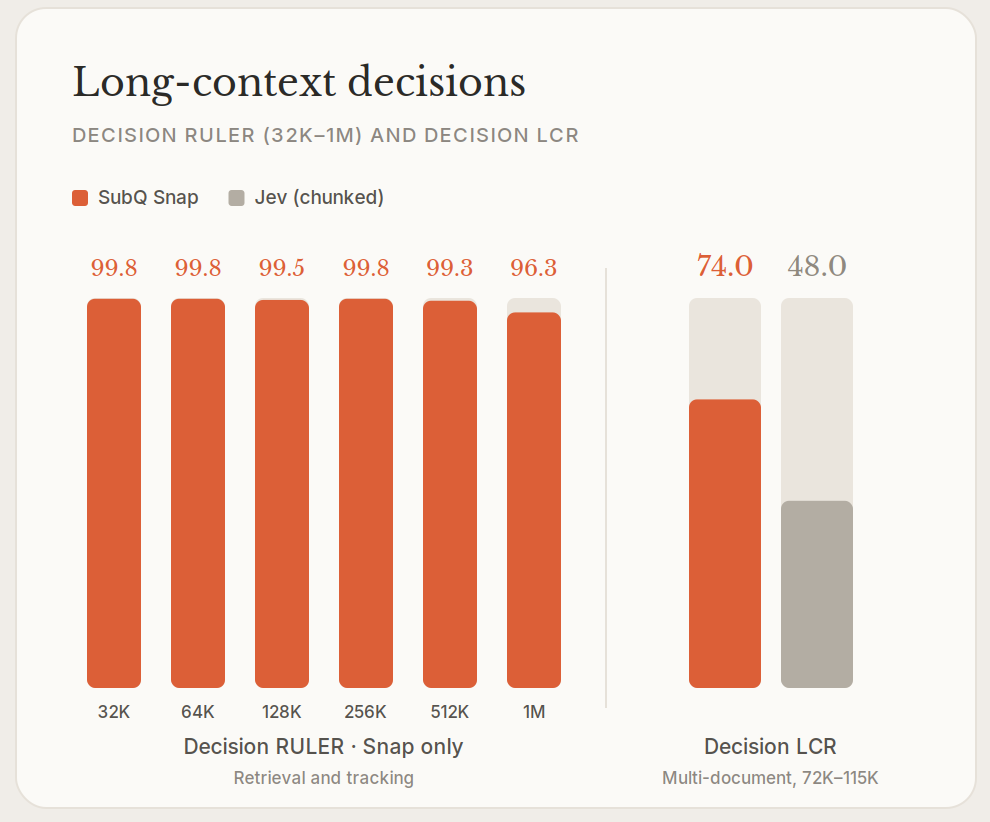
Subquadratic's internal benchmarks show Snap maintaining accuracy across varying input sizes. On an adapted RULER retrieval benchmark, Snap scored between 96.3 and 99.8 across inputs ranging from 32K to one million tokens. On Decision LCR, which tests reasoning across multiple documents, it achieved 74.0 compared to Jev's 48.0, with Jev processing documents in chunks.
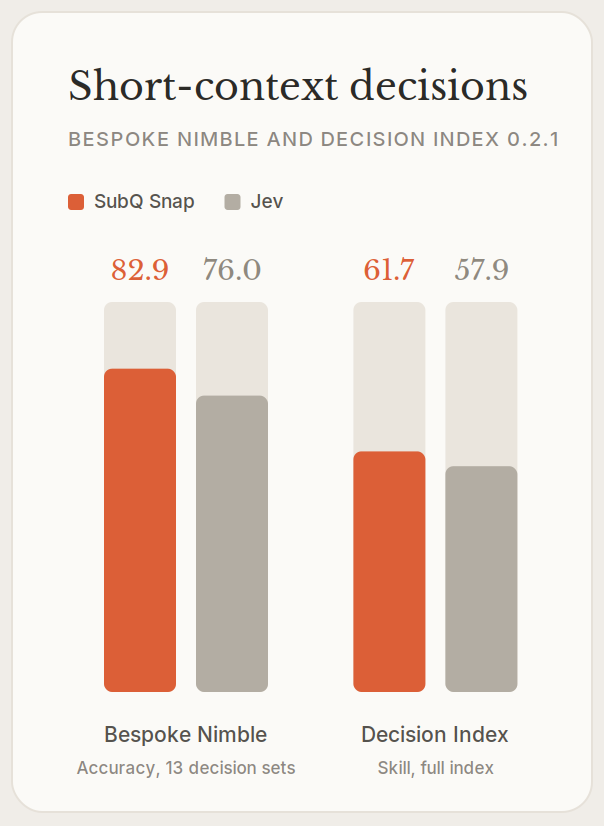
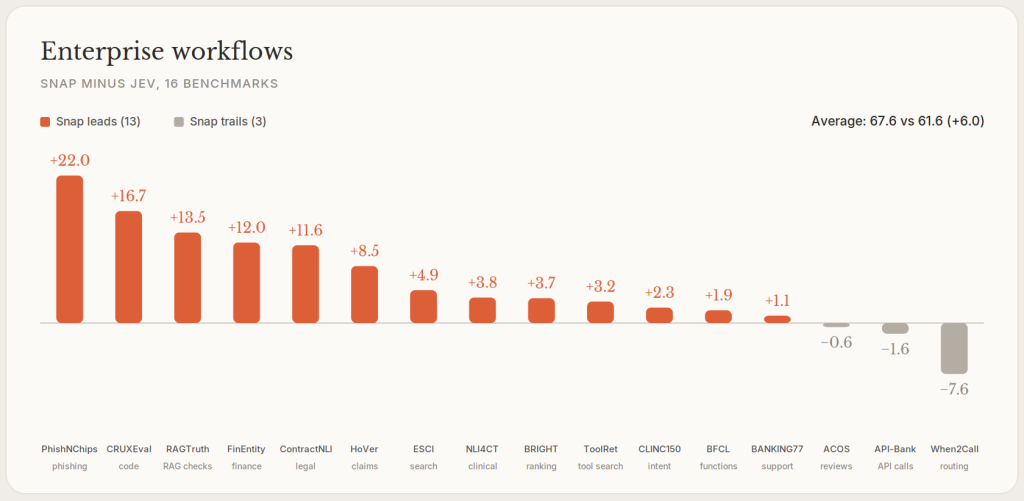
For shorter tasks, Snap scored 61.7 against Jev's 57.9 on Decision Index 0.2.1, and led on Bespoke Labs' Nimble benchmark with 82.9% accuracy versus Jev's 76.0%. Across 16 enterprise-focused benchmarks, Snap outperformed Jev on 13, posting an average score of 67.6 versus 61.6. Jev performed better on three tests, including When2Call, which assesses whether an agent should invoke a tool, request clarification, answer directly or decline.
Whedon confirmed that all published Snap results were generated internally, though Subquadratic has released code for its adapted long-context evaluations to allow independent reproduction. Snap does not yet appear on the latest Decision Index leaderboard. Whedon stated that the benchmark's authors indicated the current version prioritizes open-weight models, with Jev as an exception. The latest index version 0.3.2 also incorporates private tests, making direct comparison with Snap's published 0.2.1 score impossible.
When asked why comparisons focused on Jev, Whedon explained that it remains the most relevant model for Subquadratic's enterprise design partners, followed by OpenAI's Decisions API. "Jev still seems like the model to compare against in this category, so being able to outperform it in a largely generalizable way has been the frontier signal we were looking for," he said. Comparisons with newer rivals are in the works.
Simplifying agent development
Beyond performance metrics, Subquadratic argues that a larger context window reduces complexity in building AI agents. Developers typically rely on retrieval, summarization and chunking to fit large documents or codebases into smaller context windows. Each step requires decisions about what information to keep, risking the loss of details that later become critical.
Snap could eliminate some of these intermediate steps when material fits within its 384K-token limit, letting agents review entire documents or related file collections in a single request. Whedon acknowledged that retrieval remains necessary for much larger information collections. "Retrieval won't disappear — enterprises have corpora far larger than 384K tokens, and you still need a way to bring the right material into the window," he noted. "But the window is now big enough that retrieval can be coarse, pulling in whole documents or modules instead of carefully trimmed snippets. That removes a lot of the fragile parts."
Pricing and computational model
Snap is available in public preview at $0.05 per million input tokens, with no charge for outputs. Processing 100K tokens costs approximately half a cent, while a full 384K-token request runs around two cents.
Whedon explained that pricing reflects the computational demands of a model designed to select answers rather than generate lengthy responses. "We priced it where the cost actually is," he said. "A decision model doesn't generate text. It reads the input and returns a probability for each allowed answer, so nearly all of the compute goes into reading, and producing the output costs us almost nothing."
The 384K-token context limit is temporary, imposed during public preview due to available computing capacity. Subquadratic tested the model at one million tokens but says supporting that length publicly would require approximately 2.6 times more compute.
Subquadratic's trajectory
Subquadratic emerged from stealth in May with $29 million in seed funding at a reported $500 million valuation. The startup, previously called Aldea, was co-founded by Justin Dangel and Whedon, a former Meta engineer and head of generative AI at Tribe AI. Whedon became CEO a few months ago after serving as CTO, with Dangel moving to chairman.
The company's debut model, SubQ, drew attention for its claimed 12-million-token context window and substantial computational efficiency gains. In June, Subquadratic published detailed benchmarks for SubQ 1.1 Small, with certain results independently verified by data firm Appen. During a July interview, Whedon revealed the company was exploring architectures that eliminate attention mechanisms altogether.
Snap builds on this sparse-attention research, bringing Subquadratic's long-context ambitions into the rapidly expanding decision-model space. For now, the claimed performance advantage rests on Subquadratic's internal benchmarks. Independent testing will ultimately determine whether the larger context window translates to meaningfully better decisions.