
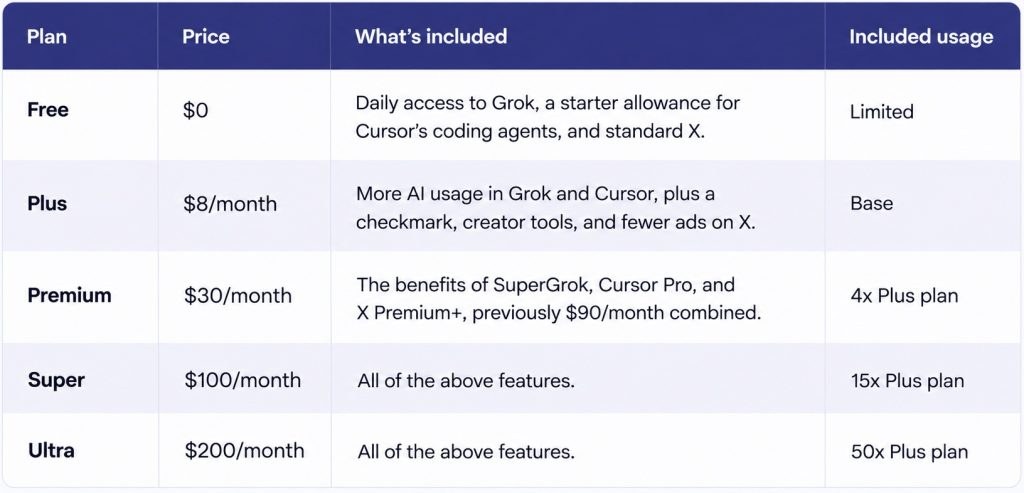
Elon Musk's consolidation of his technology holdings has reached a new milestone with the launch of The X Subscription, a unified plan that brings together Cursor, Grok, X Premium, and Grok Bot under a single pricing structure. SpaceXAI announced the offering late Monday, introducing five tiers ranging from a free option to a $200-per-month tier, with the lowest paid plan starting at $8.
Consolidating a sprawling portfolio
The path to this bundled offering reflects years of corporate restructuring. Musk acquired Twitter for $44 billion in October 2022, rebranding it as X the following July. That same month, he established xAI, which unveiled Grok later that year before integrating it directly into X. In March 2025, xAI formally acquired X as part of the corporate reorganization.
The consolidation accelerated in February when SpaceX acquired xAI, bringing both Grok and X into the rocket company's portfolio. In August, SpaceX closed its acquisition of AI coding company Cursor in a deal reportedly valued at $60 billion. That same month, SpaceX launched Grok Bot, an autonomous AI assistant capable of executing tasks across third-party applications.
While some products were already bundled—X Premium has included Grok for some time, and Cursor plans have featured Grok Bot since August—The X Subscription marks the first offering to combine all four products with a shared usage pool. Additionally, SpaceXAI is transitioning its name to SpaceXSI following Musk's confirmation in early October that he would adopt "super intelligence" (SI) terminology in place of "artificial intelligence" (AI), a change already reflected in its social media presence.
Pricing structure and tier breakdown
The five subscription tiers offer varying levels of AI usage and feature access. The free tier provides limited Grok and Cursor coding agent usage. The $8 Plus plan increases those allowances and adds X benefits including a verification checkmark, creator tools, and reduced advertisements.
https://x.com/SpaceXSI/status/2109783335296008414?ref_src=twsrc%5Etfw
The $30 Premium tier significantly expands the offering by adding Grok Bot access, more advanced X features, and four times the AI usage of the Plus plan. The $100 Super plan increases the allocation to 15 times the Plus level, while the $200 Ultra tier raises it to 50 times. SpaceXAI states that the Premium tier combines benefits that previously cost $90 monthly when purchased separately through SuperGrok, Cursor Pro, and X Premium+.
A notable change affects developers upgrading from the previous $20 Pro plan: cloud agents and Origin, the company's GitHub alternative launched in August, now require at least the $30 Premium tier, representing a $10 monthly increase for those seeking to maintain access.
Subscriptions include a weekly allocation for Grok model usage that customers can draw on across Cursor, Grok applications, and X. Grok Bot also consumes this allowance on eligible plans, meaning heavy Grok usage elsewhere could reduce available coding credits. SpaceXAI claims the new plans provide at least twice as much coding usage with its own models compared to comparable older Cursor subscriptions.
Third-party models shift to pay-per-use
The pricing structure introduces a significant change for developers preferring third-party models. Previously, Cursor's $20 Pro plan included $20 worth of usage on models such as Anthropic's Claude, OpenAI's GPT, and Google's Gemini, calculated at their respective API rates. The $60 Pro+ and $200 Ultra plans included $70 and $400 worth of API-priced model usage respectively, before additional allowances.
Under The X Subscription, third-party model access begins at the $30 Premium tier, but the subscription fee no longer covers any usage of these models. Instead, developers face standard API rates from their first request, with charges handled through prepaid credits. This applies regardless of whether customers pay $30, $100, or $200 monthly.
The financial impact is substantial. A developer previously paying $20 for Cursor Pro with $20 in Claude usage would have their entire bill covered by the subscription. Under the new Premium plan, that same usage would cost $50—the $30 subscription plus $20 in additional charges.
Team subscriptions now start at $30 per user monthly, down from the previous $40 entry-level Cursor Teams plan, with higher tiers at $100 and $200. SpaceXAI claims the revised team offering provides three times more coding usage than its predecessor, along with administrative features including single sign-on, centralized billing, and usage analytics.
Transition timeline and customer concerns
Existing Cursor subscribers can maintain their current plans and included third-party model allowances for now. However, the announcement generated significant discussion on Cursor's community forum, with existing Pro, Pro+, and Ultra subscribers seeking clarity on how new plans compare to their current subscriptions and whether switching would increase their costs.
Colin Mueller, a technical support engineer who joined SpaceXAI from Cursor in August, addressed these concerns on Tuesday. He indicated that existing customers can remain on their current plans temporarily, though a mandatory transition may eventually occur.
Nothing happens to your Pro plan automatically. You can keep it at the same price with the same features for now. Users who don't choose to migrate will, sometime in the future, be migrated with advance notice.
Colin Mueller, SpaceXAI technical support engineer
When asked about the timeline for the existing Ultra plan, Mueller offered a more cautious response, stating that the plan is not disappearing immediately and no timeline exists for migrating remaining customers, though advance notice would be provided if that changes.
Some developers are questioning what these changes mean for Cursor's historical positioning as a model-agnostic platform. One longtime Ultra subscriber, posting as coco_max, argues that the new pricing risks alienating the developers who built Cursor's reputation, particularly those relying heavily on Claude and GPT.
Cursor earned its place next to Codex and Claude Code not because of its own model, but because it was 'one editor where you can use the best models.' A lot of us have all three installed, and Cursor is the one that stays open all day, precisely because it isn't locked to any single vendor. The new plans change that.
coco_max, Cursor user
Broader competitive dynamics
SpaceXAI's pricing restructuring occurs as Cursor faces the loss of access to one of its most widely used model providers. In August, OpenAI announced plans to withdraw direct model access through Cursor, with a proposed cutoff date of November 12, citing concerns about Musk's compliance track record with its terms of service.
Anthropic has committed to continuing Claude support in Cursor despite competing directly with Grok. The relationship carries additional complexity given Anthropic's multibillion-dollar agreement to purchase computing capacity from SpaceX.
An irony underlies the new pricing structure: just last week, Musk confirmed that Grok Bot would use whichever AI model best suited a particular task, explicitly naming Claude among the options. Yet developers wanting to use Claude directly through Cursor now face additional charges under the new subscriptions.
OpenAI is pursuing its own subscription strategy. At its September DevDay conference, the company expanded its Sign in with ChatGPT offering, allowing paying subscribers to use their existing AI allowances inside third-party developer tools such as Devin, Amp, and Warp. This approach gives OpenAI another mechanism to maintain developer engagement with its models across competing products without requiring separate API payments for eligible usage.
The new X Subscription raises fundamental questions about Cursor's future as a model-agnostic coding platform. SpaceX clearly intends to encourage greater Grok adoption, and the new pricing provides financial incentive to do so. Whether this approach will persuade developers accustomed to choosing between Claude, GPT, and other models to embrace Grok—or instead prompt them to seek alternatives—remains uncertain.