
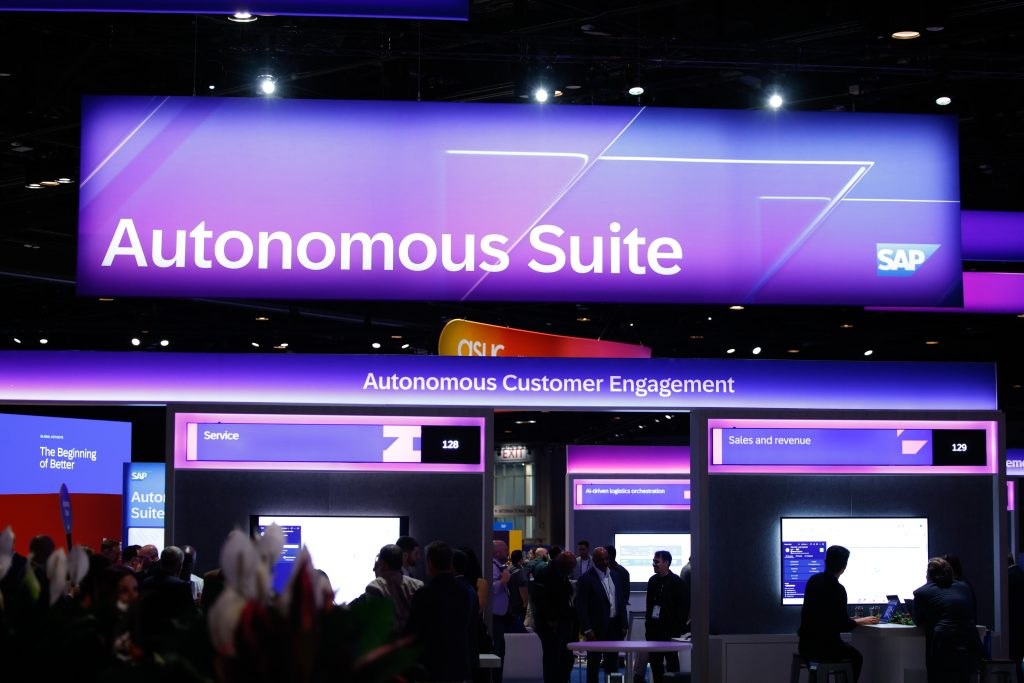
At its Connect conference in Las Vegas this week, SAP is demonstrating how it plans to operationalize the "Autonomous Enterprise" vision it outlined earlier this year at Sapphire. The company is introducing fresh Joule Assistants spanning finance, spend management, HR, customer experience, and supply chain operations, while hosting more than 20 hands-on labs where attendees can construct their own agents.
Eric van Rossum, SAP's head of product marketing for applications and suite, explained the shift in focus between the two events: "Connect is all about making it real. We set the strategy at Sapphire. Now we need to come with the proof points, what that means for our customers, what it means when we have the products in our hands and so on."
We set the strategy at Sapphire. Now we need to come with the proof points, what that means for our customers, what it means when we have the products in our hands and so on.
Eric van Rossum, SAP
While Sapphire targets IT decision-makers, Connect caters to line-of-business practitioners who manage finance, procurement, HR, and supply chain functions on a daily basis. Most of the newly unveiled assistants will become available through early adopter programs and general availability releases between now and the first quarter of 2027.
TechWolf acquisition expands workforce intelligence
SAP announced it will acquire TechWolf, a Belgian company that uses AI to map organizational work and skills. The deal is expected to close in the fourth quarter, subject to regulatory approval, with financial terms undisclosed.
TechWolf CEO and co-founder Andreas De Neve stated in the announcement: "Organizations everywhere are trying to figure out how AI is reshaping work, and what their workforce needs to look like because of it. We have spent eight years building the evidence layer to answer those questions. It's always been our mission to connect skills, tasks and work to help employers solve AI transformation, and joining SAP will allow us to extend that mission across a broader set of business context and larger scale. In this next chapter, we plan to build a world-class AI company."
Finance operations get dedicated agents
According to van Rossum, organizations typically begin with AI agents in their areas of greatest operational friction. "We see a lot in the finance area, like financial close, billing reconciliation, and elements like that."
SAP is introducing three new finance-focused assistants. The Revenue Recognition Assistant guides finance teams through revenue configuration, calculation, and posting while classifying transactions under IFRS 15 and US GAAP standards. A Disclosure Assistant handles the final stages of external financial report preparation, automating data gathering, tagging, narrative drafting, and validation before publication. An Overhead Accounting Assistant enables controllers to modify cost allocation rules and make bulk updates to cost and profit centers, accelerating period-end closing.
Beyond these three, SAP is also deploying dedicated agents for financial close, treasury, tax, billing, planning, and receivables. Early adopter programs for the new finance assistants will open in the first quarter of 2027.
The company is also introducing an International Trade Assistant for organizations conducting cross-border commerce. It categorizes products, prepares compliance documentation, and performs sanctions screening. In initial deployments, SAP reports the assistant has reduced product classification work by as much as half.
Van Rossum emphasized the stakes: "If you're going to do a financial close or if you're going to do statutory reporting or many of these items, there is just not a room for error."
SAP Pay brings embedded payments to ERP
SAP is entering the payments space with SAP Pay, a service built on its newly established Tereina subsidiary. Once an invoice receives approval in SAP Cloud ERP, SAP Pay automatically processes the payment and reconciles it against the invoice or purchase order without requiring users to leave the ERP system.
For international transactions, companies can settle payments using stablecoins. The service is currently available in the U.S. and U.K.
Governance built into agent architecture
Van Rossum described agents as "to a certain degree is actually just an extension of the process in the back end." SAP has embedded country-specific localization and regulatory requirements into its core applications over five decades, from Brazil's Nota Fiscal electronic invoicing standards to varying AI regulations across Europe and the U.S. These requirements are inherited by agents as well.
SAP refers to this approach as governing agents "from the inside out." A new Governance Assistant, arriving in the fourth quarter, will integrate with existing governance, risk, and compliance (GRC) tools and identify risk and control issues across systems, enabling continuous compliance monitoring rather than periodic reviews.
Starting in the first quarter of 2027, the Access Governance and Security Assistant will bring AI agents under the same identity governance and access controls applied to human users.
Supply chain deployments show early results
Some of SAP's most visible customer outcomes are emerging from supply chain implementations. The company is expanding the six supply chain assistants demonstrated at Sapphire with new Joule Agents capable of reading product designs and recipes, identifying plant floor disruptions, and initiating maintenance requests.
A global natural ingredients producer is using the Logistics Assistant to respond to logistics operation failures. A large biopharmaceutical company deployed the Supply Chain Planning Assistant to diagnose planning problems and recommend solutions. Combined with automated performance tracking, SAP says this creates a feedback mechanism for gradually increasing planning autonomy.
Cross-functional integration drives competitive advantage
Currently, most customers are piloting individual use cases, van Rossum notes. He anticipates substantial gains will materialize once agents coordinate across workflows spanning finance, spend management, customer operations, and HR.
"Optimizing one LoB, I think we're competing in a very narrow environment with best-of-breed, but our strength is really going to come from doing that from a cross-end-to-end perspective," van Rossum stated. SAP CEO Christian Klein echoed this positioning, saying SAP is "helping organizations connect intelligence across every function to deliver trusted business outcomes."
To enable cross-workflow coordination, SAP now provides managed integrations connecting SAP S/4HANA Cloud Public Edition to SAP Ariba and SAP Sales Cloud. Additional connections to SAP Taulia (this month), SAP Subscription Billing (November), and SAP SuccessFactors (by year's end) are forthcoming. SAP manages and maintains these integrations itself, and they are included in the cloud ERP subscription, eliminating the need for separate integration projects.
SAP Cloud ERP Private customers can already access managed Joule integration through early adopter care, with general availability expected by year's end.
Van Rossum stated: "Spending any IT dollars on integration and stitching together products delivers very little value for our end customers." He indicated SAP would prefer customers redirect those resources toward agentic AI and other transformation initiatives.
SAP is also incorporating master data management technology from its Reltio acquisition into its AI platform. SAP Reltio, now generally available in SAP Business Data Cloud, identifies when the same customer, supplier, product, or employee appears in different forms across SAP and non-SAP systems and consolidates them into a single profile, preventing Joule and its agents from reasoning over conflicting information.
Measuring agent ROI and business impact
Van Rossum noted that customer discussions increasingly begin with business outcomes rather than technology features. Since agents introduce costs, those expenses must be justified through efficiency gains, productivity improvements, or revenue generation. "This needs to lead to tangible business outcome and benefits."
To support this business case, SAP worked with consulting partners and customers to establish benchmark KPIs for each assistant. The company is launching a value calculator that compares a customer's performance data against these benchmarks to identify where assistants could deliver value. SAP intends to eventually link this with SAP Signavio for process analysis and the AI Agent Hub in SAP LeanIX for agent management.
In the first quarter of 2027, SAP Signavio will introduce enhanced agent mining, applying process mining techniques to workflows where multiple agents transfer work to each other. New AI insights in WalkMe will enable business leaders to ask in natural language where employees encounter difficulties, including with AI assistants, and WalkMe will generate dashboards from live usage data to provide answers.