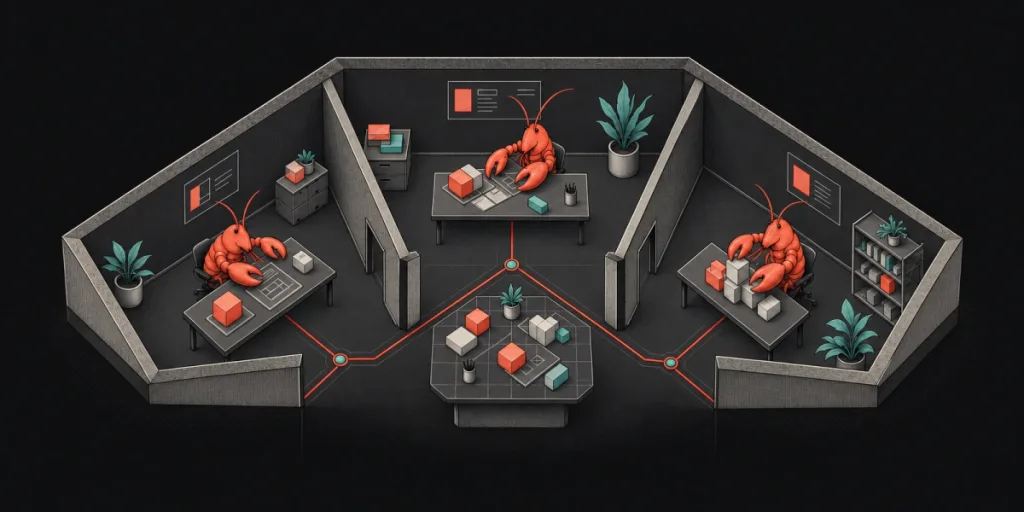
Enterprise IT departments typically prohibit agent platforms entirely due to governance and security concerns. OpenClaw Enterprise (OCE) seeks to change that calculus by providing a centralized control plane for managing autonomous agents across organizational infrastructure.
The OpenClaw project has grown substantially since its inception as a weekend side project by Austrian developer Peter Steinberger in late 2025. Within months, the self-hosted AI agent framework accumulated more than 100,000 GitHub stars, and by February, when OpenAI recruited Steinberger, the project had already gained significant traction. Since then, OpenClaw has matured considerably, establishing the independent OpenClaw Foundation with backing from OpenAI, Nvidia, Red Hat, GitHub and numerous other technology firms committed to resource contributions.
Enterprise control plane addresses governance gaps
Granting agents access to source repositories, authentication credentials, integrations, communication systems and other corporate infrastructure introduces substantial risk management challenges. As agents become more capable, their potential impact on business operations grows proportionally, making centralized oversight essential.
Kevin Lin, a technical staff member at OpenAI overseeing OCE development, highlighted the governance challenge in a Tuesday blog post. He noted that organizations consistently report needing stronger baseline standards for security, safety and governance before deploying agent platforms at scale.
The default stance of IT in most organizations is to ban agentic platforms like OpenClaw altogether.
Kevin Lin, OpenAI
OpenClaw Enterprise remains in early development, with Lin indicating the project is "being developed in the open before its 1.0 release" scheduled for later this year. Current deployments are restricted to internal pilot programs only.
The OpenClaw Control Plane (OCC) forms the architectural core of OCE, providing administrators with a unified interface for deploying agents, organizing them into isolated namespaces, managing configuration and secrets, enforcing access controls, and maintaining audit trails. Agent operations occur through separate components: gateways process incoming messages, while harnesses manage agent execution cycles, model invocations and tool interactions.
OCE targets multi-tenant scenarios where numerous agents, users and teams operate on shared infrastructure with granular access boundaries and workload isolation. According to the project's architecture documentation, the API, console, persistent worker, PostgreSQL backend and Kubernetes packaging are already functional. Remaining work includes external gateway admission controls, workload authentication back to OCC and certain model authentication approaches.
OCE is built to run on your own infrastructure and will always be free for any organization to use.
Kevin Lin, OpenAI
The early open-source release strategy allows organizations to evaluate and customize the software independently while enabling external developers to contribute before the formal 1.0 launch. Code is available on GitHub with documentation for local execution and organizational deployment.
Kubernetes model applied to agent orchestration
OpenClaw Enterprise originated within OpenAI before transitioning to the OpenClaw Foundation. Red Hat and Nvidia have contributed to development efforts, with both organizations currently running internal testing of the platform.
Think of it as Kubernetes for agents.
OpenClaw project documentation
The project explicitly draws inspiration from Kubernetes architecture, aiming to establish OCE as a universal layer for agent management across diverse deployment contexts. Local development environments run the control plane, PostgreSQL and agent workloads within a Kubernetes cluster, while organizations can deploy OCE into their existing Kubernetes infrastructure. Docker or Podman Compose options exist for control-plane preview purposes, though agent deployment through OCC requires Kubernetes.
Similar to how K8 became the standard for deploying containers in the cloud, we want OCE to be that for agents.
Kevin Lin, OpenAI
Red Hat frames enterprise agent adoption within a historical continuum of transformative technology shifts. Joe Fernandes, vice president and general manager of Red Hat's AI business unit, drew parallels between the Unix-to-Linux transition, containerization, Kubernetes adoption and the emerging agent era. Red Hat engineers are already contributing to OpenClaw development, with plans to expand involvement by applying expertise in Linux, Kubernetes, distributed systems, security and enterprise infrastructure.
Security represents OpenClaw's primary focus area. The project integrates isolation between trusted and untrusted workloads with sandboxing techniques, fine-grained permission models and LLM-assisted code review. A reference architecture demonstrating how these components integrate is planned for publication.
OpenClaw Enterprise remains under active development with significant work remaining before production readiness. The project continues soliciting input from developers, operators and security professionals to shape the platform's direction prior to the 1.0 release.