
With one billion monthly users, Microsoft's Bing search engine remains a major player in human-driven web search. However, the company has quietly built a parallel infrastructure: Web IQ, an agentic search platform that taps into the same Bing index but serves an entirely different audience. This service competes with emerging players including Exa, Firecrawl, and Tavily, while DeepSeek launched its own search API for developers in October.
At Microsoft's Ignite conference in San Francisco this week, Jordi Ribas, the company's president of Search & AI, discussed the philosophical and technical differences between these two services. Ribas has been with the search division since 2008, when Bing operated under the name Live Search. His current role oversees both Bing and Web IQ, which Microsoft introduced at Build in June and made broadly available to Azure customers on Tuesday.
How agents search differently
Bing is a search engine for humans.
Jordi Ribas
According to Ribas, the distinction goes beyond surface-level differences. "This is really [a] search engine where the queries come from the AI, and so you do need to design it differently because agents search differently." The queries themselves often appear distinctly mechanical, but the divergence runs deeper into how results are structured and delivered.
When humans use Bing, ranking matters significantly because users must evaluate and select which links to follow. Agents operate under different constraints. "An agent doesn't really need that," Ribas explains, "because an agent will read everything." This fundamental difference shapes how Web IQ processes and returns information.
Both services share the underlying document retrieval mechanism at their core. Where they diverge is in the extraction layer: Web IQ isolates the most pertinent passages and returns them to the agent, rather than delivering entire pages or documents. Consider an agent analyzing corporate earnings statements—it might need only a single row from a table on page 12. Returning the complete report would burden the agent with unnecessary context and force the language model to process far more text than required, substantially increasing computational costs.
As Ribas frames it, "the agent will spend money basically by reading all the documents." He emphasizes that precision in extraction is critical: "So it's very important that you extract exactly what you need, and no more." Microsoft's approach includes strict adherence to robots.txt directives and explicit identification of its crawler to site operators. Ribas stressed this practice multiple times, noting that "not everybody does that in the space."
How much of the search should the agent do?
Typically, an agent's orchestrator determines when to invoke Web IQ and what queries to submit. However, Ribas acknowledges a limitation: "Sometimes the orchestrator is not that smart about knowing what queries to do," he says, "and it may do multiple iterations." This inefficiency prompted Microsoft to introduce Auto as the default search mode at Ignite—essentially a lightweight orchestrator embedded within Web IQ itself.
Under this model, an agent sends Web IQ a single question. Microsoft then executes multiple query variations in parallel and returns passages with citations. Auto Advanced extends this capability by evaluating whether the initial search yielded sufficient information. If gaps emerge, the system reformulates the query and searches again. Ribas describes the logic: "And we do have a model that says, 'OK, is that evidence enough to provide a good chat response?' And if it's yes, great, we're done."
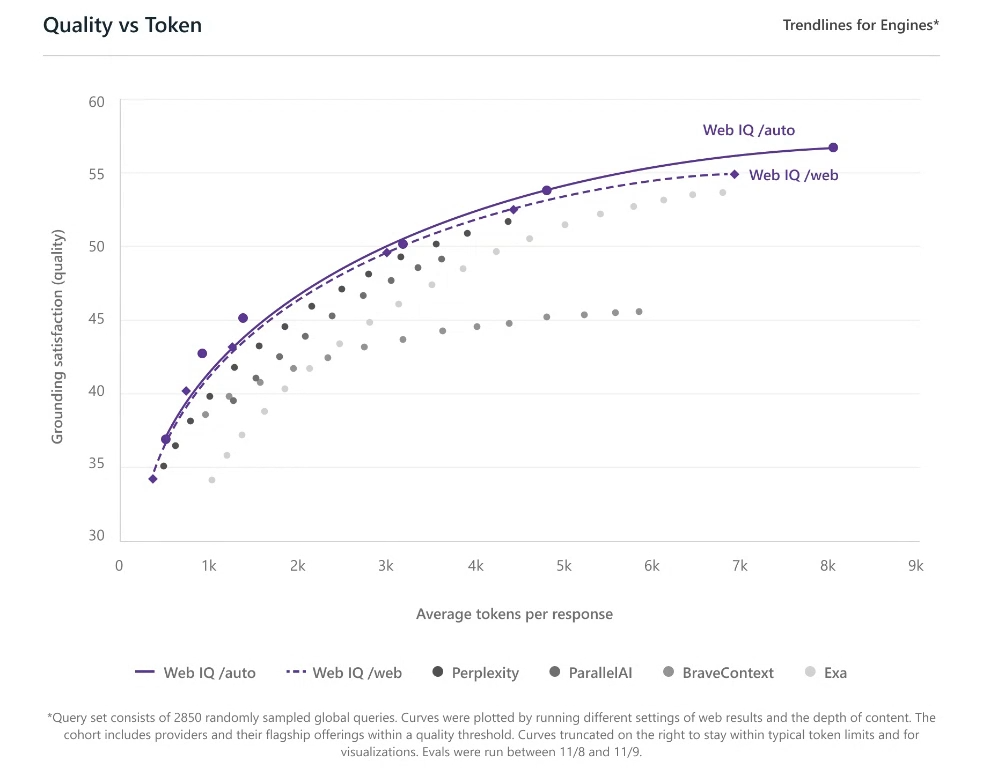
Unlike some competitors that attempt to synthesize complete answers and research reports independently, Microsoft delegates answer generation to the agents and models themselves. "You can use pretty much any model on top of it," Ribas says, though he indicates Microsoft is exploring bundling Web IQ with a model in the future.
What Web IQ costs
Pricing varies by search tier. Standard web searches run $7 per thousand queries, while Auto costs $8 per thousand and Auto Advanced costs $9 per thousand. (The $1 entry point advertised by Microsoft applies to Browse mode, where the URL is already known.) For use cases with precise search requirements, the standard tier may suffice. However, when agents routinely parse results, reformulate queries, and retry, a single Auto call could deliver better overall economics.
If you want to be fast but you want higher quality, maybe Auto is the way to go.
Jordi Ribas
Ribas outlines the trade-offs: "If all you care is about being super fast, then you would just use maybe the primitives directly," referring to individual search APIs. "If you want to be fast but you want higher quality, maybe Auto is the way to go."
A crowded agent search market
The competitive landscape is intensifying. "People are predicting that in a couple of years there will be 1,000 times more queries done by agents than by humans," Ribas observes. "That's why there are so many competitors in [the] space." This explosion of agent-driven search is reshaping the market dynamics.
Competing approaches vary in their optimization priorities. Some prioritize quality but "bring a lot of tokens to come up with a comprehensive answer," Ribas notes, driving up both cost and latency. Others prioritize speed but sacrifice quality in the process. Microsoft claims a different advantage: "We are able to optimize across three dimensions: quality, latency, and token efficiency," Ribas says, "and that's really hard to do."
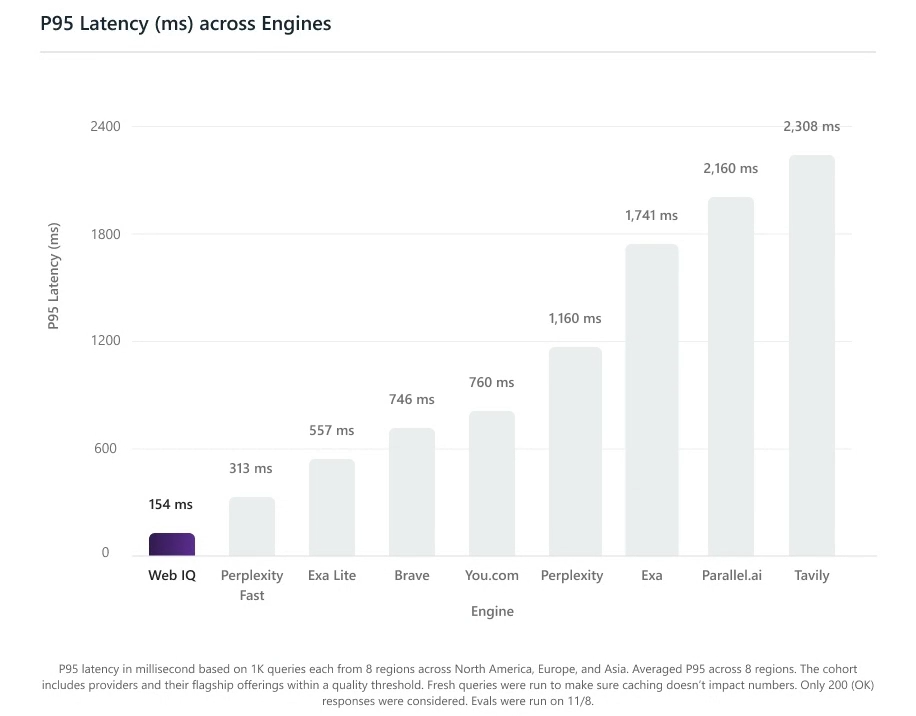
Early adopters are seeing measurable gains. Ray Zhong, co-founder of Genspark, reported in Microsoft's announcement that switching to Web IQ reduced his voice assistant's response time from six seconds to 0.6 seconds. "Six seconds in a voice turn is audible dead air," he noted, highlighting the practical importance of latency in conversational AI applications.