On Monday, Google introduced TimesFM-3, a time-series forecasting model with 330 million parameters that was trained using more than a trillion data points from both real-world and synthetic sources. The model is accessible through Hugging Face, though under a non-commercial license rather than an open one.
Time-series forecasting models function similarly to language models in their core operation—they predict what comes next, but for numerical data rather than text. The sector has witnessed significant activity, with Amazon releasing Chronos-2 last year, Salesforce introducing Moirai 2.0, and Datadog launching Toto 2.0 more recently.
A key advancement in this generation of models is their ability to process multiple time series simultaneously. As Google research scientists Ayush Jain and Rajat Sen note in their announcement, "most real-world forecasting problems are inherently multivariate: where multiple time series and auxiliary external features jointly impact the future forecast of a time series." They elaborate that effective forecasting requires considering interconnected factors: "A good forecast should also draw on sales of related products (e.g., ice cream cones, syrups), historical foot traffic, and known future events like weather forecasts, promotions, and holidays."
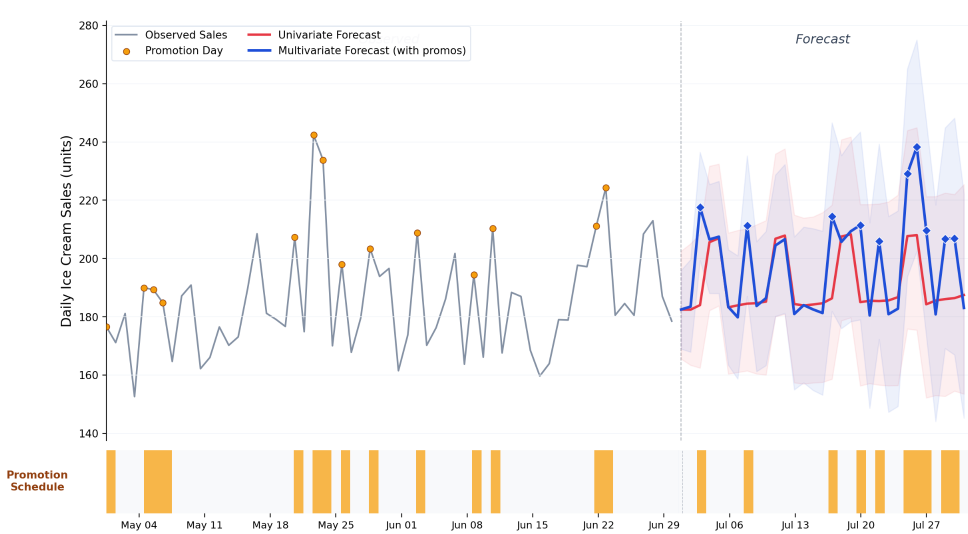
TimesFM-3 distinguishes itself as Google's inaugural model designed from the ground up to handle multiple time series with zero-shot generalization capabilities. This enables concurrent forecasting of related time series while incorporating historical context such as past foot traffic patterns.
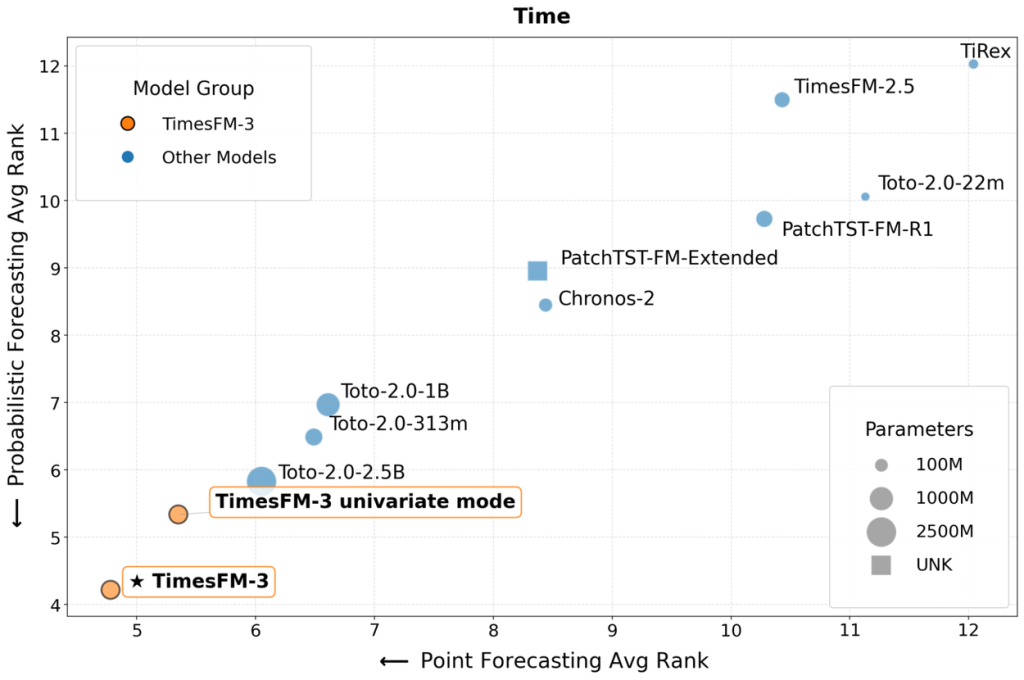
In comparative testing, TimesFM-3 surpasses competing models across all evaluated benchmarks, frequently by substantial margins. Google's evaluation included assessments from Salesforce's Gift-Eval, Amazon and AutoGluon's FEV-Bench, and Time. Notably, TimesFM-2.5, which held state-of-the-art status when it launched in September 2025, now ranks at the lower end of these benchmarks—a testament to the rapid pace of development in this field.
The architecture
TimesFM-3 maintains the decoder-only transformer design of its predecessors, segmenting each time series into patches containing 32 data points and processing them analogously to how language models handle tokens.
The innovation lies in how these tokens traverse the network. Two distinct attention layer types now alternate throughout processing. One variety examines temporal progression within individual series while enforcing strict causality, preventing the model from accessing future values. The other type operates across all series at a given time point, enabling information from one product line's promotion to influence forecasts for another.
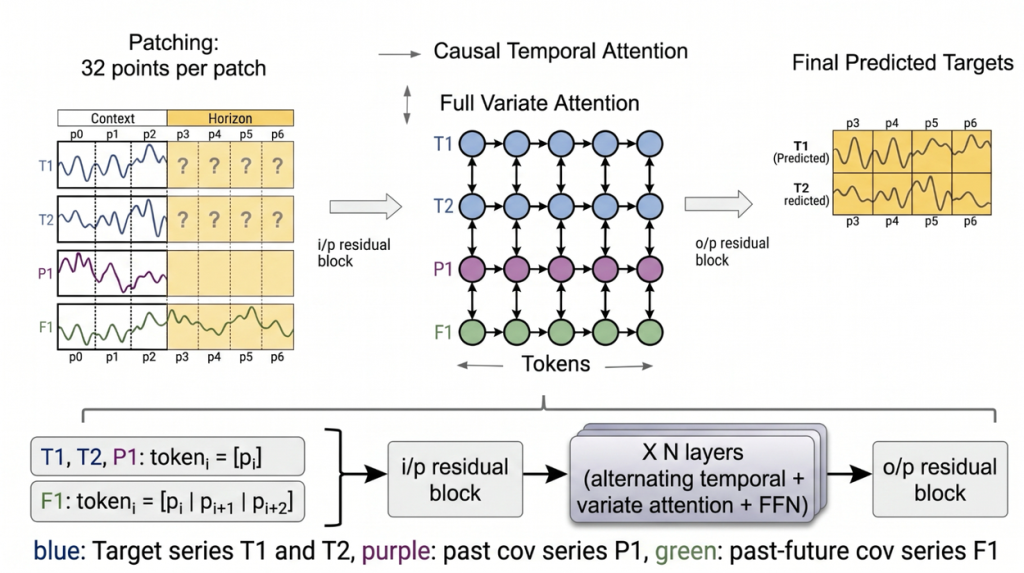
The decoding mechanism underwent substantial revision as well. Prior iterations generated forecasts sequentially, one patch at a time, which introduced latency and accumulated prediction errors. TimesFM-3 instead inserts masked placeholder tokens spanning the entire forecast window and completes them through a single forward pass.
The non-commercial license
Google opted to distribute TimesFM-3 under a non-commercial license, reflecting an emerging pattern among model developers. TimesFM-2.5, by contrast, shipped with the Apache 2.0 license, as do Toto 2.0 and Chronos-2.
While the TimesFM-3 source code retains the Apache license, Google specifies that "for the time being, TimesFM 3.0 pretrained weights are distributed under the separate timesfm-non-commercial-license-v1.0 license and are restricted to non-commercial, non-production use. Commercial or production use of the default pretrained weights is not permitted."
Google intends to deploy TimesFM-3 to power BitQuery's AI.FORECAST command, replacing TimesFM-2.5, indicating the company is actively pursuing commercial monetization of these models. While integrating forecasting models into proprietary platforms is standard practice across the industry, Google's approach of restricting state-of-the-art weights while establishing a paid route through its data warehouse suggests where major research organizations anticipate long-term revenue opportunities.
Source: The New Stack