Anthropic's Claude Opus 5.5 demonstrates distinct changes in its writing behavior compared to its predecessor, according to analysis from Arena, an AI benchmarking platform. The model exhibits fewer hallmarks of AI-generated text, including shorter sentence structures and more straightforward vocabulary than Opus 5.
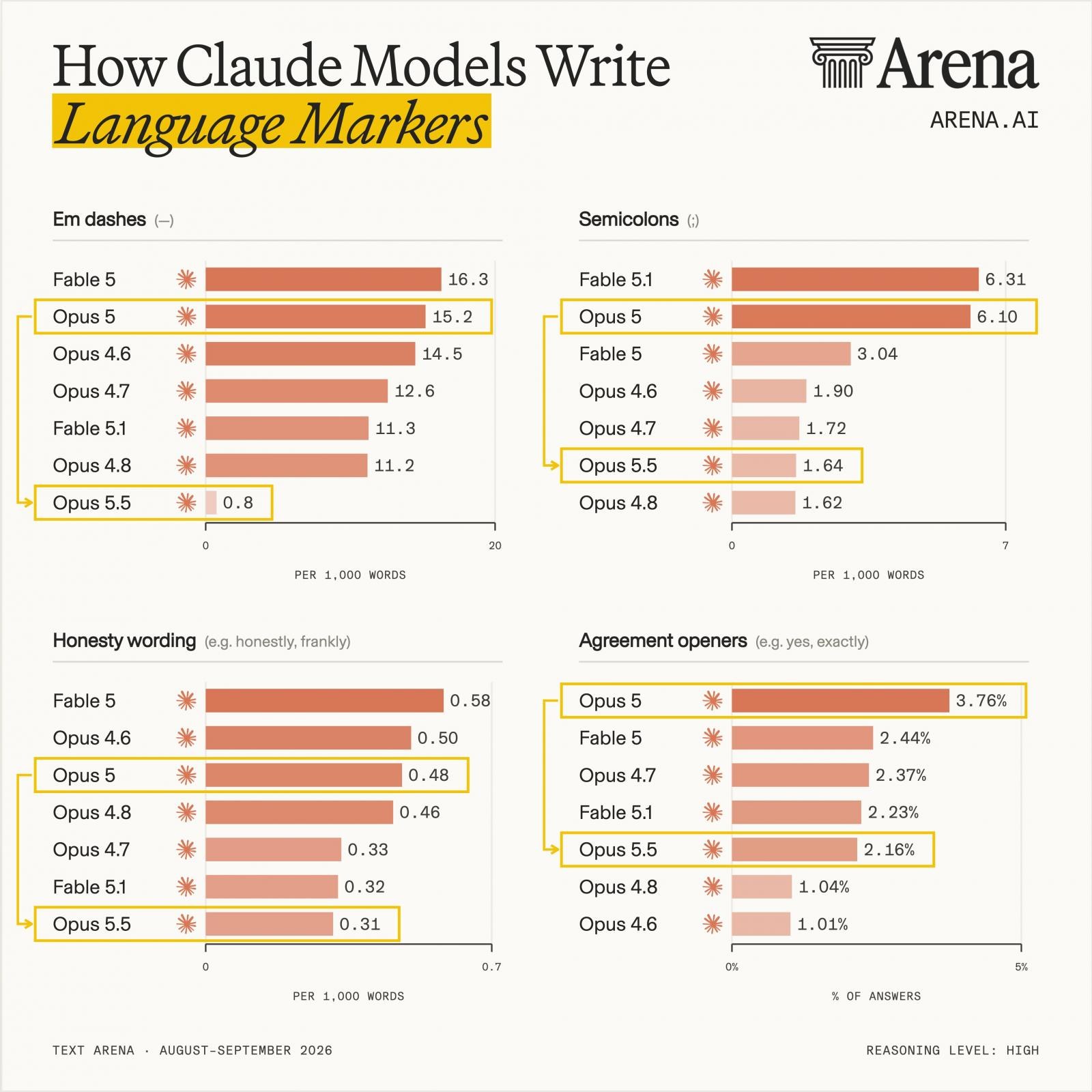
Arena examined high-reasoning Text Arena responses from August and September 2026, tracking 12 distinct writing metrics. The analysis found that 10 of these 12 measures shifted in directions the platform considers improvements.
The most striking finding concerns em dashes, a punctuation mark that has become synonymous with AI-generated content. Opus 5 deployed 15.2 em dashes per 1,000 words, while Opus 5.5 reduced this to just 0.8—a decline of approximately 95%. Semicolon usage also dropped sharply, falling from 6.10 to 1.64 per 1,000 words.
Sentence length contracted as well, with Opus 5.5 averaging 10.03 words per sentence compared to 12.14 for Opus 5. This shift toward brevity and simplicity reduces the likelihood of generating what is commonly called AI slop—content that carries obvious machine-generated characteristics.
The trade-off comes in overall verbosity. While individual sentences have become shorter, complete responses have grown longer. Average answer length increased from 453 words to 481 words, making Opus 5.5 the most verbose iteration in the Opus model family that Arena measured.
The shift reflects a broader industry trend of refinement in language model outputs. As AI development has increasingly concentrated on coding capabilities, Anthropic's focus on improving natural language generation stands out. The reduction in telltale punctuation patterns suggests that users may encounter fewer obviously machine-generated texts across the internet as adoption of Opus 5.5 spreads.